史鉴
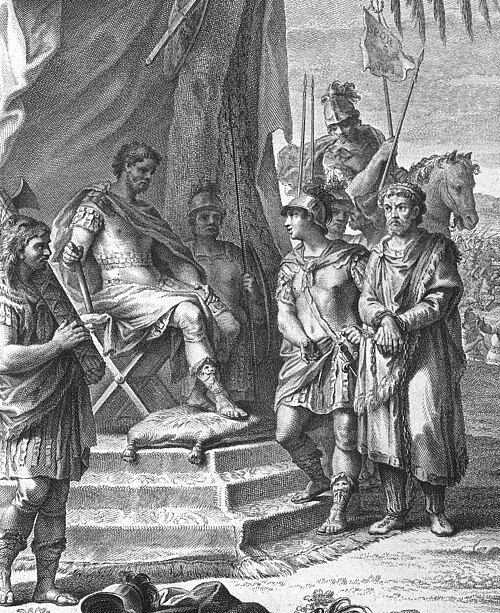
图:Joachin Ibarra, scanned by Shlavozensky · Public domain · 维基共享资源
- 生卒
- 公元前 160 年—公元前 104 年
- 出生地
- 基尔塔
- 去世地
- 罗马
- 国籍 / 所属
- 努米底亚
- 身份
- 军事领袖、sovereign
- 职位
- 国王
- 父亲
- Mastanabal
- 配偶
- Bocchus' daughter
- 子女
- Oxyntas
- 原文名
- ⵢⵓⴳ·ⵔⵜⵏ
- 死因
- 饿死
- 简述
- King of Numidia
朱古达(柏柏尔语:ⵢⵓⴳⴻⵔⵜⵏ;拉丁语:Jugurtha;约前160年—前104年),是一个努米底亚的国王,他的祖父是在第二次布匿战争中的罗马的盟友马西尼萨。公元前113年,朱古达在王位继承战中击败对手。公元前111年,罗马元老院向朱古达国王宣战,史称“朱古达战争”。前106年,马略和部将苏拉开始负责对朱古达的战事。公元前105年,马略击败朱古达,朱古达逃到毛里塔尼亚(今阿尔及利亚和摩洛哥北部)后被国王波库斯所俘,交付罗马,并于前104年判处死刑。
正文摘自中文维基百科「朱古达」(删去了参考文献、表格和图片),按 CC BY-SA 4.0 使用
英文维基百科的更多内容
中文维基百科这一条比较短,下面是英文维基百科同一条目的节选,原文为英文,未翻译。
Jugurtha or Jugurthen ( c. 160 – 104 BC) was a king of Numidia, the ancient kingdom of the Numidians in northwest Africa. When the Numidian king Micipsa, who had adopted Jugurtha, died in 118 BC, Micipsa's two sons, Hiempsal and Adherbal, along with Jugurtha, were in line for succession. Jugurtha arranged to have Hiempsal killed in 117 BC and, after a civil war, defeated and killed Adherbal in 112 BC.
The death of Adherbal, which was against the wishes of Rome, along with the growing popular anger in Rome at Jugurtha's success in bribing Roman senators and thus avoiding retribution, led to the Jugurthine War between Rome and Numidia. After a number of battles in Numidia between Roman and Numidian forces, Jugurtha was captured in 105 BC and paraded through Rome as part of Gaius Marius' Roman triumph. He was thrown into the Tullianum prison, where he was executed by strangulation in 104 BC.
Etymology
The Numidian name Jugurtha matches the ancient naming traditions of Berber peoples and is likely analyzable as the Libyco-Berber word yugurtən “he exceeded them” connected to the stem agər/ugər “to exceed” in modern Berber languages.
Background
Numidia was a region of North Africa roughly within the boundaries of what is now eastern Algeria, parts of western Tunisia and Western Libya. Indigenous inhabitants of Numidia remained semi-nomadic, often identified as Berbers, until Masinissa, chief of the Massyli tribe based near Cirta, who supported Rome during the Second Punic War (206 BC) against the nearby Punics of Carthage, used the support of Rome to establish a kingdom. To do so, Masinissa defeated the rival chief Syphax with the help of famed Roman general Scipio Africanus in 203 BC. Numidian horsemanship and cavalry tactics, as asserted by Polybius, contributed greatly to the development of cavalry tactics in the Roman army which helped them to victory in the Second Punic War.……
Rise to power
When Micipsa died in 118 BC, he was succeeded jointly by Jugurtha and his two sons (Jugurtha's adoptive-brothers) Hiempsal and Adherbal. Hiempsal and Jugurtha quarrelled immediately after the death of Micipsa. Jugurtha had Hiempsal killed, which led to open war with Adherbal. After Jugurtha defeated him in open battle, Adherbal fled to Rome for help. The Roman officials settled the fight by dividing Numidia into two parts, probably in 116, but this settlement was tainted by accusations that the Roman officials accepted bribes to favor Jugurtha. Among the officials found guilty was Lucius Opimius (who, as consul in 121 BC, had presided over events which led to the death of Gaius Gracchus). Jugurtha was assigned the western half;……
War with Rome
By 112 BC Jugurtha resumed his war with Adherbal, penning the latter up in his capital of Cirta. Adherbal was encouraged to hold out by a corps of Roman residents, in expectation of military aid arriving from Rome. However, Roman troops were engaged in the Cimbrian War and the Senate merely sent two successive embassies to remonstrate with Jugurtha who delayed until he had captured Cirta. His troops then massacred many residents including the Romans. This brought Jugurtha into direct conflict with Rome, which sent troops under the Consul Lucius Calpurnius Bestia. Although the Romans made significant inroads into Numidia, their heavy infantry was unable to inflict any significant casualties on Jugurtha's army which included large numbers of light cavalry.
Literary references
Jugurtha features in one of Arthur Rimbaud's earliest surviving poems. Rimbaud was a French poet living in the mid- to late nineteenth century, his father a captain in the French army. The poem is a Latin ode to the Numidian king, contextualized to Rimbaud's modern context by having the ghost of Jugurtha, à la Hamlet, appear to a baby Abdelkader al-Jazairi (who is unnamed in the poem) a hero of the Algerian struggle for independence against France. The poem opens:
正文摘自英文维基百科(原文为英文,未翻译)「Jugurtha」(节选,删去了参考文献、表格和图片),按 CC BY-SA 4.0 使用;在维基百科读全文 ›
所属政权

同时代、同地区的人物