史鉴
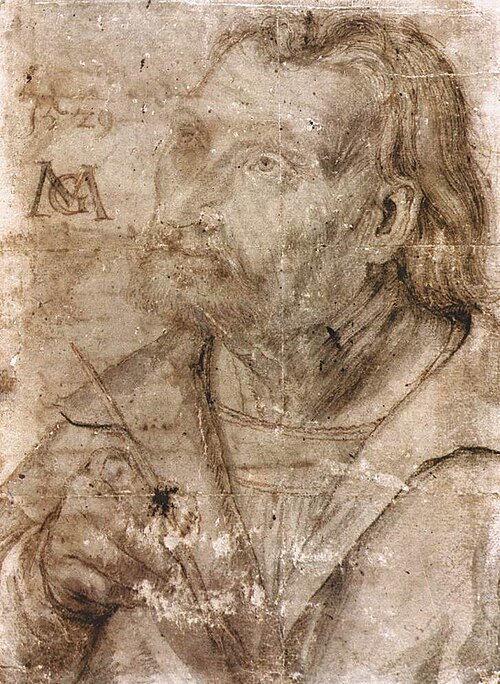
图:Matthias Grünewald · Public domain · 维基共享资源
- 生卒
- 1480 年—1528 年 8 月 31 日 (日期为儒略历)
- 出生地
- 维尔茨堡
- 去世地
- 萨勒河畔哈雷
- 国籍 / 所属
- 德国
- 身份
- 建筑师、工程师、承建商、画家、雕塑家、营造师、建筑绘图员、素描家
- 代表作
- 斯图帕赫圣母、伊森海姆祭坛画、Trias Romana
- 原文名
- Mathias Grünewald
- 宗教
- 天主教会
- 领域
- 绘画
- 流派 / 运动
- 德国文艺复兴时期
- 死因
- 鼠疫
- 简述
- German Renaissance painter (c.1480–1528)
马蒂亚斯·格吕内瓦尔德(德语:Matthias Grünewald,约1470年—1528年8月31日),真名为马蒂亚斯·哥特哈德(Mathias Gothardt),德国文艺复兴时期画家,不过他仍坚持中世纪哥特式传统,是德国哥特式绘画的最后一位伟大代表。
格吕内瓦尔德曾担任美因茨大主教的宫廷画师与艺术监管人,最杰出的代表作为《伊森海姆祭坛画》。他常用扭曲夸张的表现手法,其风格影响了20世纪的表现主义。
正文摘自中文维基百科「马蒂亚斯·格吕内瓦尔德」(删去了参考文献、表格和图片),按 CC BY-SA 4.0 使用
英文维基百科的更多内容
中文维基百科这一条比较短,下面是英文维基百科同一条目的节选,原文为英文,未翻译。
Matthias Grünewald (c. 1470 – 31 August 1528; also known as Mathis Gothart Nithart) was a German Renaissance painter of religious works who ignored Renaissance classicism to continue the style of late medieval Central European art into the 16th century.
Only ten paintings—including several polyptychs—and thirty-five drawings survive, all religious, although many others were lost at sea on their way to Sweden as war booty. He was obscure until the late nineteenth century, when many of his paintings were attributed to Albrecht Dürer, who is now seen as his stylistic antithesis. His largest and most famous work is the Isenheim Altarpiece created c. 1512 to 1516.
Life
He was recognised in his lifetime, as shown by his commissions, yet the details of his life are unusually unclear for a painter of his significance at this date. The first source to sketch his biography comes from the German art historian Joachim von Sandrart, who describes him around 1505 working on the exterior decoration of an altarpiece by Albrecht Dürer in Frankfurt. As this work is typically performed by apprentices, it was estimated that he was born in 1475. Sandrart records that Grünewald's apprentice was the painter Hans Grimmer, who became famous in his time, but most of whose works were lost in the Thirty Years' War. Sandrart describes Grünewald as leading a withdrawn and melancholy life, and marrying unhappily.
More recent investigations have provided further information on Grünewald's life. In 1511 he became court artist of Uriel von Gemmingen, Archbishop of Mainz, and he also worked for the next archbishop, Albert of Brandenburg.……
Works
Only religious works are included in his small surviving corpus, the most famous being the Isenheim Altarpiece, completed 1515, now in the Musée d'Unterlinden, Colmar. Its nine images on twelve panels are arranged on double wings to present three views (rather than just the open and closed states of triptych altarpieces), according to the season or occasion. The first view with the outer wings closed shows a Crucifixion flanked by Saint Sebastien and Saint Anthony, with a predella showing the entombment. When the first set of wings is opened, the Annunciation, Angelic Concert (sometimes interpreted as the Birth of Ecclesia) Mary bathing Christ, and Resurrection are displayed. The third view discloses a carved and gilded wood altarpiece by Nikolaus Hagenauer, flanked by the Temptation of St. Anthony and Anthony's visit to Saint Paul. As well as being by far his greatest surviving work, the altarpiece contains most of his surviving painting by surface area, being 2.65 metres high and over 5 metres wide at its fullest extent.
Reputation
The Lutheran theologian Philipp Melanchthon is one of the few contemporary writers to refer to Grünewald, who is rather puzzlingly described as "moderate" in style, when compared with Dürer and Cranach; what paintings this judgement is based on is uncertain. By the end of the century, when the Holy Roman Emperor, Rudolph II, embarked on his quest to secure as many Dürer paintings as possible, the Isenheim Altarpiece was already generally believed to be a Dürer.
In the late 19th century he was rediscovered, and became something of a cult figure, with the angst-laden expressionism—and absence of any direct classicism—of the Isenheim Altarpiece appealing to both German Nationalists and Modernists. Joris-Karl Huysmans promoted his art enthusiastically in both novels and journalism, rather as Proust did that of Vermeer. His apparent sympathies with the peasants in the Peasants' War also brought him admiration from the political left.
The composer Paul Hindemith based his 1938 opera Mathis der Maler on the life of Grünewald during the German Peasants' War;……
正文摘自英文维基百科(原文为英文,未翻译)「Matthias Grünewald」(节选,删去了参考文献、表格和图片),按 CC BY-SA 4.0 使用;在维基百科读全文 ›
同时代、同地区的人物



同时代、同身份的人物(军事)