 史鉴
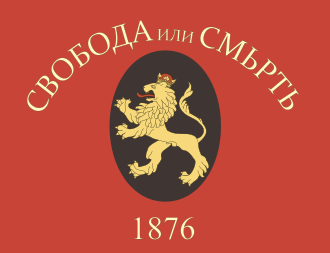
图:Kreuzkümmel · Public domain · 维基共享资源
- 时间
- 1876 年
- 地点
- 保加利亚
- 国家 / 地区
- 保加利亚
- 属于
- 奥斯曼帝国境内的民族主义
- 类型
- 举事
- 简述
- 保加利亚反抗奥斯曼帝国起义
保加利亚1876年起义又称四月起义(保加利亚语:Априлско въстание,罗马化:Aprilsko vastanie)是1876年4月至5月保加利亚人发动的一场反抗奥斯曼帝国的一场举事。举事最终被巴什波祖克镇压。期间约3万名群众遭屠杀,数百城镇、乡村被夷为平地。
之后波斯尼亚地区也出现动乱,最后导致俄罗斯介入与土耳其开战。
正文摘自中文维基百科「保加利亚1876年起义」(删去了参考文献、表格和图片),按 CC BY-SA 4.0 使用
英文维基百科的更多内容
中文维基百科这一条比较短,下面是英文维基百科同一条目的节选,原文为英文,未翻译。
The April Uprising (Bulgarian: Априлско въстание, romanized: Aprilsko vastanie) was an insurrection organised by the Bulgarians in the Ottoman Empire from April to May 1876. The rebellion was suppressed by irregular Ottoman bashi-bazouk units that engaged in indiscriminate slaughter of both rebels and non-combatants (see Batak massacre).
The American community around Robert College in Istanbul, the Protestant mission in Plovdiv headed by J.F. Clarke as well as two other Americans, journalist Januarius MacGahan and diplomat Eugene Schuyler, were indispensable in bringing knowledge of Ottoman atrocities to the wider European public.
Their reports of the events, which came to be known in the press as the Bulgarian Horrors and the Crime of the Century, caused a public outcry across Europe and mobilised both common folks and famous intellectuals to demand a reform of the failed Ottoman model of governance of the Bulgarian lands.
The shift in public opinion, in particular, in the Ottoman Empire's hitherto closest ally, the British Empire, eventually led to the re-establishment of a separate Bulgarian state in 1878.
Background
In Europe, in the 18th century, the classic non-national states were the multi-ethnic empires such as the Ottoman Empire and the Austro-Hungarian Empire, whose population belonged to many ethnic groups and spoke many languages. The idea of nation state became more prominent during the 19th century. The most noticeable characteristic was the degree to which nation states used the state as an instrument of national unity in economic, social and cultural life.……
Preparation
In November 1875, activists of the Bulgarian Revolutionary Central Committee met in the Romanian town of Giurgiu and decided that the political situation was suitable for a general uprising. The uprising was scheduled for April or May 1876. The territory of the country was divided into five revolutionary districts with centers in Vratsa (leader-Stoyan Zaimov), Veliko Tarnovo (Stefan Stambolov), Sliven (Ilarion Dragostinov), Plovdiv (Panayot Volov—who later gave his position to his assistant Georgi Benkovski) and Sofia (Nikola Obretenov).
Outbreak and suppression
In conformity with the decisions taken at Oborishte, the local rebel committee attacked and surrounded the headquarters of the Ottoman police in Koprivshtitsa on 20 April 1876. At least two Ottoman police officers were killed, and the commander, Necip Aga, was forced to release arrested rebel suspects. Necip Aga and his close officials managed to escape the siege. However, due to this incident, the Bulgarian rebels had to proclaim the insurrection two weeks in advance of the planned date.
Casualties
The most detailed contemporary account of the uprising was prepared by American diplomat Eugene Schuyler. He learned about the events from faculty members at Robert College, who feared that the coming investigation of Englishman Walter Baring would turn into a cover-up because of the British Empire's strongly pro-Ottoman official stance and his own reputation as a Turkophile.
Reaction in the West
Press reports
News of massacres of Bulgarians reached European embassies in Istanbul in May and June 1876 through Bulgarian students at Robert College, the American college in the city. Faculty members at Robert College wrote to the British Ambassador and to the Istanbul correspondents of The Times and the Daily News.
But let me tell you what we saw at Batak ... The number of children killed in these massacres is something enormous.……
正文摘自英文维基百科(原文为英文,未翻译)「April Uprising of 1876」(节选,删去了参考文献、表格和图片),按 CC BY-SA 4.0 使用;在维基百科读全文 ›
下属事件
- 巴塔克屠杀1876 年 5 月 · 屠杀与暗杀 · 欧洲
相关人物
同时期、同地区的大事
- 普法战争1870 年 7 月 19 日—1871 年 1 月 28 日 · 战争 · 欧洲
- 巴黎公社1871 年 3 月 18 日—1871 年 5 月 28 日 · 其他事件 · 欧洲
- 德意志统一1866 年 8 月 18 日—1871 年 5 月 10 日 · 其他事件 · 欧洲
- 俄土战争1877 年 4 月 24 日—1878 年 3 月 3 日 · 战争 · 欧洲
- 柏林西非会议1884 年 11 月 15 日—1885 年 2 月 26 日 · 其他事件 · 欧洲
- 普奥战争1866 年 6 月 14 日—1866 年 7 月 26 日 · 战争 · 欧洲
- 伯尔尼保护文学和艺术作品公约1886 年 9 月 9 日 · 条约与会议 · 欧洲
- 1878年柏林会议1878 年 6 月 13 日—1878 年 7 月 13 日 · 条约与会议 · 欧洲
- 一月起义1863 年 1 月 22 日—1864 年 · 革命与起义 · 欧洲
- 普丹战争1864 年 2 月 1 日—1864 年 10 月 31 日 · 战争 · 欧洲
- 色当会战1870 年 9 月 1 日—1870 年 9 月 2 日 · 战役 · 欧洲
- 文化斗争1872 年—1878 年 · 时代与时期 · 欧洲
同时期的同类事件(革命与起义)
- 印度民族起义1857 年 5 月 10 日—1858 年 6 月 20 日 · 革命与起义 · 南亚
- 义和团运动1899 年 8 月—1901 年 9 月 · 革命与起义 · 东亚
- 1905年俄国革命1905 年 1 月 22 日—1907 年 6 月 16 日 · 革命与起义 · 中亚与北亚
- 法国二月革命1848 年 2 月 22 日—1848 年 12 月 2 日 · 革命与起义 · 欧洲
- 干草市场事件1886 年 5 月 4 日 · 革命与起义 · 北美洲
- 德意志1848年革命1848 年 · 革命与起义 · 欧洲
- 先知以利亚日起义1903 年 7 月 20 日—1903 年 10 月 · 革命与起义 · 西亚
- 波斯立宪革命1905 年—1911 年 · 革命与起义 · 西亚
- 米兰的五日1848 年 3 月 18 日—1848 年 3 月 22 日 · 革命与起义 · 欧洲
- 马及马及起义1905 年 7 月—1907 年 8 月 · 革命与起义 · 非洲
- 赫赛哥维那起义1875 年—1878 年 · 革命与起义 · 欧洲
- 西班牙光荣革命1868 年 9 月 19 日—1868 年 9 月 27 日 · 革命与起义 · 欧洲