 史鉴
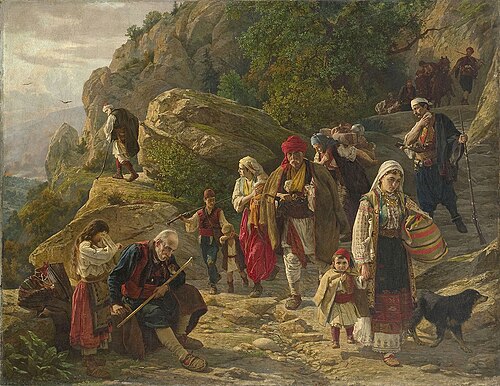
图:Uroš Predić · Public domain · 维基共享资源
- 时间
- 1875 年—1878 年
- 地点
- 波斯尼亚州 (奥斯曼帝国)
- 国家 / 地区
- 波斯尼亚和黑塞哥维那、奥斯曼帝国
- 属于
- 奥斯曼帝国境内的民族主义
- 类型
- 举事
- 简述
- Serb rebellion against Ottoman rule
黑塞哥维那起义(塞尔维亚语:Херцеговачки устанак,罗马化:Hercegovački ustanak ) 是塞尔维亚族领导的反对奥斯曼帝国的举事。1875年7月初,赫塞哥维纳率先爆发举事,然后蔓延到波斯尼亚地区和拉什卡。 举事者要求奥斯曼帝国军队撤出黑塞哥维那而且减轻赋税。1878年,举事被镇压。
举事者得到了黑山公国和塞尔维亚公国的支援,这两个公国政府最终于1876年6月18日联合向奥斯曼帝国宣战,导致了塞尔维亚—土耳其战争和黑山—土耳其战争爆发,随即又爆发俄土战争和东方危机。战争最终导致1878年柏林会议召开。
正文摘自中文维基百科「黑塞哥维那起义」(删去了参考文献、表格和图片),按 CC BY-SA 4.0 使用
英文维基百科的更多内容
中文维基百科这一条比较短,下面是英文维基百科同一条目的节选,原文为英文,未翻译。
The Herzegovina uprising (Serbian: Херцеговачки устанак, romanized: Hercegovački ustanak) was an uprising led by the Christian Serb population against the Ottoman Empire, firstly and predominantly in Herzegovina, from where it spread into Bosnia and Raška. It broke out in the summer of 1875, and in some regions lasted until the beginning of 1878. It was followed by the Bulgarian April Uprising of 1876, and coincided with the Serbian-Turkish wars (1876–1878); these events were each situated within the Great Eastern Crisis (1875–1878).
The primary cause of the uprising was the harsh treatment of peasants in the Ottoman province of Bosnia by its governors and landowners, who resisted the implementation of Sultan Abdülmecid I's reforming policies. The reforms, which provided that all should have religious liberty and equal civil rights; that tax farming be abolished; and that taxes be fairly imposed, were frequently opposed in more distant parts of the empire. As such, in Bosnia, peasants continued to be heavily taxed and Christians continued to be oppressed.
The rebels were aided with weapons and volunteers from the principalities of Montenegro and Serbia, whose governments eventually jointly declared war on the Ottomans on 18 June 1876, leading to the Serbian-Ottoman War (1876–78) and Montenegrin–Ottoman War (1876–78). These led to the Russo-Turkish War (1877–78) and the Great Eastern Crisis. The crisis ended in 1878 with the Congress of Berlin, which granted Montenegro and Serbia independence and placed Bosnia and Herzegovina under Austro-Hungarian occupation for 30 years, although it remained de jure Ottoman territory.
Background
During early 19th century, a large part of the Balkans were under Ottoman rule. However, Ottoman influence in the region declined as a result of the Serbian Revolution and the Greek War of Independence, in which Christian Serbs and Greeks rebelled against the Ottomans and established the Principality of Serbia and the Hellenic Republic, respectively.……
Preparations
In Herzegovina
In Herzegovina, local Serbian leaders began to organize the rebellion during August and September 1874. The leaders, such as Jovan Gutić, Simun Zečević, Ilija Stevanović, Trivko Grubačić, Prodan Rupar, and Petar Radović convened in secret to organize. Their plans detailed the preparation of weapon caches, the location of safe-places, and the securing of foreign aid.
In Bosnia
Preparation for revolt in Bosnia began later than in Herzegovina, as the actions in the two regions were not coordinated.……
Uprising in Herzegovina
The revolt first began in the summer of 1875 among Christians in the village of Gabela on 3 July, followed by the start of the larger uprising in Nevesinje on July 9.……
Uprising in Bosnia
According to Herr Fritz, the Serb rebels were "extremely numerous and in some cases well armed" and were divided among following troops and bands:
Risovac and Grmeč, in West Bosnia, under the leadership of well-known Golub Babić, Marinković, Simo Davidović, Pop-Karan and Trifko Amelić.……
Aftermath
The uprising was the starting point of the Great Eastern Crisis, the reopening of the "Eastern Question". The unrest rapidly spread among the Christian populations of the other Ottoman provinces in the Balkans (notably the April Uprising in Bulgaria) setting off what would become known as the Great Eastern Crisis.……
Legacy
The Nevesinje municipality has a coat of arms with two rifles, symbolising the revolt. The government of Republika Srpska together with the Nevesinje municipality annually organises the anniversary of the revolt.
In 1963, a Yugoslav film by Žika Mitrović about the Nevesinje rebellion was released, titled in Serbian as Невесињска пушка and in English as Thundering Mountains.
正文摘自英文维基百科(原文为英文,未翻译)「Herzegovina uprising (1875–1877)」(节选,删去了参考文献、表格和图片),按 CC BY-SA 4.0 使用;在维基百科读全文 ›
下属事件
- Battle of Vučji Do1876 年 7 月 18 日 · 战役 · 欧洲
相关人物
相关政权
同时期、同地区的大事
- 普法战争1870 年 7 月 19 日—1871 年 1 月 28 日 · 战争 · 欧洲
- 巴黎公社1871 年 3 月 18 日—1871 年 5 月 28 日 · 其他事件 · 欧洲
- 德意志统一1866 年 8 月 18 日—1871 年 5 月 10 日 · 其他事件 · 欧洲
- 俄土战争1877 年 4 月 24 日—1878 年 3 月 3 日 · 战争 · 欧洲
- 柏林西非会议1884 年 11 月 15 日—1885 年 2 月 26 日 · 其他事件 · 欧洲
- 普奥战争1866 年 6 月 14 日—1866 年 7 月 26 日 · 战争 · 欧洲
- 伯尔尼保护文学和艺术作品公约1886 年 9 月 9 日 · 条约与会议 · 欧洲
- 1878年柏林会议1878 年 6 月 13 日—1878 年 7 月 13 日 · 条约与会议 · 欧洲
- 一月起义1863 年 1 月 22 日—1864 年 · 革命与起义 · 欧洲
- 普丹战争1864 年 2 月 1 日—1864 年 10 月 31 日 · 战争 · 欧洲
- 色当会战1870 年 9 月 1 日—1870 年 9 月 2 日 · 战役 · 欧洲
- 文化斗争1872 年—1878 年 · 时代与时期 · 欧洲
同时期的同类事件(革命与起义)
- 印度民族起义1857 年 5 月 10 日—1858 年 6 月 20 日 · 革命与起义 · 南亚
- 义和团运动1899 年 8 月—1901 年 9 月 · 革命与起义 · 东亚
- 1905年俄国革命1905 年 1 月 22 日—1907 年 6 月 16 日 · 革命与起义 · 中亚与北亚
- 法国二月革命1848 年 2 月 22 日—1848 年 12 月 2 日 · 革命与起义 · 欧洲
- 干草市场事件1886 年 5 月 4 日 · 革命与起义 · 北美洲
- 德意志1848年革命1848 年 · 革命与起义 · 欧洲
- 先知以利亚日起义1903 年 7 月 20 日—1903 年 10 月 · 革命与起义 · 西亚
- 波斯立宪革命1905 年—1911 年 · 革命与起义 · 西亚
- 米兰的五日1848 年 3 月 18 日—1848 年 3 月 22 日 · 革命与起义 · 欧洲
- 四月起义1876 年 · 革命与起义 · 欧洲
- 马及马及起义1905 年 7 月—1907 年 8 月 · 革命与起义 · 非洲
- 西班牙光荣革命1868 年 9 月 19 日—1868 年 9 月 27 日 · 革命与起义 · 欧洲