 史鉴
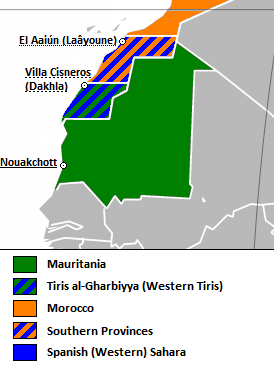
图:Tiris_al-Gharbiyya_Location.png: Н.Сидоров. Original uploader was Nicolay Sidoro · Public domain · 维基共享资源
- 时间
- 1975 年 11 月 14 日
- 地点
- 马德里
- 国家 / 地区
- 西班牙
- 属于
- 西撒哈拉冲突
- 类型
- 条约
- 简述
- 1975 treaty between Spain, Morocco, and Mauritania to end Spanish presence in the Sahara
《马德里协定》是西班牙、摩洛哥和毛里塔尼亚三国为结束西班牙占领西撒哈拉领土而签订的条约,在《马德里协定》签订之前,西撒哈拉一直是西班牙的一个省和殖民地。该协定于1975年11月14日在马德里签署,不过该协定从未在《西班牙国家官方公报》上公布。根据《马德里协定》,西撒哈拉将由摩洛哥和毛里塔尼亚瓜分。
主要内容包括:
称为“原则声明”的文件,其中规定了将土地移交给摩洛哥和毛里塔尼亚的过程,以及一系列与捕鱼以及经济和工业合作有关的协议。包括西班牙放弃了撒哈拉以换取了其对布克拉磷酸盐矿的开采,其捕鱼船队在西撒海域捕捞权以及在加那利群岛附近的两个军事基地可经西撒进行补给。
西班牙非殖民化西撒哈拉土地,结束了其作为对上述领土的行政责任和权力。
根据先前的决定以及联合国与有关当事方建议的谈判,西班牙应立即开始在这些领土上建立一个临时行政当局,摩洛哥和毛里塔尼亚将在该临时行政当局中参与与共同体的合作,并应移交给该主管部门应具有上段所述的责任和权力。因此同意任命摩洛哥和毛里塔尼亚提议的两名辅助官员协助该地行政长官的工作,西班牙在该领土上的存在将在1976年2月28日之前永久终止。
撒哈拉威居民通过社区表达的意见受到尊重。
这三个国家将根据《联合国宪章》第三十三条进行的谈判的结果通知联合国秘书长本文件已核准的内容。
三个签约国宣布,他们本着最佳理解,兄弟情谊和对《联合国宪章》原则的尊重,以及对维护国际和平与安全的最佳贡献,取得了先前的成绩。
该文件应在《官方公报》上发布“西撒哈拉非殖民化法律”的同一天生效,该法律授权西班牙政府承担本文件所载的义务。
正文摘自中文维基百科「马德里协定 (1975年)」(删去了参考文献、表格和图片),按 CC BY-SA 4.0 使用
英文维基百科的更多内容
中文维基百科这一条比较短,下面是英文维基百科同一条目的节选,原文为英文,未翻译。
The Madrid Accords, formally the Declaration of Principles on Western Sahara, was a treaty between Spain, Morocco, and Mauritania setting out six principles which would end the Spanish presence in the territory of Spanish Sahara and arrange a temporary administration in the area pending a referendum.
The territory had been a Spanish province and former colony. The agreement was signed in Madrid on November 14, 1975, six days before Spanish dictator Francisco Franco died, although it was never published on the Boletin Oficial del Estado. This agreement conflicted with the Law on decolonization of Sahara, ratified by the Spanish Parliament (Cortes) on November 18.
Under the Madrid agreement, the territory would then be divided between Morocco and Mauritania, with no role for either the Polisario Front or the Sahrawi people generally. Following the accords, the Polisario relocated from the Mauritanian border to Algeria.
Background
The province's future had been in dispute for several years, with both Morocco and Mauritania demanding its full annexation to their territory and Spain attempting to introduce either a regime of internal autonomy or a Sahrawi pro-Spanish independent state. Additionally, an independent group of indigenous Sahrawis called the Polisario Front sought independence through guerrilla warfare. The United Nations had since 1963 regarded the area as a colony, and demanded self-determination for it, in accordance with General Assembly Resolution 1514.
Motivations of the parties
The Madrid Accords followed on the heels of the Green March, a 350,000-strong Moroccan demonstration on 6 November 1975 called by King Hassan II, intended to put pressure on Spanish authorities.
Content and importance
Thompson and Adloff write,
According to [the treaty's] publicised terms, Spain agreed to decolonise the Sahara and leave the area before 28 February 1976. In the interim, the territory would be administered by the Spanish governor general, assisted by two Moroccan and Mauritanian deputy governors, who would respect Sahrawi public opinion as expressed through the yemaa. (...) As to the Bu Craa (a phosphate mine) deposits, Spain would retain 35 per cent of the shares in the Fosfatos de Bucraa, S. A., Fosbucraa company, and a portion of the 65 per cent that would go to Morocco would presumably be allotted to Mauritania.……
Results
The agreement was bitterly opposed by Algeria and the Polisario Front, which remained committed to independence. Algeria dispatched a high-level delegation to Madrid in order to pressure Spain not to sign the Accords and started supporting the Polisario Front militarily and diplomatically by early 1975. Algeria officially viewed its opposition as a way to uphold the UN charter and combat colonialism, although some observers believed that Algeria's actions were more to counter Morocco's influence and to gain access to the Atlantic Ocean. A long-standing rivalry between the two countries contributed to the tense relations.
International status of the accords
The United Nations considers Western Sahara to remain a Non-Sovereign Territory, awaiting formal decolonization. It recognizes that Morocco presently administers much of it de facto, but neither the General Assembly nor any other UN body has ever recognized this as constituting sovereignty.
In a 2002 letter of the General Secretary for Legal Affairs and Legal Counsel of the United Nations, Hans Corell, in which he gave an opinion on the legality of actions taken by Moroccan authorities in signing contracts for the exploration of mineral resources in Western Sahara, he stated:
正文摘自英文维基百科(原文为英文,未翻译)「Madrid Accords」(节选,删去了参考文献、表格和图片),按 CC BY-SA 4.0 使用;在维基百科读全文 ›
相关政权

同时期、同地区的大事
- 柏林墙1961 年 8 月 13 日—1989 年 11 月 9 日 · 其他事件 · 欧洲
- 切尔诺贝利核事故1986 年 4 月 26 日 · 其他事件 · 欧洲
- 两德统一1989 年 11 月 9 日—1990 年 10 月 3 日 · 其他事件 · 欧洲
- 申根公约1985 年 6 月 14 日 · 条约与会议 · 欧洲
- 布拉格之春1968 年 · 其他事件 · 欧洲
- 不扩散核武器条约1968 年 7 月 1 日 · 条约与会议 · 欧洲
- 五月风暴1968 年 5 月 2 日—1968 年 6 月 23 日 · 其他事件 · 欧洲
- 康乃馨革命1974 年 4 月 25 日 · 革命与起义 · 欧洲
- 东欧剧变1989 年 3 月 9 日—1992 年 4 月 27 日 · 其他事件 · 欧洲
- 天鹅绒革命1989 年 11 月 17 日—1989 年 12 月 29 日 · 革命与起义 · 欧洲
- 北爱尔兰问题1960 年代—1998 年 · 时代与时期 · 欧洲
- 慕尼黑惨案1972 年 9 月 5 日—1972 年 9 月 6 日 · 屠杀与暗杀 · 欧洲
同时期的同类事件(条约与会议)
- 雅尔塔会议1945 年 2 月 4 日—1945 年 2 月 11 日 · 条约与会议 · 欧洲
- 南极条约体系1959 年 12 月 1 日 · 条约与会议
- 波茨坦会议1945 年 7 月 17 日—1945 年 8 月 2 日 · 条约与会议 · 欧洲
- 代顿协议1995 年 11 月 21 日 · 条约与会议 · 北美洲
- 国际刑事法院罗马规约1998 年 7 月 17 日 · 条约与会议 · 欧洲
- 关税与贸易总协定1947 年 10 月 30 日 · 条约与会议 · 欧洲
- 旧金山和约1952 年 4 月 28 日 · 条约与会议 · 北美洲
- 太平洋安全保障条约1951 年 9 月 1 日 · 条约与会议 · 北美洲
- 贝尔法斯特协议1998 年 4 月 10 日 · 条约与会议 · 欧洲
- 赫尔辛基协议1975 年 8 月 1 日 · 条约与会议 · 欧洲
- 戴维营协议1978 年 9 月 17 日 · 条约与会议 · 北美洲
- 日内瓦会议 (1954年)1954 年 4 月 26 日—1954 年 7 月 20 日 · 条约与会议 · 欧洲