 史鉴
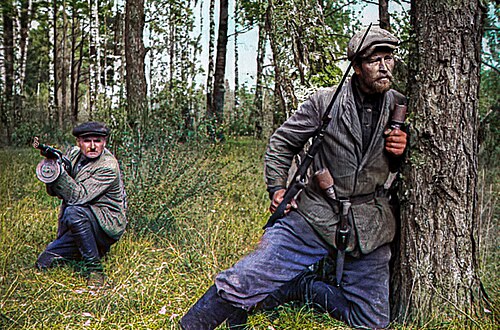
图:Stanisweb17 · Public domain · 维基共享资源
- 时间
- 1941 年—1944 年
- 国家 / 地区
- 苏联
- 属于
- 军事单位、内务人民委员会、第二次世界大战抵抗运动
- 类型
- 第二次世界大战抵抗运动、游击队组织
- 简述
- anti-fascist and armed resistance movement in German-occupied USSR territory
苏联游击队是第二次世界大战期间纳粹德国占领区内的由苏联扶持的游击队。苏联游击队主要破坏纳粹党局的设施,向占领区人民发传单以及宣传苏联。苏联游击队的存在使得轴心国军队感到不安。
游击队在战争中发挥了重要作用,阻止了德国对占领的苏联领土进行经济剥削的计划,为红军正规军提供了大量援助,对德国后方通信进行了系统性的攻击,并通过出版报纸和传单向当地居民传播政治言论。他们完全依赖平民志愿者的支持。
详细介绍
运动的历史
由于苏联对这次袭击毫无准备,除了共产党的命令外,民众自发组织在抵抗中发挥了关键作用。
游击队的战略管理由苏联最高统帅部通过游击队中央指挥部进行。负责人是白俄罗斯共产党中央委员会书记潘捷列伊蒙·波诺马连科。莫斯科还设有共和国总部和地区总部,它们都隶属于中央总部。游击运动乌克兰总部的负责人是苏联共产党(布尔什维克)中央委员会书记季莫菲·斯特罗卡奇 。
游击队中的医生注意到,游击队员开始生病是因为饮食中肉类过多。
游击队员们过着放荡的生活。士兵和指挥官中性病是一种普遍现象。通常,每个游击队的集体照上都会画一头牛,牛的侧面有时会写着“占领者去死!”虽然拖着牛穿越袭击很麻烦,但对于游击队来说这却是非常必要的。科夫帕克、萨布罗夫、费奥多罗夫等人的队伍中,性病确实流行起来。由于药品短缺,游击队员们只能尽力自己治疗。注射牛奶后,身体对外来蛋白质产生剧烈反应,游击队员的体温长时间升至近40℃(淋球菌在38℃时略有升高而死亡)。就这样,奶牛拯救了游击队 。
1945年5月,克里姆林宫公布游击队人数,约为20万人,其中白俄罗斯的苏联抵抗力量数量位居第一,乌克兰的游击力量位居第二。
正文摘自中文维基百科「苏联游击队」(删去了参考文献、表格和图片),按 CC BY-SA 4.0 使用
英文维基百科的更多内容
中文维基百科这一条比较短,下面是英文维基百科同一条目的节选,原文为英文,未翻译。
Soviet partisans were members of resistance movements that fought a guerrilla war against Axis forces during World War II in the Soviet Union, the previously Soviet-occupied territories of interwar Poland in 1941–1945 and eastern Finland. The activity emerged after Nazi Germany's Operation Barbarossa was launched from mid-1941 on. It was coordinated and controlled by the Soviet government and modeled on that of the Red Army.
The partisans made a significant contribution to the war by countering German plans to exploit occupied Soviet territories economically, gave considerable help to the Red Army by conducting systematic attacks against Germany's rear communication network, disseminated political rhetoric among the local population by publishing newspapers and leaflets, and succeeded in creating and maintaining feelings of insecurity among Axis forces.
Soviet partisans also operated on interwar Polish and Baltic territories occupied by the Soviet Union in 1939–1940, but they had significantly less support there and often clashed with local national partisan groups, as well as German-controlled auxiliary police.
Formation of anti-German Soviet resistance
After the German invasion of Poland in 1939, which marked the beginning of World War II, the Soviet Union invaded the eastern regions of the Second Polish Republic (referred to as the Kresy) and annexed the lands totalling 201,015 square kilometres (77,612 sq mi) with a population of 13,299,000 inhabitants including ethnic Belarusians, Ukrainians, Poles, Jews, Czechs and others.……
Areas of operations
Belarus
By Soviet estimates, in August 1941 about 231 detachments were operating already. Units formed and inserted into Belarus totalled 437 by the end of the 1941, comprising more than 7,200 personnel.……
Vitsyebsk gate and Western Belarus
The turning point in the development of the Soviet partisan movement came with the opening of the Vitsyebsk gate, a corridor connecting Soviet-controlled and German-occupied territories, in February 1942.……
Relations with local population
To survive, resistance fighters largely relied on the civilian population. This included access to food, clothing and other supplies. Soviet partisans requisitioned food, livestock and clothes from local peasants, and when peasants did not share them willingly, they often did it by force.……
In annexed territories
Numerous accounts of Soviet partisan operations in former Polish territories discuss their strained relations with local peasants.……
List of operations
Vasily Korzh raid, Autumn 1941 – 23 March 1942. 1,000 km (620 mi) raid of a partisan formation in the Minsk and Pinsk Oblasts of Belarus.
Battles of Spadshchansky Forest, 19 October – November 1941.……
Intelligence activity
From the very beginning of its existence, the partisan intelligence had been aimed chiefly at serving the Red Army operational purposes. It had frequently been asked to provide detailed information on enemy's whereabouts, strengths, armaments, movements and intentions.……
Psychological warfare
The partisan propaganda means had developed over the occupation period. In its early stage, the partisan messages were mainly short and unsophisticated and used simple spreading channels, such as verbal communication and leaflets.……
Foreign nationalities serving with the partisans and Soviet partisans abroad
A significant number of Soviet citizens were outside Soviet borders during the war and many took part in numerous partisan formations and saboteur groups in France, Poland, Yugoslavia, Bulgaria, Belgium, Czechoslovakia, and other countries.……
Ethnic minorities serving with the partisans
Jews and partisans
Able-bodied male Jews were usually welcomed by the partisans (sometimes only if they brought their own weapons). More than 10% of the Soviet partisan movement were Jews. However, Jewish women, children, and the elderly were usually not welcome.……
Soviet Ukrainian partisans
The Soviet Ukrainian partisans achieved some success only in Slovakia, a nominally independent country under German tutelage.……
Operations against independence movements
In addition to fighting the Nazis, Soviet partisans fought against organizations that sought to establish independent non-communist states of Poland, Lithuania, Latvia, Estonia, Belarus, and Ukraine.……
Relations with Polish partisans
In the early years of the war, following German invasion of the Soviet Union, many Polish and Soviet partisans saw Germans as the common enemy, and hostility between the two groups was limited.……
Historical assessment
With the German supply lines already over-extended, the partisan operations in the rear of the front lines were able to severely disrupt the flow of supplies to the army that acted deep into Soviet territory.……
Partisan commemoration and legacy
Commemorative holidays
Partisans and Underground Fighters Day (Russian: День партизан и подпольщиков) is a holiday in Russia, celebrated on 29 June since 2010, celebrating the veterans of Partisan units throughout the USSR. It was established by the State Duma in March 2009 at the initiative of the Bryansk Regional Duma.……
正文摘自英文维基百科(原文为英文,未翻译)「Soviet partisans」(节选,删去了参考文献、表格和图片),按 CC BY-SA 4.0 使用;在维基百科读全文 ›
相关政权

同时期、同地区的大事
- 苏联肃反运动1936 年 8 月—1938 年 11 月 17 日 · 其他事件 · 中亚与北亚
- 苏联的人口转移1930 年 · 屠杀与暗杀 · 中亚与北亚
- 赫鲁晓夫解冻1954 年—1964 年 · 时代与时期 · 中亚与北亚
- 1932年苏联大饥荒1932 年—1933 年 · 灾难与瘟疫 · 中亚与北亚
- 莫斯科公审1936 年 8 月 19 日—1938 年 3 月 · 其他事件 · 中亚与北亚
- 列宁格勒-大诺夫哥罗德攻势1944 年 1 月 14 日—1944 年 3 月 1 日 · 战役 · 中亚与北亚
- 内务人民委员会对囚犯的屠杀1941 年 · 屠杀与暗杀 · 中亚与北亚
- 1946年-1947年苏联饥荒1946 年—1947 年 · 灾难与瘟疫 · 中亚与北亚