 史鉴
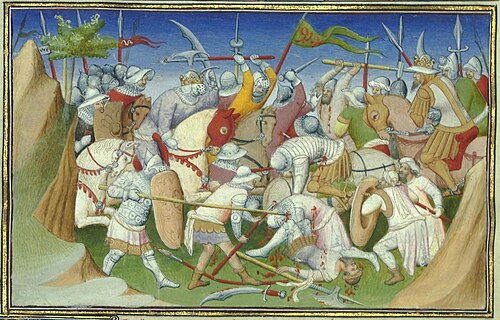
图:佚名 · Public domain · 维基共享资源
- 时间
- 1529 年—1543 年
- 地点
- 埃塞俄比亚
- 国家 / 地区
- 埃塞俄比亚
- 参与方
- 奥斯曼帝国、葡萄牙帝国、阿比西尼亚帝国、阿居兰苏丹国、阿达尔苏丹国、梅德里·巴赫里、达赫勒克苏丹国
- 类型
- 战争
- 简述
- 1529-1543 war between the Ethiopian Empire and the Adal Sultanate
The Ethiopian–Adal War, also known as the Abyssinian–Adal War and Futūḥ Al-Ḥabaša (Arabic: فتوح الحبش, lit. 'Conquest of Abyssinia'), was a war fought between the Christian Ethiopian Empire and the Muslim Adal Sultanate from 1529 to 1543. The Christian Ethiopian troops were drawn mainly from Tigray, Amhara, Gojjam, Begemder, Angot, Qeda, Gan, Medri Bahri, Gafat, and a certain numbers of Agaw troops At the closing of the war, the Christian forces were supported by the Portuguese Empire with no less than 400 musketeers. The Adal forces were composed of Harla/Harari, Somali, Afar as well as Arab and Turkish gunmen. Both sides would see the Maya mercenaries at times join their ranks. The conflict was followed shortly by the 16th century Ottoman–Ethiopian War.
详细介绍
Background
In the early 1500s, Ethiopia faced significant pressure from the Adalites, who, under Imam Mahfuz, had commenced threatening their territory. The period following his death at the hands of the Ethiopians under Lebna Dengel was marked by an extended military succession crisis in Adal known as the Adalite Civil War, which concluded with Ahmed taking control. The defeat of Mahfuz had inadvertently strengthened the Adalite leadership, leading to a situation where proponents of peace with the Ethiopians would be reduced to a minority.
Imam Ahmad ibn Ibrahim al-Ghazi was a military leader of the medieval Adal Sultanate in the northern Horn of Africa. Between 1529 and 1543, he embarked on a campaign referred to as the Futuh al-Habasha, bringing the three-quarters of Christian Abyssinia under the control of the Muslim empire. With an army composed of Harari (Harla), and Somalis, al-Ghazi's forces came close to extinguishing the ancient Ethiopian kingdom, slaughtering any Ethiopian who refused to convert to Islam.……
Course of the war
Fighting between Ahmad and the Christian kingdom had in fact broken out before the war's conventional starting date at the Battle of Hubat. Christian sources record a raid into Muslim border territory in 1527 led by Dagalhan, a brother-in-law of Lebna Dengel, and the Futuh al-Habasha describes two further clashes: at Badeqe in September 1528, and at Shimbra Kure in March 1529, where Ahmad's forces met the Christian king's army directly for the first time. Both sides still treated these as raids for plunder rather than a war of conquest; it is the Ethiopian chronicles that mark 1529, the year of Shimbra Kure, as the start of what they call the persecution. At Shimbra Kure itself, Imam Ahmad's Adal troops defeated a larger Ethiopian contingent; the Harari cavalry, also known as the Malassay, proved instrumental, as the Abyssinian troops were outmaneuvered.
The victories that gave the followers of Imam Ahmad the upper hand came in 1531.……
Motives
The Futūḥ al-Ḥabaša, the primary Arabic chronicle of the war, does not explain Ahmad's reasons for the invasion of Ethiopia. Later Ethiopian tradition, though, filled this gap with several different, partly competing, explanations.
Christian legendary explanations
The most widely attested tradition holds that Ahmad's invasion was a divine punishment for the pride of the Christian king, Lebna Dengel. Two independent transcriptions of Ethiopian chronicle material preserve different versions of this legend. In one, published by Ignazio Guidi, Lebna Dengel takes a census of his army in the 19th year of his reign, and upon learning he commands 900,000 soldiers besides his other forces, he "was overcome by pride and became very arrogant," prompting God to send Ahmad as a scourge. In a second version, recorded by Carlo Conti Rossini, the same episode instead centers on a massive herd of 30,000 horses, and when asked why he needed so many, the king reportedly replied, "What use are they to me, since I have no enemies?" Ahmad then appeared and killed the vanguard general.……
Scholarly explanations
Modern historians, though, have proposed several non-personal explanations as well.……
Aftermath
In the months after Ahmad's death his forces splintered, some soldiers withdrawing toward the pre-conquest Muslim territories, others going over to the Christian side. The vizier Abbas tried to hold the annexed border provinces of Bali, Fatagar and Dawaro in the hope of reconstituting Muslim rule, but the resistance did not last: in October 1544, a year and a half after Ahmad's death, Gelawdewos defeated and killed Abbas, recovering these provinces along with Hadiya.
Emperor Galawdewos retained the services of around 170 of the Portuguese soldiers who had helped defeat Ahmad. He rewarded them with substantial lands, on which they lived, in Telles's words, "after the Country Fashion," keeping horses, mules and servants. Relations between the Emperor and his former allies soon soured, however, as Portuguese arrogance and attempts to impose Catholicism on the country led to conflict and their eventual banishment to the provinces.……
正文摘自英文维基百科(原文为英文,未翻译)「Ethiopian–Adal War」(节选,删去了参考文献、表格和图片),按 CC BY-SA 4.0 使用;在维基百科读全文 ›
下属事件
- Battle of Shimbra Kure1529 年 3 月 9 日 · 战役 · 非洲
- Battle of Antukyah1531 年 · 战役 · 非洲
- Battle of Sahart1541 年 4 月 24 日 · 战役 · 西亚
- Battle of Wofla1542 年 8 月 28 日 · 战役
- Battle of Baçente1542 年 2 月 2 日 · 战役 · 西亚
- Battle of Jarte1542 年 4 月 4 日—1542 年 4 月 16 日 · 战役 · 西亚
- Battle of Wayna Daga1543 年 2 月 21 日 · 战役 · 非洲
相关政权
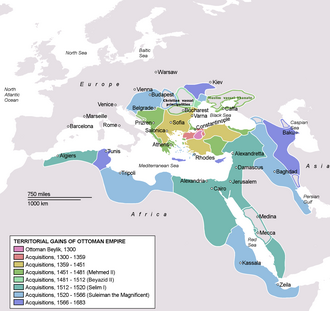


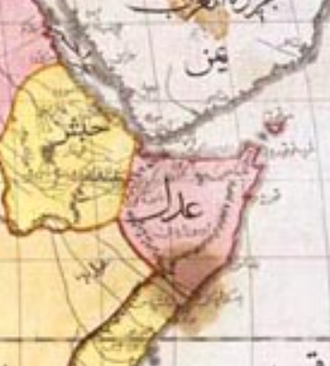
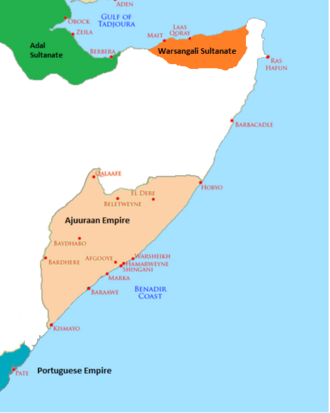
同时期、同地区的大事
- 罗德岛之围 (1522年)1522 年 6 月 26 日—1522 年 12 月 22 日 · 战役 · 非洲
同时期的同类事件(战争)
- 利沃尼亚战争1558 年 1 月 17 日—1583 年 5 月 26 日 · 战争 · 欧洲
- 德国农民战争1524 年—1525 年 · 战争 · 欧洲
- 施马尔卡尔登战争1546 年 7 月 10 日—1547 年 5 月 23 日 · 战争 · 欧洲
- 施瓦本战争1499 年 2 月—1499 年 9 月 22 日 · 战争 · 欧洲
- 温莎条约1521 年—1526 年 · 战争 · 欧洲
- 康布雷同盟1508 年 2 月—1516 年 12 月 · 战争 · 欧洲
- 瑞典解放战争1521 年—1523 年 · 战争 · 欧洲
- 奥斯曼-萨非战争1532 年—1555 年 · 战争 · 西亚
- 干邑同盟战争1526 年—1530 年 · 战争 · 欧洲
- 欧洲宗教战争1524 年—1697 年 · 战争 · 欧洲
- 奥斯曼-波斯战争1514 年—1823 年 · 战争 · 西亚
- Comuneros起义1520 年—1522 年 · 战争 · 欧洲