 史鉴
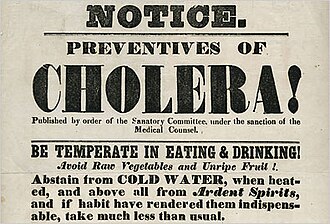
图:Sanatory Committee, under the sanction of the Medical Counsel, in New York City · Public domain · 维基共享资源
- 时间
- 1829 年—1852 年
- 起因
- 霍乱
- 前一事件
- 第一次霍乱大流行
- 后一事件
- 第三次霍乱大流行
- 类型
- 瘟疫、霍乱的历史
- 简述
- worldwide outbreak of cholera from 1826 to 1837
第二次霍乱大流行(英文:Second cholera pandemic),是指于1826-1837年间(也有认为持续到1849年)发生的霍乱大流行,是历史上第二次霍乱的大规模爆发。此次大流行起源于印度东北地区的孟加拉管辖区,其传播范围超过第一次霍乱大流行、到达欧洲和北美洲,被许多人认为是19世纪最严重的一次霍乱大流行(由于不同学者对流行时期的划分不同,部分第二次流行时期可能与第三次霍乱大流行重叠)。
1826年,霍乱疫情在孟加拉恒河三角洲地区爆发,并迅速蔓延至印度全国。1827年,霍乱疫情传播至俄罗斯帝国的布哈拉,1830年又传至莫斯科,俄罗斯帝国境内甚至有人不满政府为应对霍乱的疫情采取的隔离以及限制人员流动的措施而发动暴动。此后霍乱疫情进一步蔓延到了芬兰和波兰。德国、法国、意大利、匈牙利、瑞典、奥地利等欧洲大陆各国均有疫情报道,其中匈牙利有约10万人死于霍乱。1831年起,英格兰和威尔士经历了为期两年的疫情,尽管对商船进行了严格的隔离,疫情还是造成了约22,000人死亡,苏格兰则有约9,500人死于霍乱。1832年2月,疫情传播到爱尔兰,造成25,000余人死亡。1836年起,意大利西西里有约69,000人死亡、那不勒斯有19,470人死亡。
与此同时,1832年,爱尔兰移民将霍乱传播到了北美地区,包括美国和加拿大。1832年,加拿大蒙特利尔有1,220人死亡、魁北克地区则有1,000余人死亡。1833年,古巴的哈瓦那有约8,000人死于霍乱,而墨西哥有约15,000死亡。
此次大流行期间,科学界对霍乱的致病原因和机理存在分歧。法国医生认为霍乱与贫穷地区的恶劣环境有关,俄国人认为此疾病具有传染性,部分英国人则相信霍乱的发生与神的干预有关,还有人提出与地球磁场或大气层的扰动有关。直至第三次霍乱大流行期间,英国科学家约翰·斯诺最终利用科学方法证明了污染的水源是霍乱传播途径。
正文摘自中文维基百科「第二次霍乱大流行」(删去了参考文献、表格和图片),按 CC BY-SA 4.0 使用
英文维基百科的更多内容
中文维基百科这一条比较短,下面是英文维基百科同一条目的节选,原文为英文,未翻译。
The second cholera pandemic (1826–1837), also known as the Asiatic cholera pandemic, was a cholera pandemic that reached from India across Western Asia to Europe, Great Britain, and the Americas, as well as east to China and Japan. Cholera caused more deaths than any other epidemic disease in the 19th century, and as such, researchers consider it a defining epidemic disease of the century. The medical community now believes cholera to be exclusively a human disease, spread through many means of travel during the time, and transmitted through warm fecal-contaminated river waters and contaminated foods. During the second pandemic, the scientific community varied in its beliefs about the causes of cholera.
History
First pandemic
The first cholera pandemic (1817–24) began near Kolkata and spread throughout Southeast Asia to the Middle East, eastern Africa, and the Mediterranean coast. While cholera had spread across India many times previously, this outbreak went farther; it reached as far as China and the Mediterranean Sea before receding. Hundreds of thousands of people died as a result of this pandemic, including many British soldiers from the presidency armies, which attracted European attention. This was the first of several cholera pandemics to sweep through Asia and Europe during the 19th and 20th centuries. This first pandemic spread over an unprecedented range of territory, affecting many countries throughout Asia.
Origins of the second pandemic
Historians believe that the first pandemic had lingered in Indonesia and the Philippines in 1830.
Although not much is known about the journey of the cholera pandemic in east India, many believe that this pandemic began, like the first, with outbreaks along the Ganges Delta in India. From there, the disease spread along trade routes to cover most of India. By 1828, the disease had traveled to China. Cholera was also reported in China in 1826 and 1835, and in Japan in 1831. In 1829, Iran was apparently infected with cholera from Afghanistan.
Cholera reached the southern tips of the Ural Mountains in 1829.……
1830s
The second cholera pandemic spread from the Russian Empire to the rest of Europe, claiming hundreds of thousands of lives.……
Causes
During the second pandemic, the scientific community varied in its beliefs about the causes of cholera. In France, doctors believed cholera was associated with the poverty of certain communities or poor environment. Russians believed the disease was contagious, although doctors did not understand how it spread. The United States believed that cholera was brought by recent immigrants, specifically the Irish, and epidemiologists understand they were carrying disease from British ports. Lastly, the British thought the disease might rise from divine intervention.
Legacy
Norwegian poet Henrik Wergeland wrote a stage play inspired by the pandemic, which had reached Norway. In The Indian Cholera (Den indiske Cholera, 1835), he set his play in Colonial India, lambasting the poor response to the pandemic by authorities.
In response to the second cholera pandemic, the Ottoman Empire and Egypt reformed their quarantine systems, following the western Mediterranean model. In 1831, the Egyptian Quarantine Board was established. It constructed Egypt's first modern lazaretto in Alexandria in 1833. In 1831, the Ottoman government set up the first permanent quarantine complex in Istanbul. In 1838, the Ottoman government established the Supreme Council of Health, which oversaw 59 quarantines. While largely useless against cholera, these quarantines shored up the two countries' epidemiological defenses against bubonic plague.
As a result of the epidemic, the medical community developed a major advance, the intravenous saline drip. It was developed from the work of Dr. Thomas Latta of Leith, near Edinburgh. Latta established from blood studies that a saline drip greatly improved the condition of patients and saved many lives by preventing dehydration. Latta died in 1833 of tuberculosis.
A major outbreak in Sligo, Ireland, was reported on by Charlotte Thornley;……
正文摘自英文维基百科(原文为英文,未翻译)「1826–1837 cholera pandemic」(节选,删去了参考文献、表格和图片),按 CC BY-SA 4.0 使用;在维基百科读全文 ›