 史鉴
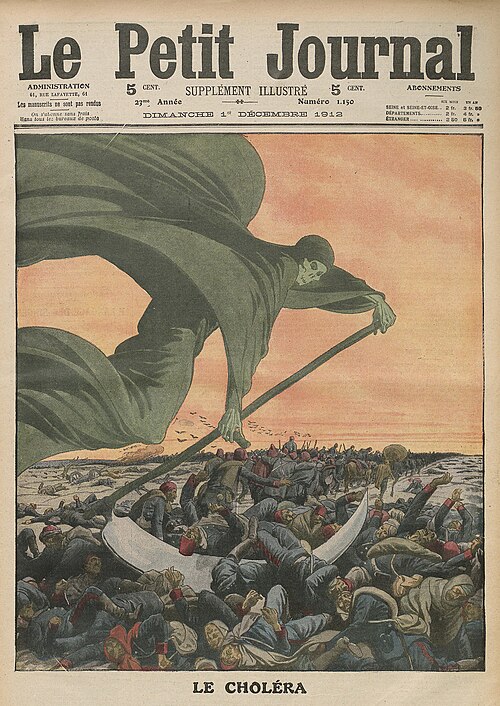
图:佚名 · Public domain · 维基共享资源
- 时间
- 1817 年
- 起因
- 霍乱、霍乱弧菌
- 简述
- worldwide outbreaks and pandemics of cholera
Seven cholera pandemics have occurred in the past 200 years, with the first pandemic originating in India in 1817. The seventh cholera pandemic is officially a current pandemic and has been ongoing since 1961, according to a World Health Organization factsheet in March 2022. Additionally, there have been many documented major local cholera outbreaks, such as a 1991–1994 outbreak in South America and, more recently, the 2016–2021 Yemen cholera outbreak.
Although much is known about the mechanisms behind the spread of cholera, this has not led to a full understanding of what makes cholera outbreaks happen in some places and not others. Lack of treatment of human feces and lack of treatment of drinking water greatly facilitate its spread. Bodies of water have been found to serve as a reservoir, and seafood shipped long distances can spread the disease.
Between 1816 and 1923, the first six cholera pandemics occurred consecutively and continuously over time. Increased commerce, migration, and pilgrimage are credited for its transmission. Late in this period (particularly 1879–1883), major scientific breakthroughs toward the treatment of cholera develop: the first immunization by Louis Pasteur, the development of the first cholera vaccine, and identification of the bacterium Vibrio cholerae by Filippo Pacini and Robert Koch. After a long hiatus, a seventh pandemic spread in 1961. It subsided in the 1970s, but has continued on a smaller scale. Outbreaks occur across the developing world to the current day. Epidemics occurred after wars, civil unrest, or natural disasters, when water and food supplies had become contaminated with Vibrio cholerae, and also due to crowded living conditions and poor sanitation.
详细介绍
Pandemics
The first cholera pandemic occurred in the Bengal region of India, near Calcutta (now Kolkata), starting in 1817 through 1824. The disease dispersed from India to Southeast Asia, the Middle East, Europe, and Eastern Africa through trade routes. The second pandemic lasted from 1826 to 1837 and particularly affected North America and Europe, due to the result of advancements in transportation and global trade, and increased human migration, including soldiers. The third pandemic erupted in 1846, persisted until 1860, extended to North Africa, and reached South America, for the first time specifically affecting Brazil. The fourth pandemic lasted from 1863 to 1875, and spread from India to Naples and Spain, and to the United States in 1873. The fifth pandemic was from 1881 to 1896 and started in India and spread to Europe, Asia, and South America. The sixth pandemic started in India and lasted from 1899 to 1923. These epidemics were less fatal due to a greater understanding of the cholera bacteria. Egypt, the Arabian peninsula, Persia, India, and the Philippines were hit hardest during these epidemics, while other areas, such as Germany in 1892 and Naples from 1910 to 1911, also suffered severe outbreaks.……
First, 1817–1824
The first cholera pandemic, though previously restricted, began in Bengal, and then spread across India by 1820.……
Second, 1826–1837
A second cholera pandemic reached Russia (see Cholera Riots), Hungary (about 100,000 deaths) and Germany in 1831;……
Other outbreaks
Vibrio cholerae has shown to be a very potent pathogenic bacterium causing many pandemics and epidemics over the past three centuries. However, most outbreaks are known to be self-limiting, meaning they come to an end after peaking, without human intervention. One of the mechanisms significantly determining the course of epidemics is phage predation. This process is strongly dependent on successful recognition of the bacteria by lytic phages, in which cell surface receptors play a crucial role. Bacteria can reduce their susceptibility by changing their surface receptors and preventing phage adsorption. In the case of V. cholerae, the changed receptor gene expression is due to an alteration in cell-density during its infection cycle, a process called quorum sensing (QS). The stool samples collected from patients contain clumps of bacterial cells, demonstrating the occurrence of cell-cell interaction in the latter stage of the infection cycle. QS is strongly regulated by two auto-inducer molecules, AI-2 and CAI-1. Evidently, these molecules will have a significant effect on the success of phage predation in V. cholerae infections.
A previous study has unravelled the mode of action of auto-inducers on preventing predation on the level of phage entry.……
1990s
January 1991 – September 1994: Outbreak in South America, apparently initiated when a Chinese ship discharged ballast water.……
False reports
A persistent urban myth states 90,000 people died in Chicago of cholera and typhoid fever in 1885, but this story has no factual basis. In 1885, a torrential rainstorm flushed the Chicago River and its attendant pollutants into Lake Michigan far enough that the city's water supply was contaminated. But, as cholera was not present in the city, there were no cholera-related deaths. As a result of the pollution, the city made changes to improve its treatment of sewage and avoid similar events.
正文摘自英文维基百科(原文为英文,未翻译)「History of cholera」(节选,删去了参考文献、表格和图片),按 CC BY-SA 4.0 使用;在维基百科读全文 ›