 史鉴
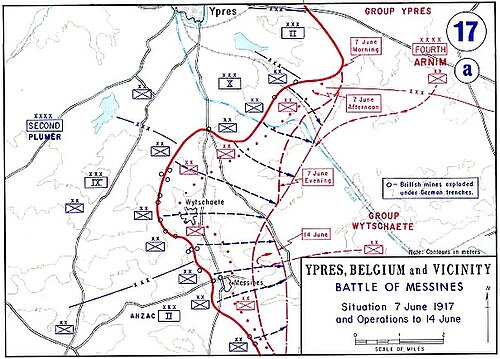
图:佚名 · Public domain · 维基共享资源
- 时间
- 1917 年 6 月 7 日—1917 年 6 月 14 日
- 地点
- 西佛兰德省
- 国家 / 地区
- 比利时
- 参与方
- 澳大利亚、德意志帝国、大不列颠及爱尔兰联合王国、新西兰自治领
- 属于
- 西方战线
- 类型
- 战役
- 简述
- 1917 offensive conducted by the British Second Army
The Battle of Messines (7–14 June 1917) was an attack by the British Second Army (General Sir Herbert Plumer), on the Western Front, near the village of Messines (Dutch: Mesen) in West Flanders, Belgium, during the First World War. The Nivelle Offensive in April and May had failed to achieve its more grandiose aims, had led to the demoralisation of French troops and confounded the Anglo-French strategy for 1917.
The attack forced the Germans to move reserves to Flanders from the Arras and Aisne fronts, relieving pressure on the French. The British tactical objective was to capture the German defences on the ridge, which ran from Ploegsteert Wood (Plugstreet to the British) in the south, through Messines and Wytschaete to Mt Sorrel, depriving the German 4th Army of the high ground. The ridge gave commanding views of the British defences and back areas of Ypres to the north, from which the British intended to conduct the Northern Operation, an advance to Passchendaele Ridge and then the capture of the Belgian coast up to the Dutch frontier. The Second Army had five corps, three for the attack and two on the northern flank not part of the operation; XIV Corps was in General Headquarters reserve. The 4th Army divisions of Group Wytschaete (Gruppe Wijtschate, the IX Reserve Corps headquarters) held the ridge and were later reinforced by a division from Group Ypres (Gruppe Ypern).
The British attacked with the II Anzac Corps (3rd Australian Division, New Zealand Division and the 25th Division, with the 4th Australian Division in reserve), IX Corps (36th (Ulster), 16th (Irish) and 19th (Western) divisions and the 11th (Northern) Division in reserve) and X Corps (41st, 47th (1/2nd London) and 23rd Divisions with the 24th Division in reserve).……
详细介绍
Background
British strategy 1916–1917
In 1916, the British planned to clear the Germans from the Belgian coast to deny them the use of the ports as naval bases. In January, Plumer recommended to Field Marshal Sir Douglas Haig the capture of Messines Ridge (part of the southern arc of the Ypres Salient) before an operation to capture the Gheluvelt plateau further north. The highest ground north of the Messines–Wytschaete ridge lies on the Menin road, between Hooge and Veldhoek, 1.5 mi (2.4 km) from Gheluvelt, at the west end of the main Ypres ridge, which runs from Ypres, east to Broodseinde and then north-east to Passchendaele, Westroosebeek and Staden. The British called it the Gheluvelt Plateau or Menin Ridge. Roads and tracks converged on the Menin road at this point (Clapham Junction to the British).……
Ypres salient
Ypres is overlooked by Kemmel Hill in the south-west and from the east by a line of low hills running south-west to north-east.……
Prelude
British preparations
The Second Army centralised its artillery and devised a plan of great sophistication, following the precedent set at the Battle of Arras in April. The use of field survey, gun calibration, weather data and a new and highly accurate 1:10,000 scale map, much improved artillery accuracy. Systematic target-finding was established by the use of new sound-ranging equipment, better organisation of flash-spotting and the communication of results through the Army Report Centre at Locre Château. Counter-battery artillery bombardments increased from twelve in the week ending 19 April, to 438 in the last ten days before the attack. A survey of captured ground after the battle found that 90 per cent of the German artillery positions had been plotted.……
Battle
Second Army
Fine weather was forecast for 4 June, with perhaps a morning haze (between 15 May and 9 June the weather was fair or fine except for 16, 17 and 29 May, when it was very bad). Zero Day was fixed for 7 June, with zero hour at 3:10 a.m., when it was expected that a man could be seen from the west at 100 yd (91 m). There was a thunderstorm in the evening of 6 June but by midnight the sky had cleared and at 2:00 a.m., British aircraft cruised over the German lines to camouflage the sound of tanks as they drove to their starting points. By 3:00 a.m., the attacking troops had reached their jumping-off positions unnoticed, except for some in the II Anzac Corps area.
Routine British artillery night firing stopped around half an hour before dawn and birdsong could be heard. At 3:10 a.m.……
First objective (blue line)
The II Anzac Corps objective was the southern part of the ridge and Messines village.……
Aftermath
Analysis
Historians and writers disagree on the strategic significance of the battle, although most describe it as a British tactical and operational success. In 1919, Ludendorff wrote that the British victory cost the German army dear and drained German reserves. Hindenburg wrote that the losses at Messines had been "very heavy" and that he regretted that the ground had not been evacuated; in 1922, Kuhl called it one of the worst German tragedies of the war. In his Dispatches of 1920, Haig described the success of the British plan, organisation and results but refrained from hyperbole, referring to the operation as a successful preliminary to the main offensive at Ypres.……
Casualties
In 1941, Charles Bean, the Australian official historian, recorded II Anzac Corps casualties from 1 to 14 June as 4,978 in the New Zealand Division, 3,379 in the 3rd Australian Division and 2,677 casualties in the 4th Australian Division.……
正文摘自英文维基百科(原文为英文,未翻译)「Battle of Messines (1917)」(节选,删去了参考文献、表格和图片),按 CC BY-SA 4.0 使用;在维基百科读全文 ›
相关人物
相关政权
同时期、同地区的大事
- 大萧条1929 年 10 月 29 日—1941 年 · 时代与时期 · 欧洲
- 凡尔赛条约1920 年 1 月 10 日 · 条约与会议 · 欧洲
- 十月革命1917 年 10 月 25 日—1917 年 10 月 26 日 · 革命与起义 · 欧洲
- 国家社会主义德国工人党1920 年 2 月 24 日—1945 年 10 月 10 日 · 其他事件 · 欧洲
- 党卫队1925 年 4 月 4 日—1945 年 5 月 8 日 · 其他事件 · 欧洲
- 德国国旗1917 年 · 其他事件 · 欧洲
- 乌克兰大饥荒1932 年—1933 年 · 屠杀与暗杀 · 欧洲
- 俄国二月革命1917 年 3 月 8 日—1917 年 3 月 16 日 · 革命与起义 · 欧洲
- 巴黎和会1919 年 1 月 18 日—1920 年 1 月 21 日 · 其他事件 · 欧洲
- 巴尔干战争1912 年 10 月 8 日—1913 年 7 月 18 日 · 战争 · 欧洲
- 同盟国1914 年—1918 年 11 月 11 日 · 其他事件 · 欧洲
- 第一次巴尔干战争1912 年 10 月 8 日—1913 年 5 月 30 日 · 战争 · 欧洲
同时期的同类事件(战役)
- 斯大林格勒战役1942 年 8 月 23 日—1943 年 2 月 2 日 · 战役 · 欧洲
- 巴巴罗萨行动1941 年 6 月 22 日—1941 年 12 月 5 日 · 战役 · 欧洲
- 珍珠港事件1941 年 12 月 7 日 · 战役 · 大洋洲
- 波兰战役1939 年 9 月 1 日—1939 年 10 月 6 日 · 战役 · 欧洲
- 不列颠战役1940 年 7 月 10 日—1940 年 10 月 31 日 · 战役 · 欧洲
- 加里波利之战1915 年 4 月 25 日—1916 年 1 月 9 日 · 战役 · 西亚
- 法国战役1940 年 5 月 10 日—1940 年 6 月 25 日 · 战役 · 欧洲
- 海王行动1944 年 6 月 6 日—1944 年 8 月 29 日 · 战役 · 欧洲
- 柏林战役1945 年 4 月 16 日—1945 年 5 月 2 日 · 战役 · 欧洲
- 库尔斯克会战1943 年 7 月 5 日—1943 年 8 月 23 日 · 战役 · 欧洲
- 列宁格勒围城战1941 年 9 月 8 日—1944 年 1 月 27 日 · 战役 · 欧洲
- 凡尔登战役1916 年 2 月 21 日—1916 年 12 月 18 日 · 战役 · 欧洲