史鉴
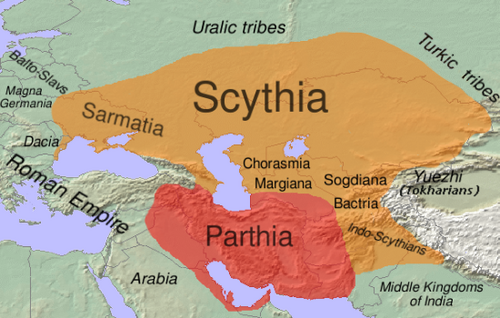
图:Dbachmann · CC BY-SA 3.0 · 维基共享资源
- 存在时间
- 公元前 9 世纪—公元前 400 年 (Wikidata 的日期只记到世纪,非确切年份)
- 首都
- Scythian Neapolis
- 类型
- 历史地区、历史国家
- 所在大洲
- 亚洲
- 简述
- multinational region of Central Eurasia in the classical era
斯基提亚(古希腊语:Σκυθική,希腊语:Σκυθία,Skythía,英语:Scythia,/siθiə/或/siðiə/), 亦称“斯基泰”或“斯基台” ,又译为西徐亚、西古提、叔提雅、斯基啡亚。在希腊古典时代,古希腊人对其北方草原游牧地带的称呼。这个区域为欧洲东北部至黑海北岸,经中亚草原一直延伸到他们不知道的领土之外,这整块区域都被古希腊人称呼为斯基提亚,包括了东欧大草原、中亚与东欧等地。
斯基提亚原义为斯基泰人之地。斯基泰人由公元前11世纪开始,居住在此地,一直到公元2世纪前后。
详细介绍
地理分布
- 在希腊古典时代所说的斯基提亚,包括了以下地区:
- 东欧大草原
哈萨克草原(Kazakh Steppe)
高加索山区北方
正文摘自中文维基百科「斯基提亚」(删去了参考文献、表格和图片),按 CC BY-SA 4.0 使用
英文维基百科的更多内容
中文维基百科这一条比较短,下面是英文维基百科同一条目的节选,原文为英文,未翻译。
Scythia (UK: , also US: ) or Scythica (UK: , also US: ) was a geographic region defined in the ancient Graeco-Roman world that encompassed the Pontic steppe. It was inhabited by Scythians, an ancient Eastern Iranic equestrian nomadic people.
Etymology
The names Scythia and Scythica are themselves Latinisations of the Ancient Greek names Skuthia (Σκυθία) and Skuthikē (Σκυθική), which were themselves derived from the ancient Greek names for the Scythians, Skuthēs (Σκύθης) and Skuthoi (Σκύθοι), derived from the Scythian endonym *Skuδa.
Geography
Scythia proper
The territory of the Scythian kingdom of the Pontic steppe extended from the Don river in the east to the Danube river in the west, and covered the territory of the treeless steppe immediately north of the Black Sea's coastline, which was inhabited by nomadic pastoralists, as well as the fertile black-earth forest-steppe area to the north of the treeless steppe, which was inhabited by an agricultural population. The northern border of this Scythian kingdom were the deciduous woodlands, while several rivers, including Don and Dnipro, flowed southwards across this region and emptied into the Black Sea.
Between the 9th and 5th centuries BCE, the climate in the steppes was cool and dry, which was a catalyst for the emergence of equestrian nomadic pastoralism in the northern Pontic region. The climate became warmer and wetter during the 5th century BCE, which allowed the steppe nomads to move into the steppes proper.
In these favourable climatic conditions, grass grew abundantly on the treeless steppe and permitted the nomadic Scythians to rear large herds of cattle and horses. The country which the Greeks named Hylaea (Ancient Greek: Ὑλαία, romanized: Hulaía, lit. 'the Woodland'), consisting of the region of the lower Dnipro river along the territory of what is modern-day Kherson and the valleys further north along the river, was covered with forests. Conditions in the southern lands near the shores of the Black Sea were propitious for agriculture.
Before the arrival of the Scythians, this region of the Pontic Steppe was dominated by the Agathyrsi, who were nomadic Iranic people related to the Scythians. The Scythian migration pushed the Agathyrsi westwards, away from the steppes and from their original home around Lake Maeotis, and into the Carpathian region.
Beginning in the late 4th century BCE, another related nomadic Iranic people, the Sarmatians, moved from the east into the Pontic steppe, where they replaced the Scythians as the dominant power of the Pontic steppe. Due to the Sarmatian invasion "Sarmatia Europea" (European Sarmatia) replaced "Scythia" as the name for the region.
Greater Scythia
During the Hellenistic period, the use of "Scythia" by Greek and Latin speakers was extended to also cover the southern Russian steppe in general, as well as the entire treeless steppe bounded by the Danubian plains in the west and the Chinese marches in the east.
In contemporary modern scholarship, "Scythian" generally refers to the nomadic Iranic people who dominated the Pontic steppe from the 7th century BCE to the 3rd century BCE, and the name "Scythia" is used to describe this region of the Pontic steppe inhabited by the Scythians.
正文摘自英文维基百科(原文为英文,未翻译)「Scythia」(节选,删去了参考文献、表格和图片),按 CC BY-SA 4.0 使用;在维基百科读全文 ›
同时期、同地区的政权