史鉴
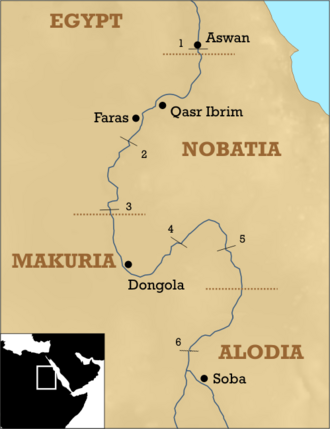
图:SimonP · CC BY-SA 2.0 · 维基共享资源
- 存在时间
- 5 世纪—1518 年 (Wikidata 的日期只记到世纪,非确切年份)
- 首都
- 老东戈拉
- 宗教
- 基督教、非洲传统宗教
- 类型
- 王国、历史国家
- 简述
- Nubian kingdom in present-day Northern Sudan and Southern Egypt
马库里亚王国是一个由努比亚人建立的王国,该国的统治范围大致位于现今苏丹北部和埃及南部。截至6世纪末,该国已皈依基督教。651年,一支阿拉伯军队入侵该国,但被击退。
由于埃及以及贝都因人的侵略、该国的内讧、瘟疫以及贸易的萧条导致该国于13世纪至14世纪期间衰落。1365年该国又爆发内战,结果该国变成了一个残存国家,并失去了原本属于该国的南部领土。最终该国的统治区域成为奥斯曼帝国的一部分。
正文摘自中文维基百科「马库里亚王国」(删去了参考文献、表格和图片),按 CC BY-SA 4.0 使用
英文维基百科的更多内容
中文维基百科这一条比较短,下面是英文维基百科同一条目的节选,原文为英文,未翻译。
Makuria (Old Nubian: ⲇⲱⲧⲁⲩⲟ, Dotawo; Greek: Μακουρία, romanized: Makouria; Arabic: المقرة, romanized: al-Muqurra) was a medieval Nubian kingdom in what is today northern Sudan and southern Egypt. Its capital was Dongola (Old Nubian: ⲧⲟⲩⲅⲅⲟⲩⲗ, Touggoul) in the Dongola Reach, about halfway between the 3rd and 4th Nile cataract.
Coming into being after the collapse of the Kingdom of Kush in the 4th century, it originally covered the Nile Valley from the 3rd cataract to somewhere south of Abu Hamed at Mograt Island. The capital of Dongola was founded around 500 and soon after, in the mid-6th century, Makuria converted to Christianity. Probably in the early 7th century Makuria annexed its northern neighbour Nobatia, now sharing a border with Byzantine Egypt.
In 652 a Rashidun Arab army invaded and besieged Dongola, but was repulsed. Both sides signed the Baqt treaty which would ensure largely uninterrupted peace between Egypt and Makuria until the 13th century. The period from the 9th to 11th century saw the peak of Makuria's cultural development resulting in the construction of buildings like the Throne Hall of Dongola, the great cruciform church of Dongola, and the Banganarti monastery, alongside the development of arts such as wall paintings and finely crafted and decorated pottery. Nubian became increasingly important as written language, but Coptic, Greek and Arabic are also recorded. Makuria maintained close dynastic ties with the fellow Nubian kingdom of Alodia to the south and expanded into northern Kordofan, while also exterting a limited political and cultural influence in Upper Egypt as far north as Akhmim.
History
Early period (5th–8th century)
By the early 4th century, if not before, the Kingdom of Kush with its capital Meroe was collapsing. The region which would later constitute Makuria, i.e. the Nile Valley between the third Nile cataract and the great Nile bend of the fourth/fifth cataract, has been proposed to have seceded from Kush already in the 3rd century.……
Government
Makuria was a monarchy ruled by a king based in Dongola. The king was also considered a priest and could perform mass. How succession was decided is not clear. Early writers indicate it was from father to son. After the 12th century, however, it seems clear that Makuria was using the uncle-to-sister's-son system.……
Culture
Historians early on considered Christian Nubia as historically considered to be something of a backwater, because their graves were small and lacking the grave goods of previous eras. Modern scholars understand that this was due to cultural differences, and that the Makurians actually had rich and vibrant arts and culture.
Languages
Nubian
In the riverine territories of Makuria the population spoke two Nubian languages: Old Nobiin, which was spoken in what was once Nobatia from the 1st cataract to about the 3rd cataract;……
Religion
Paganism
One of the most debated issues among scholars is over the religion of Makuria. Up to the 5th century the old faith of Meroe, the Kushite religion seems to have remained strong, even while ancient Egyptian religion, its counterpart in Egypt, disappeared.……
Christianity
Archaeological evidence in this period finds a number of Christian ornaments in Nubia, and some scholars feel that this implies that conversion from below was already taking place.……
Economy
The main economic activity in Makuria was agriculture, with farmers growing several crops a year of barley, millet, and dates. The methods used were generally the same that had been used for millennia. Small plots of well irrigated land were lined along the banks of the Nile, which would be fertilized by the river's annual flooding.……
Contact with Latin Europe
Thanks to the crusades western Europe grew increasingly aware of the existence of Christian Nubia during the 12th and 13th centuries. By the early 14th century there were even proposals to ally with the Nubians for another crusade against the Mamluks.……
正文摘自英文维基百科(原文为英文,未翻译)「Makuria」(节选,删去了参考文献、表格和图片),按 CC BY-SA 4.0 使用;在维基百科读全文 ›
相关事件
- First battle of Dongola642 年 · 战役 · 非洲
- Second battle of Dongola652 年 · 战役 · 非洲
- Battle of Dongola1276 年 · 战役 · 非洲
同时期、同地区的政权