史鉴
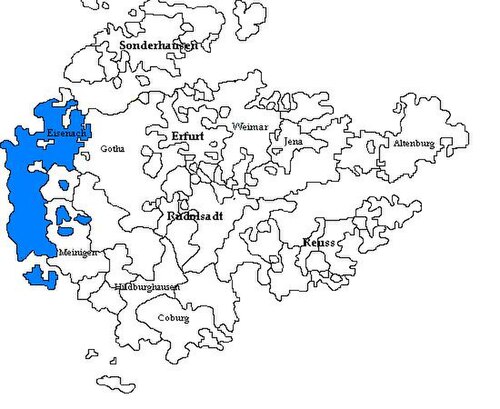
图:佚名 · Public domain · 维基共享资源
- 存在时间
- 1596 年—1809 年
- 首都
- 爱森纳赫
- 政体
- 封建社会
- 类型
- 公国、历史国家、神圣罗马帝国内的国家、state in the Confederation of the Rhine
- 简述
- historical german duchy until 1809
萨克森-艾森纳赫(德语:Sachsen-Eisenach)是德国韦廷家族恩斯特系诸邦国的成员,存在时间为1662年至1809年。
详细介绍
公爵列表
- 约翰·恩斯特,1596年至1638年
- 阿尔布雷希特,1640年至1644年
- 阿道夫·威廉,1662年至1668年
- 威廉·奥古斯特,1668年至1671年
- 约翰·格奥尔格一世,1671年至1686年
- 约翰·格奥尔格二世,1686年至1698年
- 约翰·威廉,1698年至1729年
- 威廉·海因里希,1729年至1741年
正文摘自中文维基百科「萨克森-艾森纳赫」(删去了参考文献、表格和图片),按 CC BY-SA 4.0 使用
英文维基百科的更多内容
中文维基百科这一条比较短,下面是英文维基百科同一条目的节选,原文为英文,未翻译。
Saxe-Eisenach (German: Sachsen-Eisenach) was an Ernestine duchy ruled by the Saxon House of Wettin. The state intermittently existed at three different times in the Thuringian region of the Holy Roman Empire. The chief town and capital of all three duchies was Eisenach.
History
In the 15th century, much of what is now the German state of Thuringia, including the area around Eisenach, was in the hands of the Wettin dynasty, since 1423 Prince-electors of Saxony. In 1485, the Wettin lands were divided according to the Treaty of Leipzig, with most of the Thuringian lands going to Elector Ernest of Saxony and his descendants. The Ernestine Wettins also retained the title of Elector. However, when Ernest's grandson John Frederick the Magnanimous revolted against Emperor Charles V during the Schmalkaldic War, he was defeated at the 1547 Battle of Mühlberg and deprived of the electorate in favour of his Wettin cousin Maurice. According to the Capitulation of Wittenberg he was only allowed to retain the lands in Thuringia.
Ernestine duchies
After John Frederick's son Duke John Frederick II in 1566 had been banned by Emperor Maximilian II due to his involvement in the Grumbach feuds, the Ernestine duchy was at first ruled by his younger brother John William. According to the 1572 Division of Erfurt, he partitioned the lands among himself and his minor nephews, the sons of John Frederick II: He himself retained the Duchy of Saxe-Weimar, while the Duchy of Saxe-Coburg-Eisenach passed to John Casimir and John Ernest, under the regency of their cousin Elector Augustus of Saxony.
For the next three centuries the Ernestine lands were divided whenever the dukes had more than one son to provide for, and re-combined when they died without direct heirs, but all of the lands stayed in the Ernestine branch of the Wettin family. All descendants of John Frederick the Magnanimous in the male line bore the title "Duke of Saxony", whether or not they actually ruled any territory. Brothers sometimes ruled jointly, but usually there was a division of territory if there was more than one son to inherit. As a result, the Duchy of Saxe-Eisenach was separated from and subsumed into other Ernestine duchies several times. The actual territories included in the duchy changed with each creation, but always with the town of Eisenach as the core.
Duchies of Saxe-Eisenach
The first Duchy of Saxe-Eisenach was created in 1596, after the banned Duke John Frederick II had died in captivity and his surviving sons had come of age. Their Duchy of Saxe-Coburg-Eisenach was split, whereby the younger John Ernest became Duke at Eisenach, while the elder John Casimir took his residence at Coburg. When in 1633 Duke John Casimir died without issue, the Wettin line in Saxe-Coburg died out, and John Ernest inherited it. Nevertheless, he himself also died heirless in 1638, and his territories were split between Saxe-Weimar and Saxe-Altenburg, which had itself been separated from Saxe-Weimar in 1603.
Dukes of Saxe-Eisenach
First creation
- Created in 1572 as Saxe-Coburg-Eisenach
- 1596 divided into Saxe-Coburg and Saxe-Eisenach
- John Ernest (1596–1638), left no issue
- Divided between Saxe-Altenburg and Saxe-Weimar
Second creation
- Albrecht (1640–1644), left no issue
- Divided between Saxe-Gotha and Saxe-Weimar
Third creation
Adolf Wilhelm (1662–68), second son of Duke William of Saxe-Weimar
William Augustus (1668–71), minor son, left no issue
John George I (1671–86), third son of Duke William of Saxe-Weimar
- John George II (1686–98), son, left no issue
- John William (1698–1729), younger brother
- William Henry (1729–41), son, left no issue
- Line extinct
Personal union with Saxe-Weimar
- Ernst August I (1741–1748), Duke of Saxe-Weimar since 1728
- Ernst August II (1748–1758), son
- Charles Augustus (1758–1809), son
- Merged with Saxe-Weimar into Saxe-Weimar-Eisenach
正文摘自英文维基百科(原文为英文,未翻译)「Saxe-Eisenach」(节选,删去了参考文献、表格和图片),按 CC BY-SA 4.0 使用;在维基百科读全文 ›
人物
同时期、同地区的政权