史鉴
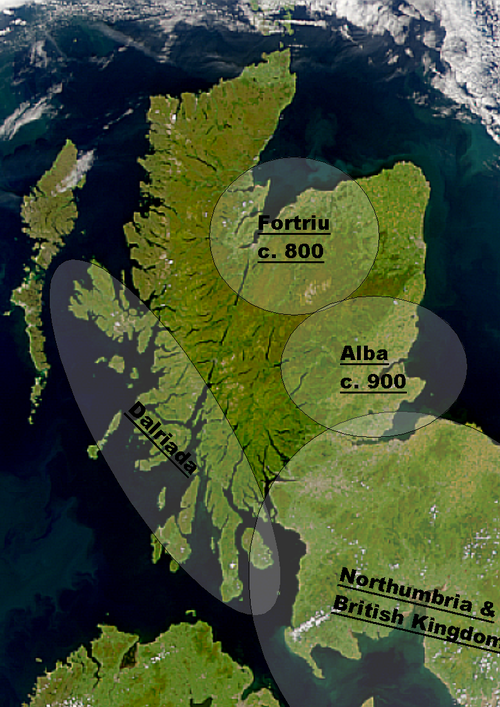
图:Users Angusmclellan, Angusmclellan, Angusmclellan on en.wikipedia · Public domain · 维基共享资源
- 存在时间
- 430 年—848 年
- 后继
- 阿尔巴王国
- 类型
- 历史国家、Pictland
- 简述
- former country
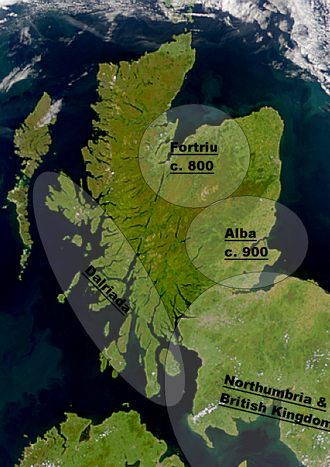
福尔特里乌(拉丁语:Verturiones;古爱尔兰语:*Foirtrinn;古英语:Wærteras;皮克特语:*Uerteru)是一个在4世纪—10世纪有记载的皮克特人王国。传统上认为该王国位于苏格兰中部的斯特拉瑟恩及其周边地区,但更有可能位于北方,即莫里和伊斯特罗斯一带。“福尔特里乌”一名为历史学家所用,因为我们并不知道其人民用什么名称称呼自己的政体。历史学家有时也将该名称与广义上的“皮克特兰”等同使用。
正文摘自中文维基百科「福尔特里乌」(删去了参考文献、表格和图片),按 CC BY-SA 4.0 使用
英文维基百科的更多内容
中文维基百科这一条比较短,下面是英文维基百科同一条目的节选,原文为英文,未翻译。
Fortriu (Latin: Verturiones; Old Irish: *Foirtrinn; Old English: Wærteras; Pictish: *Uerteru) was a Pictish kingdom recorded between the 4th and 10th centuries. It was traditionally believed to be located in and around Strathearn in central Scotland, but is more likely to have been based in the north, in the Moray and Easter Ross area. Fortriu is a term used by historians as it is not known what name its people used to refer to their polity. Historians also sometimes use the name synonymously with Pictland in general.
Name
The only survived indigenous writings left by the people of Fortriu are ogham inscriptions, but the name they used to describe themselves is unrecorded. They were first documented in the late 4th century by the Roman historian Ammianus Marcellinus, who referred to them in Latin as the Verturiones (or Vecturiones). The Latin root verturio has been connected etymologically by John Rhys with the later Welsh word gwerthyr, meaning "fortress", suggesting that both came from a Common Brittonic root vertera, and implying that the group's name meant "Fortress People". Mallory & Adams saw the name as representing turjones, derived from Indo European tur meaning "mighty", with the intensive prefix *wer. A reconstructed form in the Pictish language would be something like *Uerteru.
A connected Old Irish form of the name appears from the 6th to the 10th centuries in the Annals of Ulster and later sources, which contain repeated references to rex Fortrenn, ("the King of Fortriu"), la firu Fortrenn ("the men of Fortriu") and Maigh Fortrenn ("the plain of Fortriu"), alongside references to battles occurring i Fortrinn ("in Fortriu").……
History
Roman Iron Age
Fortriu is first recorded by the Roman author Ammianus Marcellinus, who writing in c. 392 used the Latin name Verturiones to describe one of the two gentes or "peoples" of the Picts who took part in the Great Conspiracy of 367–368. Although alongside the Dicalydones they are clearly described as Pictish, at this time this may just have been a pejorative Roman word for unromanised Britons. The Verturiones were probably based like their successors around the Moray Firth. It is not clear what relationship they had to earlier peoples documented in the same area, such as the Vacomagi and Decantae surveyed under Agricola in the 1st century and listed in Ptolemy's Geography, but archeological discoveries at Birnie near Elgin indicate that Rome had remained in diplomatic contact with the area throughout the 2nd century.
The Verturiones may have emerged as part of a pattern seen in other Roman frontier zones such as Germany, where areas beyond the border saw population groups amalgamating into fewer but larger political units.
As well as the two Pictish groupings, the conspiracy of 367–368 included Scotti from Ireland;……
Verturian hegemony
After the 4th century Fortriu is not explicitly mentioned in documentary sources until 664, but there are indications that Fortriu's later power may have been foreshadowed in the late 6th century.……
Location
From the 19th century until 2006 most historians believed that the kingdom recorded as Fortriu in the Irish annals lay south of the Mounth in present-day central Scotland, based on the work of E. W. Robertson and W. F. Skene. Robertson, in his 1862 work Scotland under her Early Kings, identified Fortriu as comprising Clackmannanshire, Menteith and west Fife on the left bank of the Forth, arguing that the names of both Fortriu and the medieval deanery of Fothriff derived from an earlier hypothetical *Forthreim, which he translated as "Forth Realm". This argument is based on unsound etymology, however, as Fothriff derives from the Gaelic words foithir and Fib and means "district appended to Fife", while Fortriu is related to the earlier Latin name Verturiones.……
正文摘自英文维基百科(原文为英文,未翻译)「Fortriu」(节选,删去了参考文献、表格和图片),按 CC BY-SA 4.0 使用;在维基百科读全文 ›
前后承接的政权
同时期、同地区的政权