史鉴
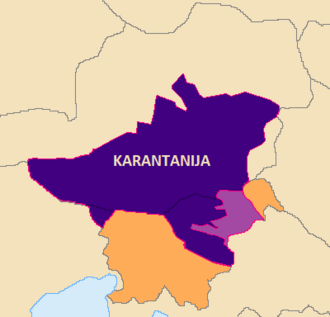
图:SirFranzPaul · CC BY 4.0 · 维基共享资源
- 存在时间
- 658 年—828 年
- 首都
- Maria Saal. Sara. Gospa Sveta
- 类型
- 历史国家
- 所在大洲
- 欧洲
- 简述
- former country
卡兰塔尼亚(斯洛文尼亚语:Karantanija,德语:Karantanien,古斯拉夫语*Korǫtanъ)是7世纪下半叶建立的斯拉夫邦国,位于今天的奥地利南部和斯洛文尼亚东北部,是889年卡洛林王朝成立的卡林提亚边境区的前身。首都为卡恩堡。
正文摘自中文维基百科「卡兰塔尼亚」(删去了参考文献、表格和图片),按 CC BY-SA 4.0 使用
英文维基百科的更多内容
中文维基百科这一条比较短,下面是英文维基百科同一条目的节选,原文为英文,未翻译。
Carantania, also known as Carentania (Slovene: Karantanija, German: Karantanien, in Old Slavic *Korǫtanъ), was a Slavic, more precisely old Slovenian principality that emerged in the second half of the 7th century, in the territory of present-day southern Austria and north-eastern Slovenia. Since the middle of the 8th century, it was allied with Bavaria against the Avars, and consequently became a vassal state of the Frankish Empire. In the same time, Christianisation of Carantanian Slavs was initiated, mainly through missionary activities of the Archdiocese of Salzburg. By 828, internal autonomy of the principality was abolished, and the entire Carantanian territory was gradually integrated into the East Frankish administrative system, based on counties and marches. Carantania thus became the predecessor of the March of Carinthia, created within the Carolingian Empire by 889.
Origin of the name
The name Carantania is of proto-Slavic origin. Paul the Deacon mentions Slavs in "Carnuntum, which is erroneously called Carantanum" (Carnuntum, quod corrupte vocitant Carantanum).
A possible etymological explanation is that it may have been formed from a toponymic base carant- which ultimately derives from pre-Indo-European root *karra meaning 'rock', or that it is of Celtic origin and derived from *karant- meaning 'friend, ally'.……
Territory
Carantania's capital was most likely Karnburg (Slovene: Krnski grad) in the Zollfeld Field (Slovene: Gosposvetsko polje), north of modern Klagenfurt (Slovene: Celovec). The principality was centered in the area of modern Carinthia, and included territories of modern Styria, most of today's East Tyrol and of the Puster Valley, the Lungau and Ennspongau regions of Salzburg, and parts of southern Upper Austria and Lower Austria.……
History
In the 4th century Chur became the seat of the first Christian bishopric north to the Alps. Despite a legend assigning its foundation to an alleged Briton king, St. Lucius, the first known bishop is one Asinio in AD 451.
In the aftermath of the Gothic War (535-554), the Byzantine Empire found itself unable to prevent the Germanic tribe of the Lombards from invading Italy and founding a kingdom there.……
The Ducal Inauguration
The principality of Carantania is particularly notable for the ancient ritual of installing Carantanian dukes (or princes, both an approximate translation of Knez/Knyaz/Fürst), a practice that continued after Carantania was incorporated into the later Duchy of Carinthia. It was last performed in 1414, when the Habsburg Ernest the Iron was enthroned as Duke of Carinthia.……
Mentions in late medieval literature
Chronicle of Fredegar mentions Carantania as Sclauvinia, Dante Alighieri (1265–1321) mentions Carantania as Chiarentana. The same name was also used by Florentines, such as the poet Fazio degli Uberti (circa 1309–1367), the famous chronicler Giovanni Villani (c. 1275–1348), and Giovanni Boccaccio (1313–1375), who wrote that the Brenta River rises from the mountains of Carantania, a land in the Alps dividing Italy from Germany.
Ethnic and social structure
The population of ancient Carantania had a polyethnic structure. The core stratum was represented by two groups of Slavs who had settled in the Eastern Alps region in 6th century and are the ancestors of the present-day Slovenes and partially also Austrians.……
Language
In its early stages, the language of Carantanian Slavs was essentially Proto-Slavic. In Slovenian linguistic literature and reference books it is sometimes provisionally termed Alpine Slavic (alpska slovanščina). Its Proto-Slavic character can be deduced from language contacts of Alpine Slavs with the remainders of the Romanised aboriginal population, later also with Bavarians.……
正文摘自英文维基百科(原文为英文,未翻译)「Carantania」(节选,删去了参考文献、表格和图片),按 CC BY-SA 4.0 使用;在维基百科读全文 ›
相关事件
- Ljudevit uprising819 年—823 年 · 革命与起义 · 欧洲
人物
同时期、同地区的政权