史鉴
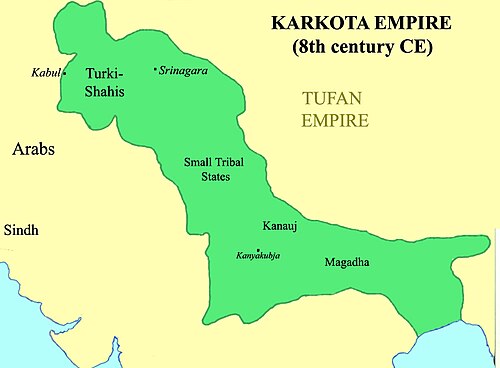
图:Ἀλέξανδρος ὁ Μέγας · CC BY-SA 3.0 · 维基共享资源
- 存在时间
- 625 年—885 年
- 首都
- 斯利那加
- 类型
- 朝代、历史国家
- 所在大洲
- 亚洲
- 简述
- 7th to 9th-century dynasty in the Indian subcontinent
卡尔科塔王朝(英语:Karkoṭa Empire)是源于喀什米尔的印度王朝。拉利塔迭多·穆克塔毗达是卡尔科塔王朝最强势的君王,在唐朝的帮助下征服了旁遮普、阿富汗、中亚的部分地区。迦尔诃纳编纂的史书《王河》记载,拉利塔迭多·穆克塔毗达在约740年击败了曲女城国王耶输跋摩以及突厥人、吐蕃人,但部分学者认为迦尔诃纳夸大了拉利塔迭多·穆克塔毗达的功绩。卡尔科塔王朝的君主大多信仰印度教,并于王城Parihaspur建造宏伟的印度教寺庙。佛教也在王朝统治下繁盛发展,王城遗址存在不少窣堵坡、佛教精舍。印度安南塔那加县的Martand太阳神庙为拉利塔迭多·穆克塔毗达所建,是现存已知最古老的印度太阳神庙,也是当时最宏伟的建筑之一。
公元885年,该王朝为阿槃提跋摩建立的Utpala王朝所取代。
正文摘自中文维基百科「卡尔科塔王朝」(删去了参考文献、表格和图片),按 CC BY-SA 4.0 使用
英文维基百科的更多内容
中文维基百科这一条比较短,下面是英文维基百科同一条目的节选,原文为英文,未翻译。
The Karkota dynasty (c. 625 − 855 CE) ruled over the Kashmir valley and some northern parts of the Indian subcontinent during 7th and 8th centuries. Their rule saw a period of political expansion, economic prosperity and emergence of Kashmir as a centre of culture and scholarship.
The Karkota rulers constructed several shrines to Vishnu in their dominions. They however also allowed Buddhism to flourish under them. Stupa, Chaitya and Vihara can be found in the ruins of their capital. Martand Sun Temple in the Anantnag district was built by Lalitaditya. It is the oldest known Sun temple in India and was also one of the biggest temple complexes at the time.
Avanti Varman ascended the throne of Kashmir in 855, establishing the Utpala dynasty and ending the rule of Karkota dynasty.
History
Establishment
Scholars disagree on the specifics of establishment of the Karkotas, though it is held that their establishment followed the rule of the Hunas in the region of Kashmir.
Kalhana's third book mentions of a Gonanda dynasty (II), which ruled for about 590 years till the establishment of the Karkotas; on cross-vetting with coins and inscriptions, names of some of these rulers are found to correspond with the Alchon Huns, who ruled hundreds of years later. Across the first three books, Kalhana reshuffles multiple names, retrofits the same stories, assigns abnormally long reigns, and telescopes some rulers into the past. Durlabhavardhana—the founder of the Karkotas—was held to be under the employment of Baladitya, the last ruler of the Gonanda dynasty (II). Baladitya had no male heir but a daughter Anaṅgalekhā and did not wish his territory to be annexed by in-laws. To avert such a possibility he had her married to Durlabhavardhana, who was from a low caste. However, after Baladitya's death, Durlabhavardhana ascended to the throne with help from a minister, and claimed descent from the mythical Naga king Karkotaka, establishing the Karkota dynasty. Witzel seems to accept this view.
Durlabhavardhana
Kalhana assigns a regnal span of thirty-six years from 625 to 661/2.……
Society
On a reading of Kuttanimata, the society seems to be unequal and dominated by merchant communities. Materialism was in vogue among the elites, and prostitution received state patronage. Sati as well as Devadasi system were prevalent. The dynasty (at least, the earlier rulers) had sought to restore Hinduism after a lengthy span of Buddhist influence in the valley; however a syncretic environment flourished.
Hunting was a popular sport for the princely class. Theaters were frequently organised and there were halls for the purpose; Ratnavali is noted to be a popular drama.
Economy
Metallic coins as well as cowrie shells were used as currency. The state collected a variety of taxes—customs-levy, prostitution-levy, market-tax etc.—corruption was rampant and Damodaragupta takes frequent digs.
Art and architecture
Literature
The Nilamata Purana is believed to have been commissioned by Durlabhavardhana. The Vishnudharmottara Purana, was crafted around the same times. A famed patron of arts, Lalitaditya invited scholars from abroad to his court and promoted study of religions.
Kalhana notes Jayapida to be a liberal patron of arts and even invited scholars from abroad; Yigal Bronner notes his court to have ushered a breakthrough moment in Kashmiri poetics. Daniel Ingalls writes that Jayapada's court was responsible for birthing the "school of literary criticism in Kashmir". Two literary theorists were installed in his office: Vāmana as a minister and Udbhaṭa as the chief scholar. Udbhata wrote four works—Kumārasambhava, a poem on the theme of the marriage of Śiva and Pārvatī; Kāvyālaṃkārasaṃgraha, a short commentary on Bhāmaha's Kāvyālaṃkāra; another (now-lost) commentary on the Nāṭyaśāstra; and a mostly-lost but extensive Vivaraṇa on Bhāmaha—in what Bronner notes to be an unprecedented volume of literature production by contemporary standards. Vāmana composed sūtra texts.……
Sculpture
Sculpting proliferated during the Karkota dynasty, and Rajatarangini notes of several bronzes.……
Shrines and cities
Durlabhavardhana, built a shrine dedicated to Lord Vishnu at Srinagar named "Durlabhasvāmin";……
正文摘自英文维基百科(原文为英文,未翻译)「Karkota dynasty」(节选,删去了参考文献、表格和图片),按 CC BY-SA 4.0 使用;在维基百科读全文 ›
人物
同时期、同地区的政权