史鉴
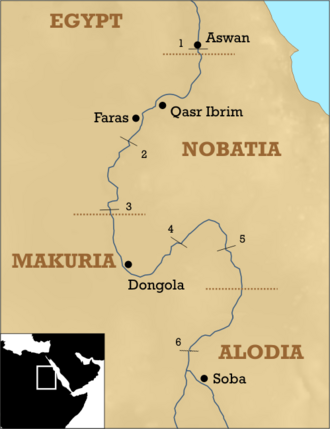
图:SimonP · CC BY-SA 2.0 · 维基共享资源
- 存在时间
- 6 世纪—1504 年 (Wikidata 的日期只记到世纪,非确切年份)
- 首都
- 索巴
- 政体
- 君主制
- 宗教
- 亚历山大科普特正教会
- 类型
- 考古遗址、历史国家
- 简述
- Medieval Nubian Kingdom
阿勒底亚是位于现今苏丹中部和南部的一个中世纪王国,它的首都位于索巴。阿勒底亚成立于350年左右,并于580年皈依基督教 。13世纪开始,阿勒底亚开始衰落。1500年左右,索巴已被阿拉伯人或丰吉苏丹国控制,这意味着阿勒底亚可能于此时灭亡。
正文摘自中文维基百科「阿勒底亚」(删去了参考文献、表格和图片),按 CC BY-SA 4.0 使用
英文维基百科的更多内容
中文维基百科这一条比较短,下面是英文维基百科同一条目的节选,原文为英文,未翻译。
Alodia, also known as Alwa (Old Nubian: ⲁⲣⲟⲩⲁ, Aroua; Byzantine Greek: Ἀρούα, Arouá; Arabic: علوة, ʿAlwa), was a medieval kingdom in what is now central Sudan. Its capital was the city of Soba, located near modern-day Khartoum at the confluence of the Blue and White Nile rivers.
Founded sometime after the ancient Kingdom of Kush fell, around 350 AD, Alodia is first mentioned in historical records in 569. It was the last of the three Nubian kingdoms to convert to Christianity in 580, following Nobadia and Makuria. It possibly reached its peak during the 9th–12th centuries when records show that it exceeded its northern neighbor, Makuria, with which it maintained close dynastic ties, in size, military power and economic prosperity. Alodia was a large, multicultural state administered by a powerful king and provincial governors appointed by him. The capital Soba, described as a town of "extensive dwellings and churches full of gold and gardens", prospered as a trading hub. Goods arrived from Makuria, the Middle East, western Africa, India and even China. Literacy in both Nubian and Greek flourished.
From the 12th, and especially the 13th century, Alodia was declining, possibly because of invasions from the south, droughts and a shift of trade routes. In the 14th century, the country might have been ravaged by the plague, while Arab tribes began to migrate into the Upper Nile valley. By around 1500 Soba had fallen to either Arabs or the Funj. This likely marked the end of Alodia, although some Sudanese oral traditions claimed that it survived in the form of the Kingdom of Fazughli within the Ethiopian–Sudanese borderlands. After the destruction of Soba, the Funj established the Sultanate of Sennar, ushering in a period of Islamization and Arabization.
Geography
Alodia was located in Nubia, a region which, in the Middle Ages, extended from Aswan in southern Egypt to an undetermined point south of the confluence of the White and Blue Nile rivers. The heartland of the kingdom was the Gezira, a fertile plain bounded by the White Nile in the west and the Blue Nile in the east. In contrast to the White Nile Valley, the Blue Nile Valley is rich in known Alodian archaeological sites, among them Soba.……
History
Origins
The name Alodia might be of considerable antiquity, perhaps appearing first as Alut on the Kushite stela of king Nastasen from the late 4th century BC. It appeared again as Alwa on a list of Kushite towns by the Roman author Pliny the Elder (1st century AD), said to be located south of Meroë.……
Administration
While information about Alodia's government is sparse, it was likely similar to that of Makuria. The head of state was the king who, according to al-Aswani, reigned as an absolute monarch. He was recorded to be able to enslave any of his subjects at will, who would not oppose his decision, but prostrated themselves before him.……
Culture
Languages
While Alodia was polyethnic, and hence polylingual, it was essentially a Nubian state whose majority spoke a Nubian language. Based on a few inscriptions found in Alodian territory it has been suggested that the Alodians spoke a dialect distinct from Old Nobiin of northern Nubia, dubbed as Alwan-Nubian.……
Church architecture
Most of the 400 churches reportedly existing throughout Alodia have yet to be located.……
Economy
Agriculture
Alodia was in the savannah belt, giving it an economic advantage over its northern neighbor Makuria. According to al-Aswani the "provisions of the country of Alwa and their king" came from Kersa, which has been identified with the Gezira. North of the confluence of the two Niles agriculture was limited to farms along the river watered by devices like the shadoof or the more sophisticated sakia.……
Trade
Trade was an important source of income for the people of Alodia.……
正文摘自英文维基百科(原文为英文,未翻译)「Alodia」(节选,删去了参考文献、表格和图片),按 CC BY-SA 4.0 使用;在维基百科读全文 ›
同时期、同地区的政权