史鉴
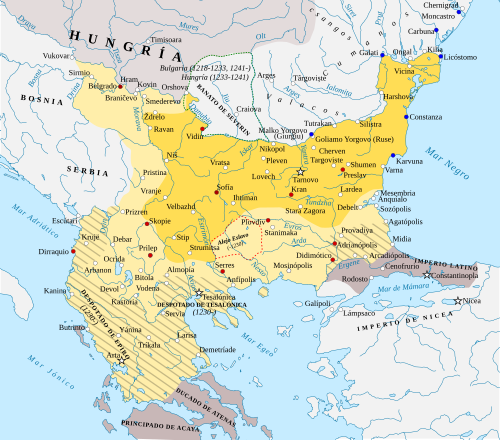
图:Bulgaria-Iván Asen-es.svg: rowanwindwhistler Болгария во время Ивана Асеня II.jp · Public domain · 维基共享资源
- 存在时间
- 1185 年—1396 年
- 首都
- 大特尔诺沃
- 政体
- 独裁
- 官方语言
- 古教会斯拉夫语
- 宗教
- 东罗马派正教会
- 类型
- 历史国家
- 所在大洲
- 欧洲
- 简述
- Medieval Bulgarian state (1185–1396)
保加利亚第二帝国(保加利亚语:Второ българско царство),也称保加利亚第二王国,是在保加利亚第一帝国灭亡近170年后,从东罗马帝国独立出来的保加利亚国家。
详细介绍
历史
公元1185年,贵族出身的伊凡·阿森和彼得·阿森兄弟领导保加利亚东北方的第诺伐人大规模起义,反抗并打败了拜占庭的驻军。1187年,拜占庭承认保加利亚独立,即为保加利亚第二帝国,首都普列斯拉夫,后迁至第诺伐。13世纪,保加利亚经济发展,城市增加。国王伊凡·阿森二世时期(公元1218年-1241年),国力达到鼎盛,疆域最广,南抵色雷斯,东西至海。
阿森二世死后,国势日衰。公元1242年,大蒙古国的拔都军入侵至此。1258年,阿森王朝被推翻。1277年,伊瓦伊洛起义爆发,起义声势浩大,国王被杀,伊瓦伊洛被拥戴为王,1278年首都第诺伐被占领。1279年2月,拜占庭军队攻占第诺伐。1280年起义失败,伊瓦伊洛逃亡后被蒙古人所杀。1330年,保加利亚沦为塞尔维亚的附属国,此后又分裂为几个小国。1396年,奥斯曼帝国吞并之,保加利亚第二帝国灭亡,存在两百余年。
正文摘自中文维基百科「保加利亚第二帝国」(删去了参考文献、表格和图片),按 CC BY-SA 4.0 使用
英文维基百科的更多内容
中文维基百科这一条比较短,下面是英文维基百科同一条目的节选,原文为英文,未翻译。
The Second Bulgarian Empire (Middle Bulgarian: Ц(а)рьство бл(ъ)гарское; Modern Bulgarian: Второ българско царство, romanized: Vtoro Balgarsko Tsarstvo) was a medieval Bulgarian state that existed between 1185 and 1396. A successor to the First Bulgarian Empire, it reached the peak of its power under Tsars Kaloyan and Ivan Asen II before gradually being conquered by the Ottomans in the late 14th century.
Until 1256, the Second Bulgarian Empire was the dominant power in the Balkans, defeating the Byzantine Empire in several major battles. In 1205, Emperor Kaloyan defeated the newly established Latin Empire in the Battle of Adrianople. His nephew Ivan Asen II defeated the Despotate of Epiros and made Bulgaria a regional power again. During his reign, Bulgaria spread from the Adriatic to the Black Sea and the economy flourished. In the late 13th century, however, the Empire declined under constant invasions by Mongols, Byzantines, Hungarians, and Serbs, as well as internal unrest and revolts. The 14th century saw a temporary recovery and stability, but also the peak of Balkan feudalism as central authorities gradually lost power in many regions. Bulgaria was divided into three parts on the eve of the Ottoman invasion.
Despite strong Byzantine influence, Bulgarian artists and architects created their own distinctive style. In the 14th century Bulgarian culture, literature, art, and architecture flourished. The capital city Tarnovo, which was considered a "New Constantinople", became the country's main cultural hub and the centre of the Eastern Orthodox world for contemporary Bulgarians.……
Nomenclature
The name most frequently used for the empire by contemporaries was Bulgaria, as the state called itself. During Kaloyan's reign, the state was sometimes known as being of both Bulgarians and Vlachs.……
Background
In 1018, when the Byzantine emperor Basil II (r. 976–1025) conquered the First Bulgarian Empire, he ruled it cautiously. The existing tax system, laws, and the power of low-ranking nobility remained unchanged until his death in 1025.……
History
Rebellion
The disastrous rule of the last Komnenian emperor Andronikos I (r. 1183–85) worsened the situation of the Bulgarian peasantry and nobility. The first act of his successor Isaac II Angelos was to impose an extra tax to finance his wedding.……
Administration, territorial division, society
The Second Bulgarian Empire was a hereditary monarchy ruled by a Tsar—the Bulgarian word for Emperor that originated in the 10th century during the First Bulgarian Empire.……
Military
The emperor of the Second Bulgarian Empire was commander-in-chief of its army; the second-in-command was the velik (great) voivoda. The detachments of the army were led by a voivoda. The protostrator was responsible for the defence of certain regions and the recruitment of soldiers.……
Economy
The economy of the Second Bulgarian Empire was based on agriculture, mining, traditional crafts, and trade. Agriculture and livestock breeding remained the mainstays of the Bulgarian economy between the 12th and 14th centuries.……
Religion
Religious policy
Following the refoundation of Bulgaria, the recognition of the imperial title of the monarch and the restoration of the Bulgarian Patriarchate became the priority of the Bulgarian foreign policy. The continuous state of war against the Byzantine empire urged Bulgarian rulers to turn to the Papacy.……
Culture
The Second Bulgarian Empire was a centre of a thriving culture that reached its peak in the mid-to-late 14th century during the reign of Ivan Alexander (r. 1331–71).……
Architecture
The network of cities in the Second Bulgarian Empire grew in the 13th and 14th centuries;……
正文摘自英文维基百科(原文为英文,未翻译)「Second Bulgarian Empire」(节选,删去了参考文献、表格和图片),按 CC BY-SA 4.0 使用;在维基百科读全文 ›
相关事件
- 拜占庭-保加利亚战争680 年—1355 年 · 战争 · 欧洲
- 阿森与彼得起义1185 年 10 月 26 日—1187 年 · 革命与起义 · 欧洲
- 阿卡第波利斯战役1194 年 · 战役 · 西亚
- Battle of Serres1205 年 6 月 · 战役 · 欧洲
- Battle of Boruy1208 年 6 月 · 战役 · 欧洲
- 科洛克尼察战役1230 年 3 月 9 日 · 战役 · 欧洲
- 蒙古入侵保加利亚与塞尔维亚1242 年 · 战役 · 欧洲
- 代维纳战役1279 年 7 月 17 日 · 战役 · 欧洲
- 拜占庭内战1321 年—1328 年 · 战争 · 西亚
- 保加利亚-奥斯曼战争1345 年—1393 年 7 月 · 战争 · 欧洲
- Battle of Demotika1352 年 10 月 · 战役 · 西亚
- Battle of Ihtiman1355 年 · 战役 · 欧洲
- 尼科波利斯战役1396 年 9 月 25 日 · 战役 · 欧洲
人物
同时期、同地区的政权