 史鉴
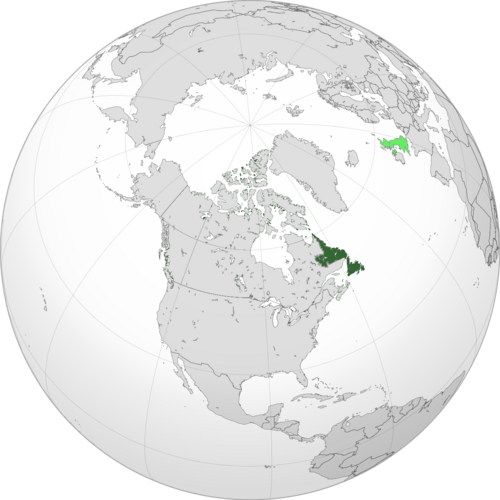
图:Earl Andrew at English Wikipedia · CC BY-SA 3.0 · 维基共享资源
- 存在时间
- 1907 年 9 月 26 日—1949 年 3 月 31 日
- 首都
- 圣约翰斯
- 政体
- 君主立宪制
- 官方语言
- 法语、英语、爱尔兰语
- 货币
- Newfoundland dollar
- 前身
- 纽芬兰殖民地、纽芬兰殖民地
- 后继
- 纽芬兰-拉布拉多省
- 类型
- 自治领、历史国家
- 所在大洲
- 北美洲
- 简述
- 英国自治领
纽芬兰自治领(英语:Dominion of Newfoundland)是一个存在于1907年至1949年期间,地处北美洲东部大西洋沿岸,以英国君主为其元首的政治实体。1854年纽芬兰成为自治殖民地,1907年纽芬兰成为自治领。第一次世界大战期间,大量纽芬兰人在战争中牺牲,加之后来的大萧条,导致纽芬兰经济出现困难。1934年,英国暂停了纽芬兰的自治领地位,直接任命对英国负责的纽芬兰总督并使其组建和领导纽芬兰政府,纽芬兰由此成为事实上的英国属地。第二次世界大战结束后,纽芬兰要求独立或并入加拿大的呼声升温。1948年,纽芬兰举行公投,赞成并入加拿大。1949年3月31日,纽芬兰并入加拿大,成为加拿大的纽芬兰省(2001年更名为纽芬兰与拉布拉多省)。
正文摘自中文维基百科「纽芬兰自治领」(删去了参考文献、表格和图片),按 CC BY-SA 4.0 使用
英文维基百科的更多内容
中文维基百科这一条比较短,下面是英文维基百科同一条目的节选,原文为英文,未翻译。
The Dominion of Newfoundland, or simply Newfoundland, was a British Dominion in eastern North America, today the modern Canadian province of Newfoundland and Labrador. It included the island of Newfoundland, and Labrador on the continental mainland. Newfoundland was one of the original dominions under the Balfour Declaration of 1926, and accordingly enjoyed a constitutional status equivalent to the other dominions of the time. Its dominion status was confirmed by the Statute of Westminster 1931, although the statute was not otherwise applicable to Newfoundland.
In 1934, Newfoundland became the only dominion to give up its self-governing status, which ended 79 years of self-government. The abolition of self-government came about because of a crisis in Newfoundland's public finances in 1932. Newfoundland had accumulated a significant amount of debt by building a railway across the island, which was completed in the 1890s, and by raising its own regiment during the First World War. In November 1932, the government warned that Newfoundland would default on payments on the public debt. The British government quickly established the Newfoundland Royal Commission to inquire into and report on the position. The commission's report, published in October 1933, recommended that Newfoundland give up self-government temporarily and allow the United Kingdom to administer it by an appointed commission.
The Newfoundland parliament accepted the recommendations; it then presented a petition to the King to ask for the suspension of the constitution and the appointment of commissioners to administer the government until the country became self-supporting again.……
Name and national symbols
The official name of the dominion was "Newfoundland" and not, as was sometimes reported, "Dominion of Newfoundland". The distinction is apparent in many statutes, most notably the Statute of Westminster that listed the full name of each realm, including the "Dominion of New Zealand", the "Dominion of Canada", and "Newfoundland".
Political origins
Newfoundland was the oldest English colony in North America, being claimed by John Cabot for Henry VII, and again by Sir Humphrey Gilbert in 1583. It gradually acquired European settlement; in 1825, it was formally recognised as a Crown colony by the British government. The British government granted representative government in 1832, and responsible government in 1854.……
First World War and afterwards
Newfoundland's own regiment, the 1st Newfoundland Regiment, fought in the First World War. On 1 July 1916, the German Army wiped out most of that regiment at Beaumont Hamel on the first day on the Somme, inflicting 90 percent casualties. Yet the regiment went on to serve with distinction in several subsequent battles, earning the prefix "Royal".……
End of responsible government
As a small country which relied primarily upon the export of fish, paper, and minerals, Newfoundland was hit hard by the Great Depression. Economic frustration combined with anger over government corruption led to a general dissatisfaction with democratic government.……
Second World War
The severe worldwide Great Depression persisted until the Second World War broke out in 1939.
Given Newfoundland's strategic location in the Battle of the Atlantic, the Allies (especially the United States of America) built many military bases there. Large numbers of men gained the first paycheques they had seen in years by working on construction and in dockside crews.……
National Convention and referendums
In 1945, London announced that a Newfoundland National Convention would be elected to advise on what constitutional choices should be voted on by referendum. Union with the United States was a possibility, but Britain rejected the option and offered instead two options: return to dominion status or continuation of the unpopular Commission.……
正文摘自英文维基百科(原文为英文,未翻译)「Dominion of Newfoundland」(节选,删去了参考文献、表格和图片),按 CC BY-SA 4.0 使用;在维基百科读全文 ›