史鉴
- 存在时间
- 公元前 337 年—公元前 322 年
- 类型
- 科伊农、历史国家
- 所在大洲
- 欧洲
- 简述
- historic federation of Greek states
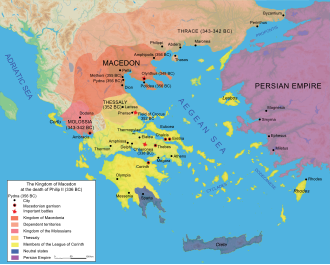
科林斯同盟,马其顿国王腓力二世于公元前338/337年冬季创建的希腊城邦同盟。旨在联合整个希腊世界的军事力量与波斯较量。
详细介绍
条款
同盟的主要条款:
成员城邦共同组建军事力量。
最高审议会议(Synedrion),即各城邦的代表大会,在科林斯召开。
同盟会制止任何针对同盟成员的侵略和颠覆行为。
同盟军按照各城邦的人口来征兵。
马其顿国王作为同盟军的最高统帅。
后来条款还增加了腓力二世在科林斯、底比斯和安布拉基亚驻军。有如此不平等的条款,是因为腓力于前338年的喀罗尼亚战役中打败了底比斯和雅典的联军。
同盟成员
- 科林斯
- 雅典
- 德尔斐
- 奥林匹亚
- 彼得那
正文摘自中文维基百科「科林斯同盟」(删去了参考文献、表格和图片),按 CC BY-SA 4.0 使用
英文维基百科的更多内容
中文维基百科这一条比较短,下面是英文维基百科同一条目的节选,原文为英文,未翻译。
The League of Corinth, also referred to as the Hellenic League (Greek: κοινὸν τῶν Ἑλλήνων, koinòn tõn Hellḗnōn; or simply οἱ Ἕλληνες, the Héllēnes), was a federation of Greek states created by Philip II of Macedon in 338–337 BC. The League was created in order to unify Greek military forces under Macedonian hegemony (leadership) in a pan-Hellenic expedition against the Persian Achaemenid Empire.
King Philip was initially urged by Isocrates in 346 BC to unify Greece against the Persians. After the Battle of Chaeronea, the League of Corinth was formed and controlled by Philip. Alexander the Great utilized his father's league when planning his pan-Hellenic invasion of Asia to expand Macedon and take revenge on the Persian Empire. During the Hellenistic period, some Antigonid rulers of Macedon shortly revived the league, also known as the 'Hellenic Alliance'.
The title 'League of Corinth' was invented by modern historians because the first council of the League took place in Corinth, though the Greek word synedrion is better translated as congress. The adjective Hellenic derives from Hellenikos meaning "pertaining to Greece and Greeks". The League was the first time in history that the Greek city-states (except Sparta, who by then was deprived of Messenia and long since in terminal decline as a military power) would unify under a single political entity.
Philip II of Macedon and the ideas of Panhellenic unity
From the mid-fourth century BC, the system of city-states (poleis) was gradually challenged by the ideas of pan-Hellenic unity, forwarded by some writers and orators, including Isocrates, who urged king Philip (in Isocrates' Philippus oration) to unify Greek powers against the Persians. Pan-Hellenic unity was only achieved with the rise of Macedon.……
Organization by Philip II
The League was governed by the Hegemon (leader) (strategos autokrator in a military context), the council (Synedrion), and the judges (Dikastai). Delegates of the member-states (Synedroi) were responsible for administering the common affairs of the League. They were summoned and presided over by a committee of presiding officers (Proedroi), chosen by lot in time of peace, and by the Hegemon in time of war. Decrees of the league were issued in Corinth, Athens, Delphi, Olympia and Pydna.……
Treaty of the Common Peace
All member states of the League of Corinth were listed in the oath they swore under the 'Treaty of the Common Peace' (Koine Eirene). The peace was watched over by a Macedonian garrison positioned at the heights of the Acrocorinth and Chalcis, as well as at the Cadmea of Thebes. (A fragmentary inscription of the oath was found in Athens)
Text
- [․․․․․․․․․21․․․․․․․․․․ Ποσ]ειδῶ ․․5․․
- ․․․․․․․․․․22․․․․․․․․․․ς ἐμμεν[ῶ ․․․․]
- ․․․․․․․․․․22․․․․․․․․․․νον[τ]ας τ․․․․
- [․․․․․․․․18․․․․․․․․ οὐδ]ὲ ὅπλα ἐ[π]οί[σω ἐ]-
Translation
Oath. I swear by Zeus, Gaia, Helios, Poseidon and all the gods and goddesses.……
Campaigns of Alexander the Great
The decision for the destruction of Thebes as transgressor of the above oath was taken by the council of the League of Corinth by a large majority. Beyond the violation of the oath, the council judged that the Thebans were thus finally punished for their betrayal of the Greeks during the Persian Wars. The League is mentioned by Arrian (I, 16, 7), after the Battle of Granicus (334 BC). Alexander the Great sent 300 panoplies to the temple of Pallas Athena in Athens, with the following inscription.……
Revivals by Antigonid kings
The League was dissolved after the Lamian War in 322 BC. Following the victory of Demetrius I Poliorcetes at the Battle of Salamis in 306 BC, his father, Antigonus I Monophthalmus, assumed the title of Basileus ("King" of Alexander's Empire) by the assembled armies and gained control over the Aegean, the eastern Mediterranean, and most of the Middle East. While Antigonus and Demetrius attempted to recreate Philip II's Hellenic league with themselves as dual hegemons, a revived coalition of the diadochi;……
正文摘自英文维基百科(原文为英文,未翻译)「League of Corinth」(节选,删去了参考文献、表格和图片),按 CC BY-SA 4.0 使用;在维基百科读全文 ›
相关事件
- 亚历山大大帝战争公元前 336 年—公元前 323 年 · 战争 · 欧洲
- 底比斯战役公元前 335 年 · 战役 · 欧洲
- 格拉尼库斯河战役公元前 334 年 5 月 · 战役 · 西亚
- 泰尔围城战公元前 332 年 1 月—公元前 332 年 7 月 · 战役 · 西亚
- 高加米拉战役公元前 331 年 10 月 1 日 · 战役 · 西亚
- 波斯门战役公元前 330 年 1 月 20 日 · 战役 · 西亚
- 印度战争公元前 327 年—公元前 325 年 · 战役 · 南亚
- Cophen Campaign公元前 327 年 5 月—公元前 326 年 3 月 · 战争 · 中亚与北亚
- 希达斯皮斯河战役公元前 326 年 5 月 · 战役 · 东亚
- 马连战役公元前 326 年 11 月—公元前 325 年 2 月 · 战争 · 南亚
同时期、同地区的政权