史鉴
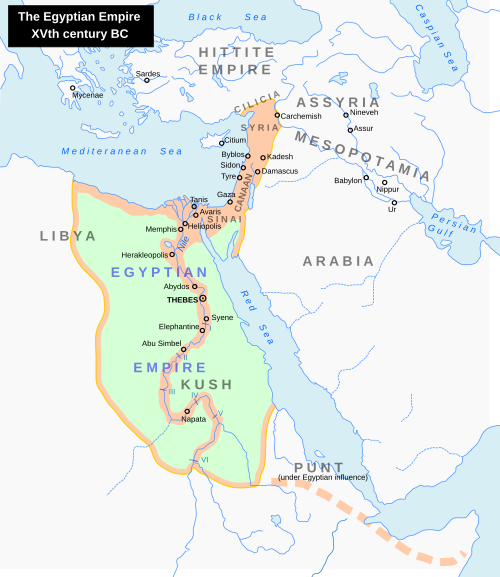
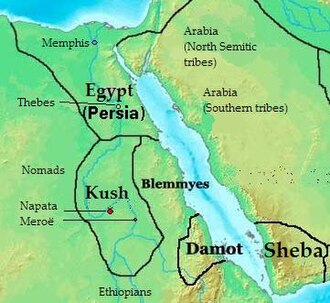
图:ArdadN at English Wikipedia · Public domain · 维基共享资源
- 存在时间
- 公元前 25 世纪—公元前 1069 年 (Wikidata 的日期只记到世纪,非确切年份)
- 类型
- 历史国家
- 简述
- ancient kingdom on the northern coast of the Horn of Africa
邦特之地,或译作蓬特、朋特(圣书体转写:pwnt,构拟读音:/puːnɛt/)是古埃及贸易记录中的一个王国,交往历史可追溯至公元前2500年的第五王朝时期。这里生产和出口黄金、芳香树脂、黑檀木、乌木、象牙和野生动物。
古埃及人通过陆海联运的复杂路线抵达该地,从红海沿岸港口出发开展远航探险,以玻璃制品等换取香料、乌木、象牙等珍稀物资 。哈特谢普苏特女王统治期间(约公元前1500年)组织了规模最大的官方探险,此次行动详细记录于代尔拜赫里神庙壁画中,展现了蓬特的异域风貌与贸易场景。
邦特之地的确切位置至今仍有争论。多数学者认为邦特位于埃及的东南部,即是今天的索马里、吉布提、厄立特里亚以及埃塞俄比亚东北的沿海地区和苏丹的红海沿岸。也有学者指出古代的一些铭文显示邦特位于阿拉伯半岛,也可能处于非洲之角和阿拉伯半岛南部。
详细介绍
埃及对邦特的描述
对于邦特的最早描述来自于第五王朝第二任法老萨胡拉,对邦特返回的货物进行了记录;也有学者指出第四王朝法老胡夫时期就已经有对邦特黄金的记录。其后,在第六王朝、第十一王朝、第十二王朝及第十八王朝时期对邦特的记述增多。
十八王朝女法老哈特谢普苏特建立了一支红海贸易船队(jlao ly and lai ly),以经六个月的行程到朋特之地进行贸易。底比斯用征服得来的努比亚黄金和奴隶前往南方的库施进行贸易,换来乳香、没药、沥青、泡碱、杜松油、亚麻及铜制饰品等,用来在卡纳克制作木乃伊。
正文摘自中文维基百科「邦特之地」(删去了参考文献、表格和图片),按 CC BY-SA 4.0 使用
英文维基百科的更多内容
中文维基百科这一条比较短,下面是英文维基百科同一条目的节选,原文为英文,未翻译。
The Land of Punt (Egyptian: pwnt; alternate Egyptological readings Pwene(t) /puːnt/) was an ancient kingdom known from Ancient Egyptian trade records. It produced and exported gold, aromatic resins, blackwood, ebony, ivory and wild animals. Recent evidence locates it in northwestern Eritrea. It is possible that it includes or corresponds to Opone, as later known by the ancient Greeks, while some biblical scholars have identified it with the biblical land of Put or Havilah.
At times Punt is referred to as Ta netjer (tꜣ nṯr), lit. 'Land of the God' in Egyptian textual records. The exact location of Punt is debated by historians. Various locations have been offered, southeast of Egypt, a coastal region south of it along the Red Sea, Gulf of Aden and the Indian Ocean, in present day north-east Sudan, Eritrea, northeast Ethiopia, Djibouti and northern Somalia, including Somaliland.
A majority of historical scholars now situate the location of Punt in African lands south-east of Egypt or in East Africa. The assumed location has generally been applied to territories covering Somalia, Sudan, Ethiopia and Eritrea.
It is also possible that it covered both the Horn of Africa and the area across the sea, in Southern Arabia. The autonomous state of Puntland, the modern day Somali administrative region at the tip of the Horn of Africa, is named in honor of this ancient kingdom.
Egyptian expeditions to Punt
The earliest recorded ancient Egyptian expedition to Punt was organized by Pharaoh Sahure of the Fifth Dynasty (25th century BC), returning with cargoes of antyue and Puntites. However, gold from Punt is recorded as having been in Egypt as early as the time of Pharaoh Khufu of the Fourth Dynasty.
Subsequently, there were more expeditions to Punt in the Sixth, Eleventh, Twelfth and Eighteenth dynasties of Egypt. In the Twelfth Dynasty, trade with Punt was celebrated in popular literature in the Tale of the Shipwrecked Sailor.
In the reign of Mentuhotep III (11th dynasty, ca. 2000 BC), an officer named Hannu organized one or more voyages to Punt, but it is uncertain whether he personally traveled on these expeditions.……
Ta netjer and connections with Ancient Egypt
At times, the ancient Egyptians called Punt Ta netjer (tꜣ nṯr), meaning "God's Land". This referred to the fact that it was among the regions of the Sun God, that is, the regions located in the direction of the sunrise, to the East of Egypt. These eastern regions' resources included products used in temples, notably incense. Older literature maintained that the label "God's Land", when interpreted as "Holy Land" or "Land of the gods/ancestors", meant that the ancient Egyptians viewed the Land of Punt as their ancestral homeland. W. M. Flinders Petrie believed that the Dynastic Race came from or through Punt and that "Pan, or Punt, was a district at the south end of the Red Sea, which probably embraced both the African and Arabian shores." Moreover, E. A.……
Proposed locations
Horn of Africa
The majority opinion places Punt in the Horn of Africa, based on the fact that the products of Punt (as depicted in the Hatshepsut illustrations) were abundantly found in the Horn of Africa but were less common or sometimes absent in Arabia. These products included gold and aromatic resins such as myrrh, frankincense, and ebony; the wild animals depicted in Punt included giraffes, baboons, hippopotami, and leopards. Richard Pankhurst states: "[Punt] has been identified with territory on both the Arabian and the Horn of Africa coasts. Consideration of the articles that the Egyptians obtained from Punt, notably gold and ivory, suggests, however, that these were primarily of African origin. ... This leads us to suppose that the term Punt probably applied more to African than Arabian territory."
正文摘自英文维基百科(原文为英文,未翻译)「Land of Punt」(节选,删去了参考文献、表格和图片),按 CC BY-SA 4.0 使用;在维基百科读全文 ›
同时期、同地区的政权