史鉴
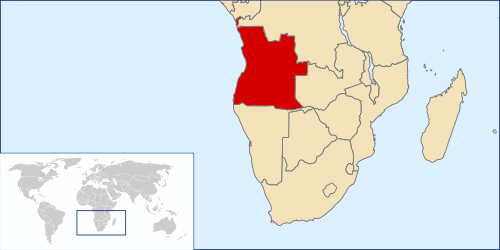
图:By Rei-artur pt en Rei-artur blog · CC BY-SA 3.0 · 维基共享资源
- 存在时间
- 1975 年 11 月 11 日—1992 年 8 月 25 日
- 首都
- 罗安达
- 政体
- 单一制
- 官方语言
- 葡萄牙语
- 后继
- 安哥拉
- 类型
- 历史国家
- 简述
- 历史上的国家
安哥拉人民共和国(葡萄牙语:República Popular de Angola)是安哥拉从1975年11月11日脱离葡萄牙独立开始,至1992年9月16日使用的国号。安哥拉人民共和国是一个社会主义国家,与苏联、古巴与莫桑比克人民共和国关系良好,由奉行马克思列宁主义且受苏联和古巴支持的安哥拉人民解放运动执政,反对派争取安哥拉彻底独立全国联盟则在美国与南非支持下与执政党展开内战。
1992年,安哥拉人民共和国改国名为“安哥拉共和国”。
正文摘自中文维基百科「安哥拉人民共和国」(删去了参考文献、表格和图片),按 CC BY-SA 4.0 使用
英文维基百科的更多内容
中文维基百科这一条比较短,下面是英文维基百科同一条目的节选,原文为英文,未翻译。
The People's Republic of Angola (Portuguese: República Popular de Angola) was declared on 11 November 1975 by leaders of the Popular Movement for the Liberation of Angola (MPLA), at the time a Marxist–Leninist organisation, as a communist state. The Angolan War of Independence from Portugal which had begun 14 years prior in 1961 ended with the Alvor Agreement, which granted independence to Angola under a transitional government that initially included groups such as the FNLA and UNITA along with the MPLA.
Disagreements between these factions resulted in civil war, which escalated following the MPLA's unilateral declaration of a people's republic in November; it competed with the rival Democratic People's Republic of Angola (UNITA), backed by South Africa and the United States, and received aid from Cuba and the Soviet Union, to which it was aligned to in the Cold War until its dissolution in 1991. The landmark Tripartite Accord of 1988 led to the withdrawal of South African and Cuban forces from Angola, and following the Bicesse Accords Angola transitioned into a multiparty democracy that was finalised with the adoption of a new constitution in 1992 while civil war between UNITA and MPLA forces continued until 2002.
History
War of Independence, 1961–1975
In 1961, the People's Movement for the Liberation of Angola (MPLA) and National Liberation Front of Angola (FNLA), based in neighbouring countries, launched a guerrilla campaign against Portuguese rule in Angola, in what was called the Overseas Province of Angola. In 1966, the National Union for the Total Independence of Angola (UNITA) joined the struggle for independence against Portugal. The MPLA was Marxist-Leninist and backed by both Cuba and the Soviet Union. UNITA was primarily backed by China. The war lasted until the overthrow of Portugal's Estado Novo regime in 1974 through the Carnation Revolution.
On 15 January 1975 the different parties signed the Alvor Accords. The agreement promised Angolan independence and elections for the National Assembly of Angola in October 1975. The agreement also called for the integration of the Angolan parties into a new unified Angolan military.
Civil War, 1975–1991
During the independence war, the three pro-independent groups sometimes fought each other, in addition to the Portuguese. Following the Alvor Accords, the relationship between these groups deteriorated further. In July 1975, the MPLA violently forced the FNLA out of Luanda, while UNITA voluntarily withdrew to its stronghold in the south. By August, the MPLA had conquered 11 of the 15 provincial capitals, including the capital city Luanda, and also the oil rich Cabinda, which was claimed by the separatist Front for the Liberation of the Enclave of Cabinda (FLEC). On October 23, South Africa launched Operation Savannah, with 2,000 soldiers crossing from Namibia in support of both the FNLA and UNITA. They quickly captured five provincial capitals from the MPLA. Zaire also intervened from the north against the MPLA in support of the FNLA. At the start of November, Cuba sent 4,000 soldiers in support of the MPLA as part of Operation Carlota.
On 11 November 1975, Agostinho Neto, the leader of the MPLA, declared Angola's independence as the People's Republic of Angola a one-party Marxist-Leninist state. In response, UNITA declared Angolan independence as the Social Democratic Republic of Angola in Huambo, while the FNLA declared the Democratic Republic of Angola based in Ambriz. FLEC declared the independence of the Republic of Cabinda. The FNLA and UNITA forged an alliance on 23 November 1975, proclaiming their own coalition government, the Democratic People's Republic of Angola, based in Huambo with FLNA's Holden Roberto and UNITA's Jonas Savimbi as co-presidents.
正文摘自英文维基百科(原文为英文,未翻译)「People's Republic of Angola」(节选,删去了参考文献、表格和图片),按 CC BY-SA 4.0 使用;在维基百科读全文 ›
同时期、同地区的政权