 史鉴
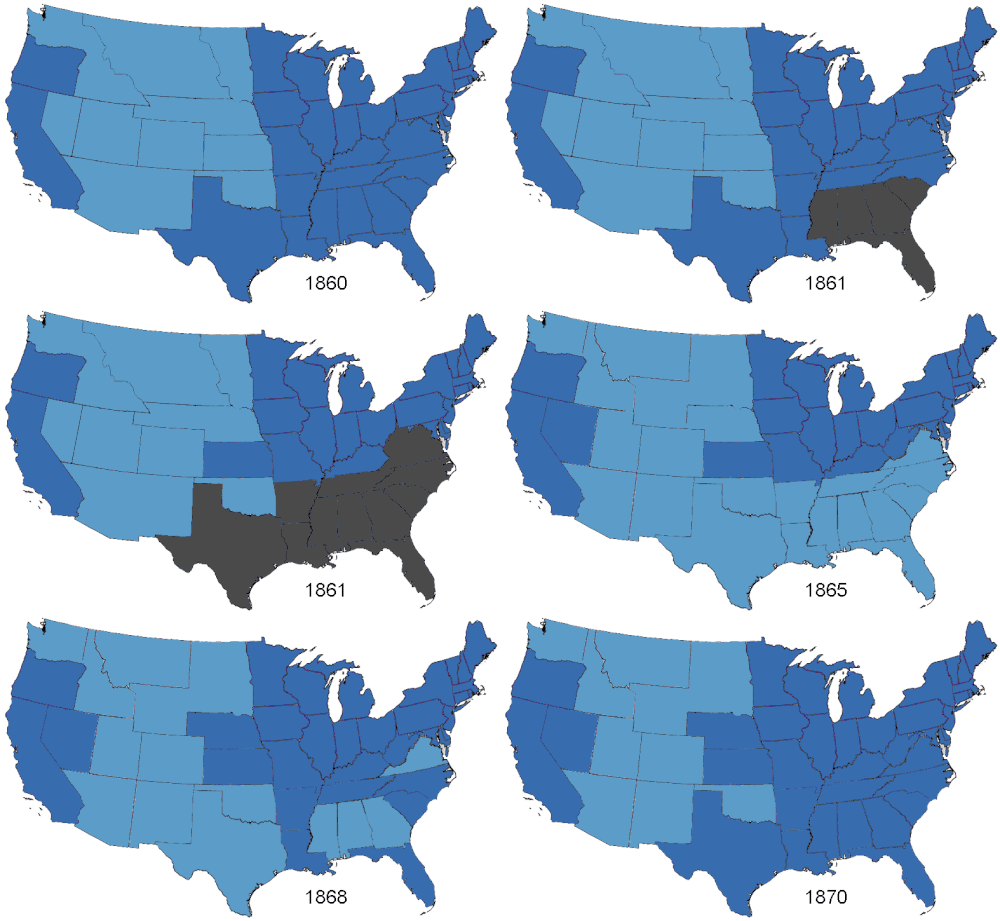
图:User:Roke~commonswiki · CC BY-SA 3.0 · 维基共享资源
- 存在时间
- 1861 年—1865 年
- 首都
- 华盛顿哥伦比亚特区
- 官方语言
- 英语
- 类型
- 共和立宪制、历史国家
- 所在大洲
- 北美洲
- 简述
- northern side in the American Civil War (1861-1865)
联邦(英语:Union),又称北方(the North),是美国南北战争(1861年—1865年)期间,常用于称呼北方美利坚合众国政府及其统治下各自由州、边境州和领地的一个政治术语。“联邦”这一称呼主要作为在历史研究和战争期间,相对于南方的美利坚联盟国(邦联)以示区别的一个常用称谓。
联邦的主要宗旨是支持联邦军击败和镇压南方各叛乱州,以及在内战后期提出解放南方全部奴隶的要求。
正文摘自中文维基百科「联邦 (南北战争)」(删去了参考文献、表格和图片),按 CC BY-SA 4.0 使用
英文维基百科的更多内容
中文维基百科这一条比较短,下面是英文维基百科同一条目的节选,原文为英文,未翻译。
The Union is a term used to refer to the federal government and loyal states of the United States during the American Civil War. Its military forces and civilian population resisted the secession of the Southern slave states that formed the Confederate States of America following the 1860 election of Abraham Lincoln as president of the United States. Lincoln's administration asserted the permanency of the federal government and the continuity of the United States Constitution, and it refused to recognize the Confederate government.
Many Americans in the 19th century commonly used the term "the Union" to mean either the federal government of the United States or the unity of the states within the federal constitutional framework. The Union can also refer to the people or territory of the states that remained loyal to the national government during the war. The loyal states located mostly north of the Mason–Dixon line were also known as the "North", although four southern border states and West Virginia, when it became a state during the war, remained loyal to the Union, and many Black Southerners (both free and enslaved) and Southern Unionists opposed secession and supported the Union war effort.
The Northeast and Midwest provided the industrial resources for a mechanized war, producing large quantities of munitions and supplies and financing the war. They also provided a vast majority of the Union Army soldiers, food, horses, financial support, and training camps. Army hospitals and prison camps were also set up across the Union. Most Northern states had Republican governors who supported the war effort and suppressed anti-war subversion.……
Etymology
In the context of the American Civil War, the Union, or the United States, is sometimes referred to as "the North", both then and now, while the Confederacy was often called "the South".
Size and strength
Compared to the Confederacy, the loyal states were more industrialized and urbanized and possessed more advanced commercial, transportation, and financial systems. Additionally, the Union states had a manpower advantage of five to two at the start of the war.
Public opinion
The attack on Fort Sumter rallied the free states to the defense of American nationalism. In 1959, Columbia University historian Allan Nevins wrote:
The thunderclap of Sumter produced a startling crystallization of Northern sentiment.... Anger swept the land.……
President Lincoln
Historians have overwhelmingly praised the "political genius" of Abraham Lincoln's performance as president. His first priority was military victory. This required that he master entirely new skills as a strategist and diplomat.……
Congress
The Republican Congress passed many major laws that reshaped the nation's economy, financial system, tax system, land system, and higher education system. These included the Morrill tariff, the Homestead Act, the Pacific Railroad Act, and the National Banking Act.……
Opposition
The opposition came from Copperhead Democrats, who were strongest in the Midwest and wanted to allow Confederate secession.……
Soldiers
Recruiting volunteers
Enthusiastic young men clamored to join the Union army in 1861. They came with family support for reasons of patriotism and excitement. Washington decided to keep the small regular army intact; it had only 16,000 men and was needed to guard the frontier.……
Economy
The Union economy grew and prospered during the war while fielding a very large army and navy.……
Financing the war
In 1860 the Treasury was a small operation that administered land sales and collected a low tariff. At the outbreak of war, the new Treasury Secretary, Salmon P.……
Society
Religion
The Protestant religion was quite strong in the Union in the 1860s. The United States Christian Commission sent agents into the Army camps to provide psychological support as well as books, newspapers, food and clothing.……
Methodists
Many Northerners had only recently become religious (following the Second Great Awakening) and religion was a powerful force in their lives.……
Unionists in Southern and Border states
People loyal to the U.S. federal government and opposed to secession living in the border states (where slavery was legal) and states under Confederate control, were termed Unionists. Confederates sometimes styled them "Homemade Yankees".……
Guerrilla warfare
Besides organized military conflict, the border states were beset by guerrilla warfare.……
Union states
Washington, D.C.
List of Wikipedia articles on Union states and major cities:
* Border states with slavery in 1861
†Had two state governments, one Unionist one Confederate, both claiming to be the legitimate government of their state.……
Union territories
The Union-controlled territories in April 1861 were:
正文摘自英文维基百科(原文为英文,未翻译)「Union (American Civil War)」(节选,删去了参考文献、表格和图片),按 CC BY-SA 4.0 使用;在维基百科读全文 ›
相关事件
- 南北战争1861 年 4 月 12 日—1865 年 4 月 9 日 · 战争 · 北美洲
- Battle of Barbourville1861 年 9 月 19 日 · 战役 · 北美洲
- 图佩罗之役1864 年 7 月 14 日—1864 年 7 月 15 日 · 战役 · 北美洲