史鉴
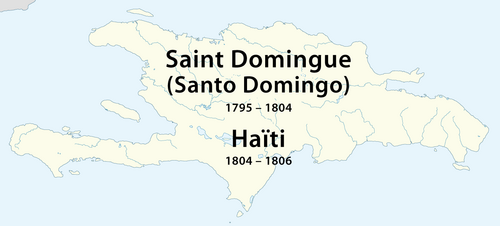
图:Maximilian Dörrbecker (Chumwa) · CC BY-SA 2.0 · 维基共享资源
- 存在时间
- 1804 年—1806 年
- 首都
- 太子港
- 政体
- 选举君主制
- 官方语言
- 法语、海地克里奥尔语
- 后继
- 海地国
- 类型
- 历史国家
- 简述
- 美洲国家
海地帝国,是海地在1804年脱离法国而独立建国、让-雅克·德萨林于同年9月22日称帝以后,所短暂建立的一个君主制国家。其君主由选举方式产生。让-雅克·德萨林自称皇帝雅克一世,10月6日加冕。1805年5月20日宪法所载帝国分成6个军事区,由皇帝任命长官,宪法还禁止所有的外国人在帝国拥有财产。
正文摘自中文维基百科「海地第一帝国」(删去了参考文献、表格和图片),按 CC BY-SA 4.0 使用
英文维基百科的更多内容
中文维基百科这一条比较短,下面是英文维基百科同一条目的节选,原文为英文,未翻译。
The First Empire of Haiti, officially known as the Empire of Haiti (French: Empire d'Haïti; Haitian Creole: Anpi an Ayiti), was an elective monarchy in North America. Haiti was controlled by France before declaring independence on 1 January 1804. The Governor-General of Haiti, Jean-Jacques Dessalines, created the empire on 22 September 1804. After being proclaimed emperor by the Generals of the Haitian Revolution Army, he held his coronation ceremony on 6 October and took the name Jacques I. The constitution of 20 May 1805 set out the way the empire was to be governed, with the country split into six military divisions. The general of each division corresponded directly with the emperor or the general in chief appointed by the emperor. The constitution also set out the succession to the throne, with the crown being elective and the reigning emperor having the power to appoint his successor. The constitution also banned white people, with the exception of naturalised Germans and Poles, from owning property inside the empire.
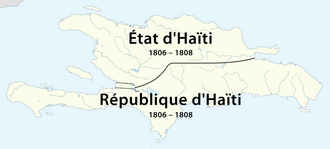
Jacques I was assassinated on 17 October 1806. Two members of his administration, Alexandre Pétion and Henri Christophe, then assumed power, which led to a split in the country – with Pétion leading the southern Republic of Haiti and Christophe leading the northern State of Haiti (later Kingdom of Haiti). Some 43 years later, President Faustin Soulouque established the Second Empire of Haiti, which lasted between 1849 and 1859.
History
Fearing the return of the French to the island, Dessalines and Henri Christophe built forts to fend them off.
On October 8, 1804, he was crowned Emperor under the name of Jacques I of Haiti, in Cap-Haïtien under the title His Majesty Jacques I, Emperor.
At the end of February 1805, Jean-Jacques Dessalines and his troops left in two directions: one part towards the north (Dajabón-Santiago-La Vega-Saint Domingue) commanded by Henri Christophe, and another towards the south (Hinche-San Juan de la Maguana-Azua-Baní-Saint-Domingue) commanded by Dessalines himself.
On February 25, 1805, Dessalines at the head of 30,000 men captured Santiago. On the southern road, the Haitian emperor realized that the inhabitants of San Juan de la Maguana and Baní had evacuated their city to protect themselves, so he reckoned that the indigenous population did not deserve his clemency. On March 6, while approaching the capital, he ordered to set fire to the city of San Carlos on the outskirts of Santo Domingo and to begin the siege of the city. On March 25, Dessalines ordered the total extermination of the white population under his control. These populations of white descent were then deported to the large cities of Haiti where they were killed in public places by being crushed (by horses or beasts of burden) and quartered.
Three days later, three frigates and two French brigantines arrived in Santo Domingo. Dessalines abandoned the siege of Santo Domingo and retreated to Haiti. In April 1805, Dessalines, Christophe and their troops razed Santiago, Moca, La Vega, Azua, San Juan de la Maguana, Baní, among others, and massacred the inhabitants who had not fled to the Central Cordillera. Approximately 10,000 people were thus killed. These massacres laid the foundation for two centuries of animosity between the two countries. On May 20, 1805, Dessalines adopted a new flag, as he changed the blue and red horizontal band that was used as the French tricolor into black and red vertical flag which has symbolized the strong ties to Africa between black (death) and red (freedom), which was later used by Henri Christophe in the Northern Kingdom of Haiti, when he proclaimed himself as Henri I: King of Haiti. 160 years later, the Haitian dictator François Duvalier (Papa Doc) became President for life of which he won 99% of the vote with a Legislature of 58 deputies throughout Haiti and returned to Dessalines' black and red design. They included the national coat of arms, but altered the flags in its trophy to black as well.
正文摘自英文维基百科(原文为英文,未翻译)「First Empire of Haiti」(节选,删去了参考文献、表格和图片),按 CC BY-SA 4.0 使用;在维基百科读全文 ›
相关事件
- 1804海地大屠杀1804 年 1 月—1804 年 4 月 22 日 · 屠杀与暗杀 · 拉丁美洲