史鉴
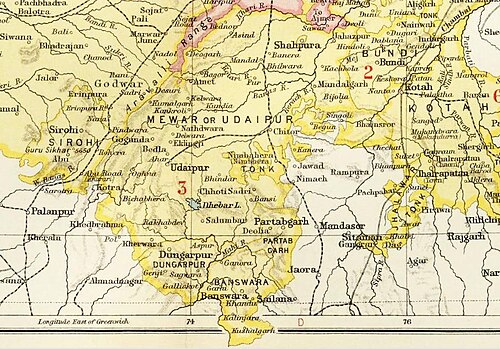
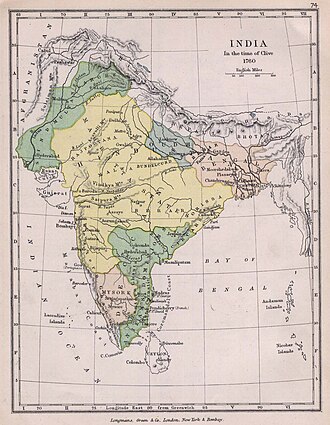
图:Great Britain India Office · Public domain · 维基共享资源
- 存在时间
- 1666 年 1 月 23 日—1949 年
- 首都
- 吉多尔格尔、乌代布尔
- 后继
- 印度
- 所属
- 梅瓦尔
- 类型
- 历史国家
- 所在大洲
- 亚洲
- 简述
- 印度历史土邦
乌代布尔土邦(英语:Udaipur State,印地语:उदयपुर रियासत),又称梅瓦尔土邦(英语:Mewar State,印地语:मेवाड़ राज्य),是印度历史上的一个土邦,统治今日拉贾斯坦邦一带。其统治者使用“玛哈拉纳”作为头衔,其在印地语中意思是“万王之王”。
乌代布尔土邦的历史可以追溯到728年左右。莫卧儿帝国崛起的时候入侵乌代布尔土邦。经过长期斗争,1615年乌代布尔土邦与莫卧儿帝国签订条约,莫卧儿帝国承认其半独立地位,乌代布尔土邦则向莫卧儿帝国进贡。1679年,马拉塔帝国侵入这片地区的时候,乌代布尔土邦与之抗争。1818年,乌代布尔土邦成为英国的保护国。
1947年印巴分治后,乌代布尔土邦加入印度。
正文摘自中文维基百科「乌代布尔土邦」(删去了参考文献、表格和图片),按 CC BY-SA 4.0 使用
英文维基百科的更多内容
中文维基百科这一条比较短,下面是英文维基百科同一条目的节选,原文为英文,未翻译。
The Kingdom of Mewar was an independent Hindu kingdom that existed in the Rajputana region of the Indian subcontinent and later became a dominant state in medieval India. The kingdom was initially founded and ruled by the Guhila dynasty, followed by its cadet branch, the Sisodia Dynasty.
The earliest kingdom was centered around the south-central part of Rajasthan, state of India. It was bordered by the Aravali Range to the northwest, Ajmer to the north, Gujarat, Vagad and Malwa regions to the south and the Hadoti region to the east.
Mewar rose to prominence in the reign of Bappa Rawal (7th century) known for his involvement in thwarting Arab incursions in India. Over time, it became vassal to Imperial Pratihara, Paramaras and then to Chahamanas. In the early 10th century, Mewar emerged as an independent state, actively battling neighboring powers and confronting the expansion of Delhi Sultanate until the fall of its capital Chittorgarh in 1303 against the latter, leading to the annihilation of Guhila Dynasty.
The Sisodia dynasty, a junior branch of Guhilas, re-occupied Mewar in 1326, ushering in a golden age characterized by military prowess and territorial expansion. Under the reigns of Maharana Kumbha and his grandson Maharana Sanga, Mewar achieved victories against Islamic States of Malwa, Gujarat, and Delhi particularly in Mewar-Malwa conflicts and Mewar- Delhi conflicts. It also successfully fought off and vassalized neighboring Hindu kingdoms. At its zenith under Rana Sanga, it controlled large parts of Northern India. After Rana Sanga's death, the kingdom declined rapidly. Nonetheless, it continued to resist Mughal expansion, most notably under Maharana Pratap, later it became a tributary state with a significant degree of autonomy.……
Geography
Mewar is surrounded by the Aravali Range to the northwest, Ajmer to the north, and Gujarat, Vagad, and Malwa to the south, with the Hadoti region to the east. The area features mountainous hills, plateaus, and rivers such as Banas, Som, and Sabarmati, along with dry deciduous forests that are denser during the monsoon months. The central plains, watered by the Banas River and its tributaries, are highly cultivated, with black, light loamy soil supporting crops like cotton, maize, sugarcane, wheat, and barley, suitable for both Kharif and Rabi seasons. The average height of these plains is about 600 ft. MSL. This geography has allowed Mewar to maintain its freedom and resist imperial powers, making it favourable for guerrilla warfare. The boundaries of Mewar largely remained consistent except from 1326 to 1533, during which time the kingdom more or less extended from near Mandu(capital of Malwa Sultanate) in the south to Bayana in the north-east, reaching into desert areas towards the Indus River in the west. Thus, controlling large parts of Northern India.……
History
Early History of Mewar
Less is known about the origins of the Kingdom of Mewar. It was originally ruled by the Guhila dynasty. Guhadatta is considered the first ruler of the kingdom in the 7th century. In the early 8th century, it came under the sub ordinance of the regional Mori rulers. The kingdom under Bappa Rawal acquired control of Chittor in 728 after taking it away from its Mori overlords. Nagda was the capital of Mewar around this period.
Bappa Rawal defeated an early Arab Caliphate invasion of India through a confederation with Gurjar-Pratihara ruler Nagabhata I. Bappa Rawals successors, namely Khuman II would continue to resist Arab incursions into the country.
The Guhilas from the 8th century acknowledged the suzerainty of the Gurjara-Pratiharas. In the 10th century, Bharttripatta II became an independent ruler and broke ties with the Pratihara empire and assumed the title Maharajadhiraja. His successor Allata killed Devapala, the ruler of the Gurjara Pratihara at that time.
The Guhilas was controlled by the Kingdom of Malwa in the 11th century and by the Chahamanas in the 12th century.……
Imperial Mewar
Early Expansion and consolidation
Following Alauddin Khalji's invasion in 1303, the Guhila Dynasty ceased to exist.……
正文摘自英文维基百科(原文为英文,未翻译)「Kingdom of Mewar」(节选,删去了参考文献、表格和图片),按 CC BY-SA 4.0 使用;在维基百科读全文 ›
人物
同时期、同地区的政权