史鉴
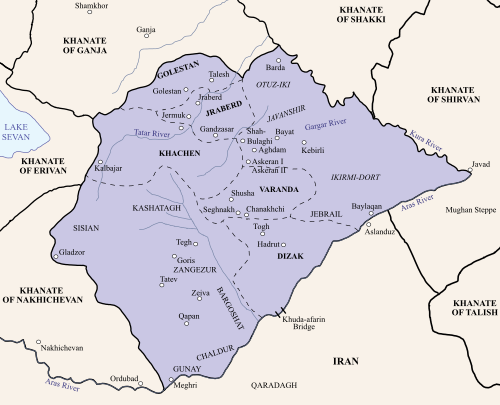
图:HistoryofIran · CC BY-SA 4.0 · 维基共享资源
- 存在时间
- 1748 年—1822 年
- 首都
- 舒沙、沙阿布拉格城堡、舒沙城堡、巴亚特城堡
- 政体
- 绝对君主制、absolutism
- 官方语言
- 波斯语
- 货币
- Abbasi
- 类型
- 汗国、历史国家
- 所在大洲
- 亚洲
- 简述
- a khanate that existed in 1748–1822
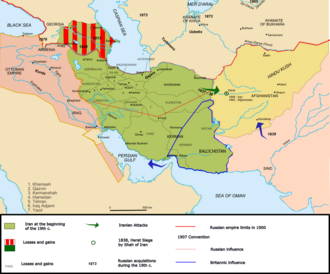
卡拉巴赫汗国(波斯语:خانات قرهباغ,阿塞拜疆语:Qarabağ xanlığı)是一个半独立的突厥汗国,位于今天的亚美尼亚和阿塞拜疆,该国约成立于1748年,当时为伊朗的附属国。卡拉巴赫汗国的半独立地位一直持续至1806年,当时俄罗斯-波斯战争爆发,俄罗斯帝国从伊朗手中取得对卡拉巴赫汗国的控制权。1813年,俄罗斯沙皇亚历山大一世与卡扎尔王朝君主法特赫-阿里沙·卡扎尔签订《古利斯坦条约》,伊朗正式将卡拉巴赫汗国割让给俄罗斯 。1822年,卡拉巴赫汗国被废除,成为俄罗斯领土上的一部分。
正文摘自中文维基百科「卡拉巴赫汗国」(删去了参考文献、表格和图片),按 CC BY-SA 4.0 使用
英文维基百科的更多内容
中文维基百科这一条比较短,下面是英文维基百科同一条目的节选,原文为英文,未翻译。
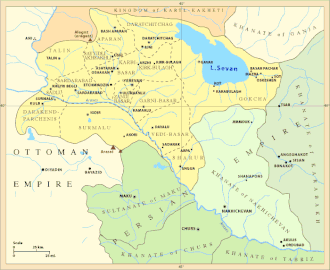
The Karabakh Khanate (also spelled Qarabagh; Persian: خانات قرهباغ, romanized: Khānāt-e Qarabāgh; Russian: Карабахское ханство, romanized: Karabakhskoye khanstvo) was a khanate under Iranian and later Russian suzerainty, which controlled the historical region of Karabakh, now divided between modern-day Armenia and Azerbaijan. In terms of structure, the Karabakh Khanate was a miniature version of Iranian kingship. The administrative and literary language in Karabakh until the end of the 19th century was Persian, with Arabic being used only for religious studies, despite the fact that most of the Muslims in the region spoke a Turkic dialect.
It was governed by members of the Javanshir, a Turkic tribe which lived in the lowlands of the region. In 1747, the Javanshir chieftain Panah Ali Khan capitalized on the turmoil that erupted after the death of the Iranian shah (king) Nader Shah (r. 1736–1747) by seizing most of Karabakh. The following year he declared his allegiance to Nader Shah's son and successor Adel Shah (r. 1747–1748), who officially appointed him khan of Karabakh. Panah Ali Khan's tenure was marked by building activities (such as the castles of Bayat, Shah-Bulaghi, and Panahabad) and the subjugation of four of the melikdoms through the assistance of his new ally, Shahnazar II, the melik (prince) of Varanda.
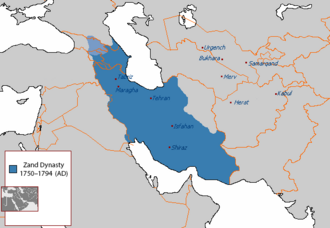
In 1762, Panah Ali Khan acknowledged the authority of the Zand ruler Karim Khan Zand (r. 1751–1779), who had established his authority in most of Iran. The latter took Panah Ali Khan hostage to Shiraz and appointed his son Ibrahim Khalil Khan as the new khan.……
Background
Karabakh is a historic region located in the Armenian highlands in the South Caucasus. The area was originally considered the southern part of Arran and was mostly inhabited by Armenians.……
History
Panah Ali Khan
Following Nader Shah's assassination in 1747, Iran fell into turmoil, especially in the South Caucasus. There the Georgians and local khans fought over land. Some Turkic tribes took advantage of his death by restoring their power in Iranian Armenia.……
Building activity
According to Mirza Jamal Javanshir, Bayat received many new settlers (including artisans) from nearby areas, including Ardabil and Tabriz. The Iranian American historian George Bournoutian stated this passage shows that Javanshirs tribal dominion included more than just pastoral or migratory land.……
Coinage
Following the establishment of the Iranian rial currency in 1790, the ten-shahi stopped being used. It was later re-established by Ibrahim Khalil Khan, being minted in silver at Shusha under the name of panahabadi in honor of Panah Ali Khan.……
Demographics
In the mahals
According to a survey conducted by the Russian Empire in 1823, the mahals (districts) of Karabakh was composed of 17,101 families of villagers and nomads. Its inhabitants were either classified as Tatars, Armenians, or nomads.……
Shusha
According to the 1823 Russian survey, 371 families were registered as living in Shusha's three-quarters.……
Revenue
Taxes were paid yearly in one single payment by the inhabitants of Shusha. The Armenian quarters were required to pay the most, providing 590 gold rubles and 200 kharvars ("donkey's load") of firewood every year. The Muslim quarter were required to pay 200 gold rubles and 60 kharvars of firewood.
Administration
Karabakh was a province of an imperial structure that was entirely Iranian, in the same fashion as other provinces such as Lorestan and Khorasan. In terms of structure, the Karabakh Khanate was a miniature version of Iranian kingship.……
Historiography
In contemporary historiography
The political history of Iran under the Safavid, Afsharid, Zand, or Qajar dynasties is the main subject of the majority of Iranian primary sources.……
In Azerbaijani historiography
The khanates, which were marginalized in Soviet historiography as remnants of an archaic feudal institution, have been revived in post-Soviet Azerbaijani historiography.……
正文摘自英文维基百科(原文为英文,未翻译)「Karabakh Khanate」(节选,删去了参考文献、表格和图片),按 CC BY-SA 4.0 使用;在维基百科读全文 ›
人物
同时期、同地区的政权