史鉴

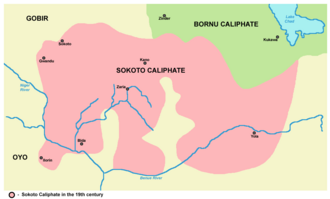
图:Anasskoko · CC BY-SA 4.0 · 维基共享资源
- 存在时间
- 9 世纪—1808 年 (Wikidata 的日期只记到世纪,非确切年份)
- 后继
- 索科托哈里发国
- 类型
- 历史国家、组
- 所在大洲
- 非洲
- 简述
- former country
豪萨城邦,又称豪萨诸王国、豪萨兰,是指11世纪—13世纪豪萨人建立的一系列城邦,这些城邦位于尼日尔河和乍得湖之间,即现今尼日利亚北部和尼日尔南部。这些城邦完全独立,并没有形成统一的国家。16世纪后,共有7个城邦被视为豪萨城邦。7个豪萨城邦虽然有着相同的血统、语言和文化,但各邦之间的关系并不友好。这些城邦互相交战,甚至和外来侵略者合作打击其他城邦。 19世纪中叶,豪萨城邦被富拉尼帝国统一。
正文摘自中文维基百科「豪萨城邦」(删去了参考文献、表格和图片),按 CC BY-SA 4.0 使用
英文维基百科的更多内容
中文维基百科这一条比较短,下面是英文维基百科同一条目的节选,原文为英文,未翻译。
The Hausa Kingdoms (Masarautun Hausa), also known as Hausaland (Kasar Hausa), were a collection of states ruled by the Hausa people, before the Fulani jihads. They were situated between the Niger River and Lake Chad (modern day northern Nigeria). Hausaland lay between the Western Sudanic empires of Ancient Ghana, Mali and Songhai and the Eastern Sudanic empire of Kanem-Bornu.
Hausa oral traditions detail the Bayajidda legend, which describes the adventures of the Baghdadi hero, Bayajidda, culminating in the killing of the snake in a well at Daura and his marriage to the local queen Magajiya Daurama. According to the legend, Bayajidda's descendants founded the Hausa Bakwai (seven "true" states), as well as the Hausa Banza ("bastard" or "illegitimate" states).
Mythology
According to the Bayajidda legend, the Hausa states were founded by the sons and grandsons of Bayajidda, a prince of Baghdad who married Daurama, the last Kabara of Daura, and heralded the end of the matriarchal monarchs that had erstwhile ruled the Hausa people. According to the legend, Bayajidda travelled through Bornu, arriving at Daura, where he went to the house of an old woman called Waira and asked her to give him water but she told him the predicament of the land, how the only well in Daura, called Kusugu, was inhabited by a snake called Sarki, who allowed citizens of Daura to fetch water only on Fridays. Since sarki is the Hausa word for "king", this may have been a metaphor for a powerful figure. Bayajidda killed Sarki and because of what he had done the queen married him for his bravery. After his marriage to Daurama the people started to call him Bayajidda which means "he didn't understand (the language) before".
Hausa Bakwai
The Hausa Bakwai were the seven "true" states (birane) that all Hausa people are said to derive from.……
History
Origins and rise
Hausa oral traditions hold that settlements were first established where iskoki (nature spirits) were found. Hausaland had great agricultural potential, and early positions of authority related to control of the land, fostered by kinship relations. Hausa chiefs were either family heads (gidaje) or religious officials tasked with rituals intended to ensure agricultural prosperity (sarkin noma; "kings of farming"). The date of the foundation of the Hausa kingdoms is unknown, however urbanisation in northern Nigeria led to the formation of states, with fortified capital cities becoming centres of power and rule. The kingdoms controlled trade in the region, and were possibly first mentioned by Ya'qubi in the 9th century. Hausa traders founded quarters (sabon gari) in various places, building an elaborate and efficient trading network. Civilians would sometimes follow their armies as traders or to provide services, and settle abroad, contributing to the diaspora.
Government
Fulani pastoralists and foreign Islamic clerics were permitted to control their own administration under the supervision of the sarki (king).
Culture and society
Ideals on social order were based on kinship, and foreign civilians were incorporated into the system by intermarriage, social reclassification, or were granted special privileges. Commerce between the states facilitated a common Hausa language, without mutually unintelligible dialects. Despite the conversion of rulers to Islam, many commoners continued to practice their traditional religion, or syncretised it with Islam, which was considered acceptable up until the Fula jihads in the 19th century. Commoners (talakawa) comprised units of farms operated by two or more families (gandu) which were headed by a legal representative (maigida). The maigida administered the unit and was tasked with reconciling disputes and ritualistic roles in ceremonies. New gandu were set up by a father adding to their son's land, to eventually be recognised as a distinct unit for tax purposes.……
正文摘自英文维基百科(原文为英文,未翻译)「Hausa Kingdoms」(节选,删去了参考文献、表格和图片),按 CC BY-SA 4.0 使用;在维基百科读全文 ›
前后承接的政权
同时期、同地区的政权