史鉴
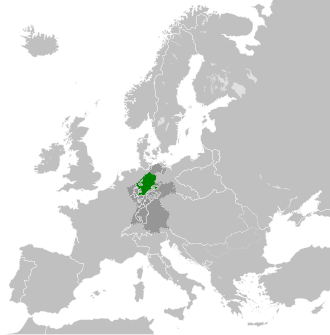
图:TRAJAN 117 · CC BY-SA 3.0 · 维基共享资源
- 存在时间
- 1807 年—1813 年
- 首都
- 卡塞尔
- 政体
- 君主制
- 宗教
- 天主教会
- 货币
- Westphalian thaler、威斯特法伦法郎
- 前身
- Electorate of Hesse
- 元首
- 热罗姆·波拿巴
- 类型
- 历史国家
- 所在大洲
- 欧洲
- 下辖
- Department of Aller、Department of the Elbe、Department of the Elbe and Weser Estuaries、Department of Fulda、Department of the Lower Elbe、Department of the Leine、奥克省、Department of the Saale、Department of the Werra、Department of the Weser、Department of the Harz
- 简述
- former country during Napoleon era (1807-1813)
威斯特法伦王国是一个1807年-1813年间在现时德国境内存在的国家。虽然官方上威斯特法伦是一个独立王国,但实际上却是法国的附庸国,由拿破仑的弟弟热罗姆·波拿巴统治。虽然王国有“威斯特法伦”一词,但王国只拥有这地区的一小部分。
威斯特法伦王国是由公元1807年普鲁士王国于提尔西特条约中割让的领土、马德堡公国、前汉诺威选候国、不伦瑞克-吕讷堡公国和黑森等选候国所组成。王国的首都是卡塞尔,国王居住于威廉高地王宫,入住后改名为拿破仑高地王宫。王国亦是莱茵邦联的一员。
为了成为拿破仑的“模范国家”,政府重新编写了一部宪法,而且进行了一连串的社会改革,包括取消农奴制、容许私人企业、推行拿破仑法典、以及度量衡改为公制等等。在拿破仑征服之前,言论自由仍然受到剥削、而且政府亦有一套审查制度监察人民。而王国必须向拿破仑提供士兵和财政支援以协助战争,因此造成了很大的经济负担。
公元1813年9月俄军哥萨克骑兵包围卡塞尔,完全击溃法军并重夺该城。10月1日哥萨克骑兵完全征服了整个王国,但三日后国王热罗姆·波拿巴带领法军回归,并预备重夺卡塞尔。接着黑森-卡塞尔选帝侯威廉一世很快到达,而哥萨克骑兵亦再次围困该城。随着拿破仑1813年10月19日在莱比锡战役中的失败,俄军宣布王国瓦解,而且回复至1806年时的状态。
详细介绍
国徽
王国的国徽反映了各被合并的领土。左上角展示了象征威斯特法伦的银色马;右上角的三只黑森狮子象征迪茨、尼达与卡岑奈伦博根三县;左下角展示象征着新规划,并未正式命名、马德堡附近一带的地区;而右下角则象征布伦瑞克、迪普霍尔茨、吕讷堡和罗德堡四城。
在盾的四周是威斯特法伦的王冠和代表法国的大鹰。上方是代表拿破仑的一颗星。交叉的权杖是拿破仑纹章的特征。
其他连结
- 威斯特法伦王国
- 2008年黑森国家展览
正文摘自中文维基百科「威斯特法伦王国」(删去了参考文献、表格和图片),按 CC BY-SA 4.0 使用
英文维基百科的更多内容
中文维基百科这一条比较短,下面是英文维基百科同一条目的节选,原文为英文,未翻译。
The Kingdom of Westphalia was a client state of France in present-day Germany that existed from 1807 to 1813. While formally independent, it was ruled by Napoleon's brother Jérôme Bonaparte. It was named after Westphalia, but this was a misnomer since the kingdom had little territory in common with that area. The region mostly covered territory formerly known as Eastphalia.
Napoleon imposed the first written modern constitution in Germany, a French-style central administration, and agricultural reform. The kingdom liberated the serfs and gave everyone equal rights and the right to a jury trial. In 1808 the kingdom passed Germany's first laws granting Jews equal rights, thereby providing a model for reform in the other German states. Westphalia seemed to be progressive in immediately enacting and enforcing the new reforms.
The country was relatively poor but Napoleon demanded heavy taxes and payments and conscripted soldiers. Few of the men who marched into Russia with Napoleon in 1812 returned. The kingdom was bankrupt by 1812. When Napoleon was retreating in the face of Allied advances in 1813, the kingdom was overrun by the Allies and (in 1815) most of its territories became Prussian. Most of the reforms, however, remained in place.
Formation
The Kingdom of Westphalia was created by Napoleon in 1807 by merging territories ceded by the Kingdom of Prussia in the Peace of Tilsit (including the Altmark, the part of the Duchy of Magdeburg west of the Elbe river, Paderborn, Hildesheim), the territories of Hanover, Brunswick-Wolfenbüttel, and the Electorate of Hesse.……
Territory
On its creation, the Kingdom of Westphalia comprised the following territories:
The Electorate of Hesse-Cassel, with Schaumburg, excluding Hanau, Schmalkalden and Catzenellnbogen;
The principalities of Brunswick-Wolfenbüttel, Hildesheim, Halberstadt, Quedlinbourg, Osnabrück, Paderborn and Minden;
The counties of Mansfeld, Stolberg, Ravensberg, Rietberg and Hohnstein;
The cities of Halle, Goslar, Mühlhausen and Nordhausen;
Jews
Following the French example, Jewish congregations in the Kingdom of Westphalia were reorganised under a central administrative body, and a Royal Westphalian Consistory of the Israelites was established to supervise Jewish religious life. The Brunswick-Wolfenbüttel court financier and reformer Israel Jacobson was appointed president of the consistory, assisted by a governing board. Jacobson sought to promote religious reform among Jewish communities in the kingdom.……
Downfall
A significant burden on the kingdom was the requirement to supply troops and financial support for the Napoleonic Wars. A Westphalian contingent took part in the Russian campaign of 1812. King Jérôme initially had a key role as the commander of the right wing for the invasion, but was reprimanded by Napoleon for his poor performance at the Battle of Smolensk, so he abandoned his command and returned to Westphalia.……
Coat of arms
The arms reflect the incorporated territories. The first quarter shows the silver horse of Westphalia; the second the lion of Hesse over the counties of Dietz, Nidda, Ziegenhain and Katzenelnbogen; the third was newly designed for non-specified territories around Magdeburg; and the fourth combined Brunswick, Diepholz, Lüneburg and Lauterburg.Around the shield are the Order of the Crown of Westphalia and the French Grand Aigle of the Légion d'honneur.……
Flag
In 1808, court architect Peter Joseph Krahe produced a design for a flag to be flown at the ducal palace in Braunschweig that depicts a white–blue field with royal emblems, offering contemporary evidence that Westphalia used white and blue as state colours—at least for official building display. The draft describes the flag as being identical to the royal flag, but without the imperial eagle.
正文摘自英文维基百科(原文为英文,未翻译)「Kingdom of Westphalia」(节选,删去了参考文献、表格和图片),按 CC BY-SA 4.0 使用;在维基百科读全文 ›
相关事件
- 巴利斯战役1809 年 2 月 25 日 · 战役 · 欧洲
- 格夫雷斯战役1809 年 7 月 8 日 · 战役 · 欧洲
- Battle of Majadahonda1812 年 8 月 11 日 · 战役 · 欧洲
人物

同时期、同地区的政权