史鉴
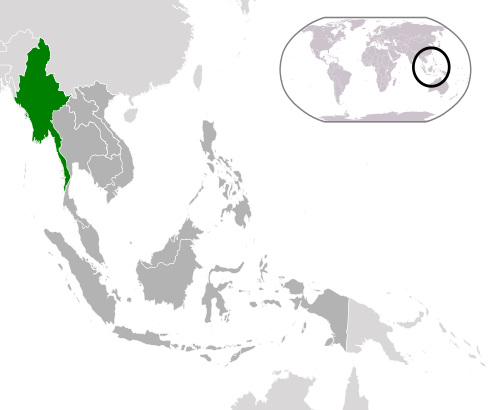
图:ASDFGHJ · Public domain · 维基共享资源
- 存在时间
- 1962 年—1988 年
- 首都
- 仰光
- 政体
- 一党制
- 前身
- Union of Burma
- 后继
- 缅甸、Burma/Myanmar under the State Peace and Development Council
- 类型
- 历史国家
- 所在大洲
- 亚洲
- 简述
- 历史国家
缅甸在1962年—1988年处于奈温的军事独裁统治之下。奈温及其在缅甸军方的盟友于1962年3月2日发动政变推翻了吴努总理领导的政府。政变后一天,政变者成立联邦革命委员会作为该国的执政机构。1962年4月,革命委员会创造“缅甸式社会主义”概念,并宣布其为缅甸的国家意识形态。1962年7月4日,革命委员会成立了缅甸社会主义纲领党作为该国的执政党和唯一合法政党。1974年,奈温颁布新宪法,用纲领党成员组成的人民议会取代革命委员会,将国名由“缅甸联邦”改为“缅甸联邦社会主义共和国”。
奈温治理缅甸的特点是极权主义、孤立主义、迷信、仇外和对冷战政治的拒绝。奈温以独裁者的身份统治缅甸,同时担任革命委员会主席(后改任缅甸总统)和缅甸总理。对主要行业的国有化和对外国投资的拒绝导致经济增长和生活水平急剧下降。
1988年,爆发被称为8888起义的大规模抗议活动,迫使包括奈温在内的纲领党官员集体辞职并实行多党制。1988年9月18日,缅甸军方发动政变推翻纲领党,并用武力结束了抗议活动,建立了一个新的军事政权,即国家恢复法律和秩序委员会。
正文摘自中文维基百科「缅甸联邦社会主义共和国」(删去了参考文献、表格和图片),按 CC BY-SA 4.0 使用
英文维基百科的更多内容
中文维基百科这一条比较短,下面是英文维基百科同一条目的节选,原文为英文,未翻译。
The Socialist Republic of the Union of Burma was a socialist country from 1974 to 1988, under the leadership of Ne Win, among other leaders, and the Burma Socialist Programme Party (BSPP). However, Burma was also a military dictatorship, under the control of Ne Win from 1962 to 1988. Ne Win and his allies in the Tatmadaw – the country's armed forces – overthrew the government of Prime Minister U Nu in a coup d'état on 2 March 1962. A day later, the coup leaders established the Revolutionary Council of the Union of Burma as the country's governing body. In April 1962, the Revolutionary Council introduced the Burmese Way to Socialism and declared it Burma's state ideology. The Revolutionary Council then founded the BSPP as the country's vanguard party on 4 July 1962. In 1974, Ne Win introduced a new constitution and replaced the Revolutionary Council with the Pyithu Hluttaw, which consisted solely of BSPP members. The country's official name was also changed from the Union of Burma to the Socialist Republic of the Union of Burma. The Communist Party of Burma which opposed Ne Win called it Ne Win-San Yu military regime.
Ne Win's governance of Burma was characterised by totalitarianism, isolationism, superstition (yadaya), xenophobia, and a rejection of Cold War politics. Ne Win ruled Burma as a dictator, serving as both Chairman of the Revolutionary Council (later President of Burma) and Prime Minister of Burma, the country's head of state and head of government, respectively. The nationalisation of major industries and rejection of foreign investment led to catastrophic declines in economic growth and living standards.
In 1988, mass protests known as the 8888 Uprising pressured BSPP officials, including Ne Win, to resign en masse and adopt a multi-party system.……
Background
Burma under Prime Minister U Nu and the AFPFL-led coalition government in the Union Parliament had implemented left-wing economic and welfare policies, although economic growth remained slow throughout the 1950s. By 1958, Burma was largely beginning to recover economically, but was beginning to fall apart politically due to a split in the ruling AFPFL into two factions: the Clean AFPFL led by U Nu and Thakin Tin, and the Stable AFPFL led by Ba Swe and Kyaw Nyein. This situation persisted despite the unexpected success of U Nu's "Arms for Democracy" offer taken up by U Seinda in the Arakan, the Pa-O, some Mon and Shan groups, but more significantly by the PVO surrendering their arms. The Union Parliament became very unstable, with U Nu barely surviving a no-confidence vote only with the support of the opposition National United Front (NUF), believed to have crypto-communists amongst them.……
History
1962 Burmese coup d'état
The elected civilian government had lost most of its legitimacy by 1962; the Burmese public perceived it as corrupt, inept at ruling the country, and unable to restore law and order. Meanwhile, the Tatmadaw rose in popularity thanks to the stability created by Ne Win's caretaker government. Burma also faced various economic, religious, and political crises, particularly the ethnic-based insurgencies in the country's peripheries and the issues of federalism and separatism. Less than two years after returning to civilian rule, Ne Win launched a second military-backed coup d'état on 2 March 1962, this time without U Nu's blessing.
The coup succeeded with little bloodshed and its instigators established the Revolutionary Council of the Union of Burma to replace the Union Parliament as Burma's supreme governing body. In April 1962, the Revolutionary Council declared Burma a socialist state and announced the "Burmese Way to Socialism" as a blueprint for economic development, decreasing foreign influence in Burma to zero per cent, and increasing the role of the military in politics.……
正文摘自英文维基百科(原文为英文,未翻译)「Socialist Republic of the Union of Burma」(节选,删去了参考文献、表格和图片),按 CC BY-SA 4.0 使用;在维基百科读全文 ›