史鉴
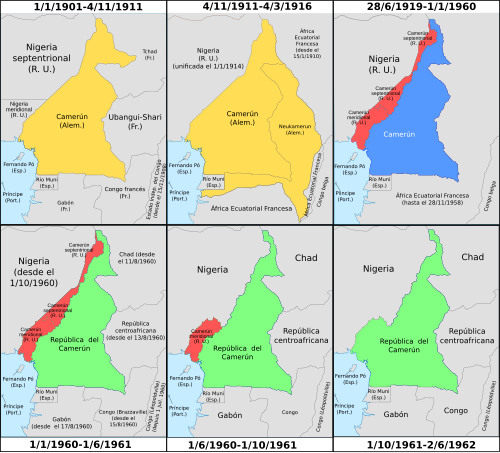
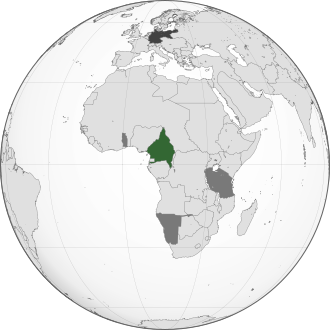
图:Cameroon boundary changes-fr.svg: Augusta 89 derivative work: rowanwindwhistler · CC BY-SA 4.0 · 维基共享资源
- 存在时间
- 1919 年 6 月 28 日—1961 年 10 月 1 日
- 首都
- 布埃亚
- 政体
- 国际联盟托管地
- 官方语言
- 英语
- 宗教
- 伊斯兰教、基督教
- 货币
- 英属西非英镑
- 前身
- 德属喀麦隆
- 后继
- Federal Republic of Cameroon、尼日利亚、Federal Republic of Cameroon
- 所属
- 大英帝国、英属西非
- 类型
- 国际联盟托管地、联合国托管领土、历史国家
- 所在大洲
- 非洲
- 简述
- former British mandate territory in West Africa
英属喀麦隆(英语:British Cameroons)是第一次世界大战之后国际联盟托管给大英帝国的西非托管地。英属喀麦隆在1961年被一分为二,北部地区划入独立的尼日利亚,南部地区划入中部非洲的喀麦隆共和国。
详细介绍
历史
19世纪末欧洲列强瓜分非洲,现今之喀麦隆领土所辖地区在当时成为德国殖民地,即德属喀麦隆。第一次世界大战期间,德属喀麦隆被英军、法军和比利时军占领,德国战败后,于1922年由国际联盟决策,将之划为托管地,分为法属喀麦隆和英属喀麦隆。英属喀麦隆又分为北喀麦隆和南喀麦隆,前者由两块独立的飞地组成。二战期间,当地约40万原住民中只有3,500人选择参加英军。
1960年1月,法属喀麦隆独立为喀麦隆共和国,尼日利亚也随后独立。1961年2月11日,英属喀麦隆举行公投,北部以穆斯林为主的地区决定加入尼日利亚,而南部地区则投票加入喀麦隆共和国。北喀麦隆在1961年5月31日正式加入尼日利亚,南喀麦隆在10月1日加入喀麦隆共和国。
正文摘自中文维基百科「英属喀麦隆」(删去了参考文献、表格和图片),按 CC BY-SA 4.0 使用
英文维基百科的更多内容
中文维基百科这一条比较短,下面是英文维基百科同一条目的节选,原文为英文,未翻译。
British Cameroons or British Cameroon was a British mandate territory in British West Africa, formed of the Northern Cameroons and Southern Cameroons. Today, the Northern Cameroons forms parts of the Borno, Adamawa and Taraba states of Nigeria, while the Southern Cameroons forms part of the Northwest and Southwest regions of Cameroon.
History
The area of present-day Cameroon was claimed by Germany as a protectorate during the "Scramble for Africa" at the end of the 19th century. The German Empire named the territory Kamerun. During World War I, French and British troops invaded the German colony Kamerun (Present day Cameroon) and decided to divide the German colony into two regions. One of the regions would be French administered (French Cameroon) and the other would be British administered (British Cameroons). The British were more concerned with other areas of Africa, specifically Nigeria. Thus, the French gained a larger portion of Cameroon when the country was divided.
League of Nations mandate
During World War I, it was occupied by British, French and Belgian troops, and a later League of Nations mandate to Great Britain and France by the League of Nations in 1922. The French mandate was known as Cameroun and the British territory was administered as two areas, Northern Cameroons and Southern Cameroons. Northern Cameroons consisted of two non-contiguous sections, divided by a point where the Nigerian and Cameroun borders met. In the 1930s, most of the white population consisted of Germans, who were interned in British camps starting in June 1940. The native population of 400,000 showed little interest in volunteering for the British forces; only 3,500 men did so.
Trust territory
When the League of Nations ceased to exist in 1946, most of the mandate territories were reclassified as United Nations trust territories, henceforth administered through the United Nations Trusteeship Council. The object of trusteeship was to prepare the lands for eventual independence. The United Nations approved the Trusteeship Agreements for British Cameroons to be governed by Britain on 6 December 1946.
Colonial legacy
Under colonial rule, Cameroons was ruled on the basis of indirect rule which allowed natives to execute judicial and executive decisions. The British in Cameroons used indirect rule because it meant that Cameroonians would comply willingly rather than having to coercively force compliance. This was important because it gave citizens of British Cameroons autonomy and helped to establish “a greater vitality of local political institutions in West Cameroon”. Despite the indirect rule used to invigorate the spirit of citizens, the British found that they had to "approach various developmental programs" because "there was little involvement of the local people in planning and executing community development programmes."
正文摘自英文维基百科(原文为英文,未翻译)「British Cameroons」(节选,删去了参考文献、表格和图片),按 CC BY-SA 4.0 使用;在维基百科读全文 ›
前后承接的政权
同时期、同地区的政权