史鉴

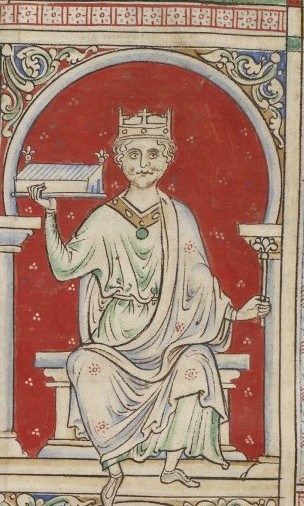
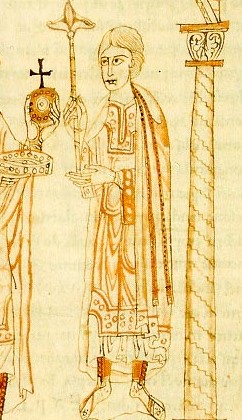
图:佚名 · Public domain · 维基共享资源
- 生卒
- 1071 年 10 月 22 日—1126 年 2 月 10 日 (日期为儒略历)
- 去世地
- 普瓦捷
- 国籍 / 所属
- 阿基坦公国
- 身份
- 作家、作曲家、诗人、游吟诗人、战士
- 父亲
- 威廉八世
- 母亲
- 希尔德加德 (勃艮第)
- 配偶
- 图卢兹女伯爵菲利帕、安茹的艾尔门加德
- 子女
- 阿格尼丝、普瓦捷的雷蒙、威廉十世 (阿基坦公爵)、Henry of Poitiers
- 参与
- Battle of Cutanda
- 代表作
- Lyrical poems
- 原文名
- Guilhem IX d'Aquitania
- 家族
- 普瓦捷王朝
- 流派 / 运动
- 中世纪音乐、troubadoric poetry
- 简述
- Duke of Aquitaine and Gascony and Count of Poitou
威廉九世(法语:Guillaume IX,1071年10月22日—1127年2月10日),亚奎丹公爵,1086年至1127年在位。
详细介绍
家庭
1088年左右,威廉九世与安茹的艾尔门加德结婚,两人没有子女。
1094年左右,威廉九世与吐鲁斯的菲莉琶结婚,两人共有2子1女:
威廉十世(1099年—1137年)
雷蒙(约1099年—1149年)
阿格尼丝(约1105年—约1159年)
正文摘自中文维基百科「威廉九世 (亚奎丹)」(删去了参考文献、表格和图片),按 CC BY-SA 4.0 使用
英文维基百科的更多内容
中文维基百科这一条比较短,下面是英文维基百科同一条目的节选,原文为英文,未翻译。
William IX (Occitan: Guilhèm de Peitieus or Guilhem de Poitou, French: Guillaume de Poitiers; called the Troubadour; 22 October 1071 – 10 February 1126) was the Duke of Aquitaine and Gascony and Count of Poitou between 1086 and his death. He was also one of the leaders of the Crusade of 1101.
Though his political and military achievements have a certain historical importance, he is best known as the earliest troubadour—a vernacular lyric poet in the Occitan language—by whom some work survives.
Ducal career
William was the son of William VIII of Aquitaine by his third wife, Hildegarde of Burgundy. His birth was a cause of great celebration at the Aquitanian court, but the Church at first considered him illegitimate because of his father's earlier divorces and his parents' consanguinity. This obliged his father to make a pilgrimage to Rome soon after his birth to seek Papal approval of his third marriage and the young William's legitimacy.
Early career, 1088–1102
William inherited the duchy at the age of fifteen upon the death of his father. It has been generally believed that he was first married in 1088, at age sixteen, to Ermengarde, daughter of Fulk IV of Anjou. Biographers have described Ermengarde as beautiful and well educated, though suffering from severe mood swings. However, Ruth Harvey's 1993 critical investigation shows the assumption of William's marriage to Ermengarde to be based largely on an error in a nineteenth-century secondary source and it is highly likely that Philippa of Toulouse was William's only wife. William married Philippa in 1094.
William invited Pope Urban II to spend the Christmas of 1095 at his court. The pope urged him to "take the cross" (i.e.……
Poetic career
William's greatest legacy to history was not as a warrior but as a troubadour—a lyric poet employing the Romance vernacular language called Occitan, or formerly Provençal.
He was the earliest troubadour whose work survives. Eleven of his songs survive (Merwin, 2002). The song traditionally numbered as the eighth (Farai chansoneta nueva) is of dubious attribution, since its style and language are significantly different (Pasero 1973, Bond 1982). Song 5 (Farai un vers, pos mi sonelh) has two significantly different versions in different manuscripts. The songs are attributed to him under his title as Count of Poitou (lo coms de Peitieus). The topics vary, treating sex, love, women, his own sexual and literary prowess, and feudal politics.
An anonymous 13th-century vida of William remembers him thus:
The Count of Poitiers was one of the most courtly men in the world and one of the greatest deceivers of women. He was a fine knight at arms, liberal in his womanizing, and a fine composer and singer of songs. He traveled much through the world, seducing women.
It is possible, however, that at least in part it is not based on facts, but on literal interpretation of his songs, written in first person; in Song 5, for example, he describes how he deceived two women.
Family
In 1094, William married Philippa, the daughter and heiress of William IV of Toulouse. According to the Chronicle of Saint-Maixent, William and Philippa had two sons and five daughters, although it does not name them. His eldest son was his eventual successor, William X. His second son, Raymond, eventually became the Prince of Antioch in the Holy Land. A daughter, Agnes, married, firstly, Aimery V of Thouars, and then King Ramiro II of Aragon.
Armenian sources, Basil the Doctor and Gregory the Priest, imply that Baldwin of Marash was a son of William and Philippa, born shortly before the latter's retirement to a convent in 1114. Alternatively, he may have been an illegitimate son. Michael the Syrian reports that Reynald, Baldwin's successor as lord of Marash, was his brother.
正文摘自英文维基百科(原文为英文,未翻译)「William IX of Aquitaine」(节选,删去了参考文献、表格和图片),按 CC BY-SA 4.0 使用;在维基百科读全文 ›
参与的事件
- Battle of Cutanda1120 年 6 月 17 日 · 战役 · 欧洲
亲属
所属政权
同时代、同地区的人物