史鉴
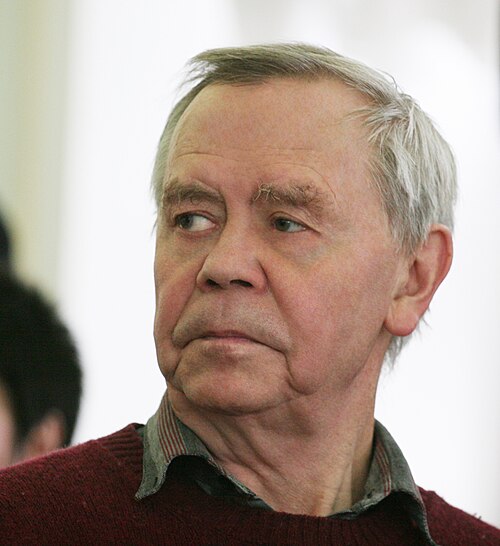
图:Александр Стручков · CC BY-SA 3.0 · 维基共享资源
- 生卒
- 1937 年 3 月 15 日—2015 年 3 月 14 日
- 出生地
- Ust'-Uda
- 去世地
- 莫斯科
- 国籍 / 所属
- 俄罗斯、苏联
- 身份
- 作家、政治人物、公众人物、新闻工作者、舆论记者、小说家、短篇故事作家
- 代表作
- Farewell to Matyora
- 原文名
- Валентин Распутин
- 就读
- 伊尔库茨克国立大学
- 所属组织
- 苏联作家协会
- 领域
- 政治、新闻学、舆论新闻业、creative and professional writing
- 简述
- 苏联/俄罗斯作家(1937-2015)
瓦连京·格里戈里耶维奇·拉斯普京(俄语:Валенти́н Григо́рьевич Распу́тин,1937年3月15日—2015年3月14日)是已故著名苏联及俄罗斯作家,被视为俄罗斯乡村文学及战争文学的代表,曾两度荣获苏联国家奖。2015年3月,拉斯普京因病陷入昏迷后不治死亡。
正文摘自中文维基百科「瓦连京·拉斯普京」(删去了参考文献、表格和图片),按 CC BY-SA 4.0 使用
英文维基百科的更多内容
中文维基百科这一条比较短,下面是英文维基百科同一条目的节选,原文为英文,未翻译。
Valentin Grigoryevich Rasputin (; Russian: Валентин Григорьевич Распутин; 15 March 1937 – 14 March 2015) was a Soviet and Russian writer. He was born and lived much of his life in the Irkutsk Oblast in Eastern Siberia. Rasputin's works depict rootless urban characters and the fight for survival of centuries-old traditional rural ways of life, addressing complex questions of ethics and spiritual revival.
Biography
Valentin Rasputin was born in the village of Ust-Uda in East Siberian Oblast. His father, Grigory Rasputin, worked for a village cooperative store, and his mother was a nurse. Soon after his birth the Rasputin family moved to the village of Atalanka in the same Ust-Udinsky District, where Rasputin spent his childhood.
Both villages, then located on the banks of the Angara River, do not exist in their original locations any more, as the Bratsk Reservoir flooded much of the Angara Valley in the 1960s, and the villages were relocated to higher ground. Later, the writer remembered growing up in Siberia as a difficult, but happy time: "As soon as we kids learned how to walk, we would toddle to the river with our fishing rods;……
Rasputin's writing
Rasputin is closely associated with a movement in post-war Soviet literature known as Village Prose (деревенская проза). Beginning in the time of the Khrushchev Thaw (оттепель), village prose was praised for its stylistic and thematic departures from socialist realism. Village prose works usually focused on the hardships of the Soviet peasantry, espoused an idealized picture of traditional village life, and implicitly or explicitly criticized official modernization projects. Rasputin's 1979 novel Farewell to Matyora, which depicts a fictional Siberian village which is to be evacuated and cleared so that a hydroelectric dam can be constructed further down the Angara River, was considered the epitome of this genre.……
Political views
By the end of perestroika Rasputin became publicly active. He criticized Mikhail Gorbachev's reforms from patriotic and nationalistic positions. His repetition (at the 1st Congress of People's Deputies of the Soviet Union) of Stolypin's statement "You need great upheavals. We need a great country" («Вам нужны великие потрясения. Нам нужна великая страна») made it a phrase commonly used by the anti-liberal opposition.
He also signed several open letters, most notably the "Letter of Russian Writers" (also known as the "Letter of the Seventy-Four") addressed to the President and the Supreme Soviet of the Soviet Union and published in the Literary Newspaper and Nash Sovremennik in 1990.……
Awards
USSR State Prize, 1977. The prize was awarded for his novel To Live and Remember, the protagonist of which was a deserter during the war.
Order of Lenin, 1984
UNEP Global 500 Roll of Honour, 1988.
Solzhenitsyn Prize, 2000
Adaptations
1969 — Rudolfio, dir. Dinara Asanova — story of the same name
1978 — French Lessons, dir. Yevgeny Tashkov — story of the same name
1979 — Money for Maria, dir. György Lengyel (Hungary) — story of the same name
1980 — The Last Frontier, dir. Timo Bergholm (Finland) — novel The Last Term
1980 — Meeting, dir. Alexander Itygilov — story of the same name
1980 — Selling Bear Fur, dir. Alexander Itygilov — story of the same name
1981 — Farewell, dir. Elem Klimov — novel Farewell to Matyora
1983 — We Live and Love from the Special Case anthology, dir. Valery Pendrakovsky — story of the same name
1981 — Vasily and Vasilisa, dir. Irina Poplavskaya — story of the same name
1985 — Money for Maria, dir. Vladimir Andreev, Viktor Khramov — story of the same name
1987 — Farewell, Little Island, dir. Sándor Reisenbüchler (Hungary) — novel Farewell to Matyora
正文摘自英文维基百科(原文为英文,未翻译)「Valentin Rasputin」(节选,删去了参考文献、表格和图片),按 CC BY-SA 4.0 使用;在维基百科读全文 ›
所属政权

同时代、同地区的人物




同时代、同身份的人物(帝王与政治)