史鉴
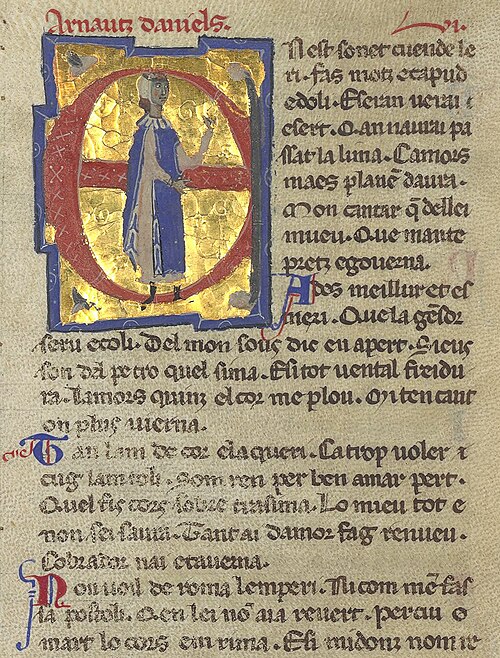
图:佚名 · Public domain · 维基共享资源
- 生卒
- 1150 年—1210 年
- 出生地
- 里贝拉克
- 去世地
- 里贝拉克
- 国籍 / 所属
- 法兰西王国
- 身份
- 作家、作曲家、诗人、游吟诗人
- 代表作
- Lyrical poems
- 流派 / 运动
- 中世纪音乐、troubadoric poetry
- 简述
- Occitan troubadour
阿尔诺·达尼埃尔(奥克语:Arnaut Daniel)是12世纪的奥克(西班牙、法国、意大利一带)游吟诗人。他的作品被意大利诗人但丁称赞为“最佳手艺家”;被意大利学者彼特拉克称赞为“无上爱情大师”;被美国诗人艾兹拉·庞德在其作品《The Spirit of Romance》中称赞为“最伟大的诗人”。
正文摘自中文维基百科「阿尔诺·达尼埃尔」(删去了参考文献、表格和图片),按 CC BY-SA 4.0 使用
英文维基百科的更多内容
中文维基百科这一条比较短,下面是英文维基百科同一条目的节选,原文为英文,未翻译。
Arnaut Daniel (Occitan: [aɾˈnawd daniˈɛl]; fl. 1180–1200) was an Occitan troubadour of the 12th century, praised by Dante as "the better craftsman" (miglior fabbro) and called a "grand master of love" (gran maestro d'amore) by Petrarch. In the 20th century he was lauded by Ezra Pound in The Spirit of Romance (1910) as the greatest poet to have ever lived.
Life
According to one biography, Daniel was born of a noble family at the castle of Ribérac in Périgord; however, the scant contemporary sources point to him being a jester with pernicious economic troubles: Raimon de Durfort calls him "a student, ruined by dice and shut-the-box". His Vida, preserved in Troubadour Manuscript B, is as follows:
Arnautz Daniels si fo d’aquella encontrada don fo Arnautz de Maroill, de l’evescat de Peiregos, d’un chastel que a nom Ribairac, et fo gentils hom. Et amparet ben letras e deleitet se en trobar et en caras rimas, per que las soas chanssons non son leus ad entendre ni ad aprendre.Et amet una auta dompna de Gascoigna, moiller d’En Guillem de Buonvila, mas non fo crezut qez anc la dompna li fezes plazer en dreich d’amor. Per que el ditz: Eu sui Arnautz q’amas l’aura e caz la lebre ab lo boue nadi contra suberna.
"And Arnaut Daniel was from those areas from which was Arnautz de Maroill, of the bishopric of Peiregos, of a castle known by the name of Ribairac, and he was a gentleman. And he learned well how to read and write, enjoyed himself in 'trobar' in precious rhymes, and his songs are not easy to understand nor to learn.……
Work and style
The dominant characteristic of Daniel's poetry is an extreme obscurity of thought and expression, a style called trobar clus ('hermetic verse'). He belonged to one school of troubadour poets that sought to make their meanings difficult to understand through the use of unfamiliar words and expressions, enigmatical allusions, complicated meters and uncommon rhyme schemes. Daniel further invented a form of stanza in which no lines rhymed with each other, finding their rhymes only in the corresponding line of the next stanza.
Daniel was the inventor of the sestina, a song of six stanzas of six lines each, with the same end words repeated in every stanza, though arranged in a different and intricate order. Henry Wadsworth Longfellow claims he was also the author of the metrical romance of Lancillotto, or Lancelot of the Lake, but this claim is completely unsubstantiated; Dante's reference to Daniel as the author of prose di romanzi ("proses of romance") thus remains a mystery. There are sixteen extant lyrics of Arnaut Daniel only one of which can be accurately dated, to 1181.……
Legacy
Daniel's attempt to avoid simple and commonplace expressions in favor of striving for newer and more subtle effects found an admirer in Dante who would imitate the sestina's form in more than one song. Petrarch also wrote several sestinas as the form later gained popularity with Italian poets.
In Dante's Divine Comedy, Arnaut Daniel appears as a character doing penance in Purgatory for lust. He responds in Old Occitan to the narrator's question about who he is:
Tan m'abellis vostre cortes deman,
qu'ieu no me puesc ni voill a vos cobrire.
Ieu sui Arnaut, que plor e vau cantan;
consiros vei la passada folor,
e vei jausen lo joi qu'esper, denan.
- Ara vos prec, per aquella valor
- que vos guida al som de l'escalina,
sovenha vos a temps de ma dolor.
(Purg., XXVI, 140–147)
- Translation:
- "Your courteous question pleases me so,
that I cannot and will not hide from you.
I am Arnaut, who weeping and singing go;
Contrite I see the folly of the past,
And, joyous, I foresee the joy I hope for one day.
- Therefore do I implore you, by that power
- Which guides you to the summit of the stairs,
- Remember my suffering, in the right time."
正文摘自英文维基百科(原文为英文,未翻译)「Arnaut Daniel」(节选,删去了参考文献、表格和图片),按 CC BY-SA 4.0 使用;在维基百科读全文 ›
所属政权

同时代、同地区的人物