史鉴
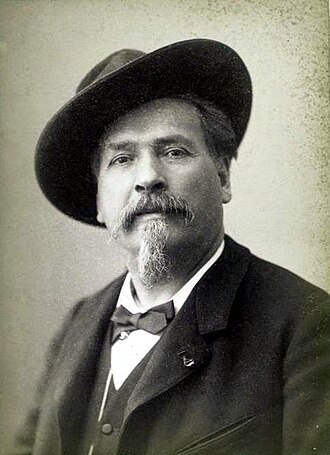
图:Tucker Collection · Public domain · 维基共享资源
- 生卒
- 1830 年 9 月 8 日—1914 年 3 月 25 日
- 出生地
- 马亚讷
- 去世地
- 马亚讷
- 国籍 / 所属
- 法国
- 身份
- 作家、诗人、词典编纂者
- 职位
- 总统、Capoulié of the Félibrige、'majoral' of the Félibrige
- 父亲
- François Mistral
- 母亲
- Adélaïde Mistral
- 配偶
- Marie Mistral
- 子女
- Marius Ferréol
- 参与
- 费利布里日协会、阿拉坦博物馆、Congress of Aix-en-Provence
- 代表作
- Mirèio、Lou Tresor dóu Felibrige、Lou Pouèmo dóu Rose、Calendau、Lis Isclo d'Or
- 受影响于
- Antoine Blaise Crousillat
- 本名
- Joseph Étienne Frédéric Mistral
- 原文名
- Frederi Mistral
- 别号
- Homer of Provenc
- 就读
- Aix-Marseille University (1896-1971)
- 所属组织
- 马赛学区、Celtic dinner、Académie des sciences, agriculture, arts et belles-lettres d'Aix、Société littéraire et scientifique de Castres
- 领域
- 文学、translation from Latin
- 流派 / 运动
- 费利布里日协会
- 简述
- 作家, 法国
弗雷德里克·米斯特拉尔(法语:Frédéric Mistral,1830年9月8日—1914年3月25日),法国诗人,曾带领19世纪奥克语(普罗旺斯语)文学复兴。他在1904年与何塞·埃切加赖共同获得诺贝尔文学奖。他是都德的好友,都德在年轻时代就结识了他,并为他写了一篇名叫《诗人米斯特拉尔》的散文,收在《磨坊信札》之中。
米斯特拉尔从诗歌创作和语言整理两方面,投身于恢复和发扬普罗旺斯语的工作。一八五四年,米斯特拉尔和罗曼尼等七位普罗旺期的热心研究者发起成立“菲利伯立格”协会,该协会专门推广、宣传及研究普罗旺斯的语言、风俗和文化等内容。同时,米斯特拉尔还参加《普罗旺斯诗选》的编辑工作。在搜集整理大量当地的民间传说、神话故事、风土人情、语言历史等资料的基础上,米斯特拉尔皓首穷经,花费八年时间编纂了《新普罗旺斯字典》,这部字典不仅是记录普罗旺斯的宝藏,而且为奥克语建立起不朽的纪念碑。米斯特拉尔对普罗旺斯文化的贡献,不仅在于他发掘、整理了普罗旺斯方言、传统,更在于他用普罗旺斯语写作的诗歌,把这种方言提高到文学语言层次,以艺术形式把普罗旺斯文化广播欧洲。
详细介绍
主要作品
参与编辑的诗选及字典:
《普罗旺斯诗选》--作家参与该诗选的编辑工作。
《新普罗旺斯字典》--作家花费八年时间编纂该字典。
诗作:
〈普罗旺斯〉--长诗,作家的处女作。
〈黄金岛〉、〈金黄色的百合花〉等抒情诗。
〈米赫尔〉、〈罗纳河之歌〉等长篇叙事诗。
作品的中译
诺贝尔文学奖全集编译委员会/编译,《边尔森(1903)/米斯特拉尔(1904)》,台北市:九华文化,1980年。
正文摘自中文维基百科「弗雷德里克·米斯特拉尔」(删去了参考文献、表格和图片),按 CC BY-SA 4.0 使用
英文维基百科的更多内容
中文维基百科这一条比较短,下面是英文维基百科同一条目的节选,原文为英文,未翻译。
Joseph Étienne Frédéric Mistral (French: [mistʁal]; Occitan: Josèp Estève Frederic Mistral, 8 September 1830 – 25 March 1914) was an Occitan writer and lexicographer of the Provençal form of the language. He received the 1904 Nobel Prize in Literature "in recognition of the fresh originality and true inspiration of his poetic production, which faithfully reflects the natural scenery and native spirit of his people, and, in addition, his significant work as a Provençal philologist". Mistral was a founding member of the Félibrige and member of the Académie de Marseille.
His name in his native language was Frederi Mistral (Mistrau) according to the Mistralian orthography, or Frederic Mistral (or Mistrau) according to the classical orthography.
Mistral's fame was owing in part to Alphonse de Lamartine who sang his praises in the 40th edition of his periodical Cours familier de littérature, following the publication of Mistral's long poem Mirèio. Alphonse Daudet, with whom he maintained a long friendship, eulogized him in "Poet Mistral", one of the stories in his collection Letters from My Windmill (Lettres de mon moulin).
Biography
Mistral was born in Maillane in the Bouches-du-Rhône department in Southern France. His parents were wealthy landed farmers. His father, François Mistral, was from Saint-Rémy-de-Provence. His mother was Adelaide Poulinet. As early as 1471, his paternal ancestor, Mermet Mistral, lived in Maillane. By 1588, the Mistral family lived in Saint-Rémy-de-Provence.
Félibrige
Mistral joined forces with one of his teachers, Joseph Roumanille, and five other Provençal poets and on 21 May 1854, they founded Félibrige, a literary and cultural association, which made it possible to promote the Occitan language. Placed under the patronage of Saint Estelle, the movement also welcomed Catalan poets from Spain, driven out by Isabelle II.
The seven founders of the organization were (to use their Provençal names): Jóusè Roumaniho, Frederi Mistral, Teodor Aubanel, Ansèume Matiéu, Jan Brunet, Anfos Tavan and Paul Giera.……
Lexicography: Lou Tresor dóu Felibrige
Mistral is the author of Lou Tresor dóu Félibrige (1878–1886), which to date remains the most comprehensive dictionary of the Occitan language, and one of the most reliable, thanks to the precision of its definitions. It is a bilingual dictionary, Occitan-French, in two large volumes, with all of the dialects of oc, including Provençal. Mistral owes to François Vidal the work of typesetting and revising that dictionary.
Mirèio – Mireille
Mistral's most important work is Mirèio (Mireille), published in 1859, after eight years of effort. Mirèio, a long poem in Provençal consisting of twelve songs, tells of the thwarted love of Vincent and Mireille, two young Provençal people of different social backgrounds. The name Mireille (Mirèio in Provence) is a doublet of the word meraviho which means wonder.
Mistral used the occasion not only to promote his language but also to share the culture of an area.……
Works
Mirèio (1859) - PDF (in Provençal)
- Calendau (1867) - online
- Lis Isclo d’or (1875) - en ligne : part I, part II
- Nerto, short story (1884) - online
- La Rèino Jano, drama (1890) - en ligne
- Lou Pouèmo dóu Rose (1897) - online
Moun espelido, Memòri e Raconte (Mes mémoires) (1906) - online
- Discours e dicho (1906) - online
- La Genèsi, traducho en prouvençau (1910) - online
- Lis óulivado (1912) - online
Lou Tresor dóu Felibrige ou Dictionnaire provençal-français embrassant les divers dialectes de la langue d'oc moderne (1878–1886) - online
Proso d’Armana (posthume) (1926, 1927, 1930) - online
Coupo Santo (1867)
正文摘自英文维基百科(原文为英文,未翻译)「Frédéric Mistral」(节选,删去了参考文献、表格和图片),按 CC BY-SA 4.0 使用;在维基百科读全文 ›
受其影响的人物

同时代、同地区的人物




同时代、同身份的人物(文学)