史鉴
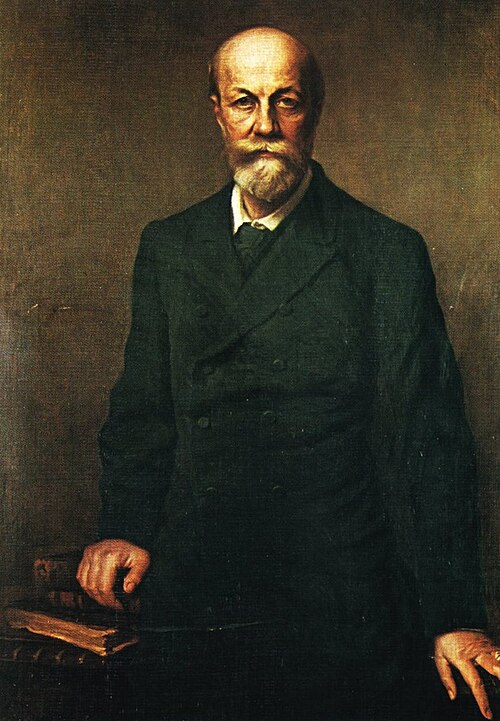
图:Ede Balló · Public domain · 维基共享资源
- 生卒
- 1825 年 2 月 18 日—1904 年 5 月 5 日
- 出生地
- 科马尔诺
- 去世地
- 布达佩斯
- 国籍 / 所属
- 匈牙利
- 身份
- 作家、政治人物、法学家、剧作家、新闻工作者
- 职位
- 匈牙利国会议员、Member of the House of Magnates
- 配偶
- 拉博尔法尔维·罗佐、Bella Nagy
- 子女
- Róza Jókai
- 代表作
- The Man with the Golden Touch
- 本名
- Ásvay Jókay Móric
- 原文名
- Jókai Mór
- 就读
- Grammar School of Pápa Reformed College
- 所属组织
- 匈牙利科学院
- 简述
- 作品 阿奥菲
约卡伊·莫尔(匈牙利语:Jókai Mór,1825年2月18日—1904年5月5日),19世纪匈牙利最重要的小说家。他是个多产作家,1894-1898年间出版的文集就多达100卷,大量的新闻作品尚不计在内。其早年作品如《工作日》(Hétköznapok,1845),流露出法国浪漫主义的影响,但是,一些成熟的小说却更反映出现实和个人经历。《一个匈牙利富豪》(Egy magyar nábob,1853-1854)和《金人》(Az arany ember,1873),是他处理当代匈牙利题材的两部最主要的小说。
约卡伊是匈牙利戏剧家,小说家和革命家。他是1848年在佩斯的匈牙利自由革命爆发中的积极参与者和领导人物。约卡伊的浪漫小说在维多利亚时代的英国精英中非常受欢迎,他经常在19世纪的英国媒体中与狄更斯相提并论。他最着名的粉丝和崇拜者之一是维多利亚女王本人。
正文摘自中文维基百科「约卡伊·莫尔」(删去了参考文献、表格和图片),按 CC BY-SA 4.0 使用
英文维基百科的更多内容
中文维基百科这一条比较短,下面是英文维基百科同一条目的节选,原文为英文,未翻译。
Móricz Jókay of Ásva [ˈmoːr ˈjoːkɒi] (18 February 1825 – 5 May 1904), known as Mór Jókai, was a Hungarian novelist, dramatist and revolutionary. Outside of Hungary, he was also known as Maurice Jókai or Maurus Jókai or Mauritius Jókai. He was a leader of the outbreak of the Hungarian Revolution of 1848 in Pest. His romantic novels became widely popular among the elite of Victorian England, where he was often compared to Charles Dickens by the press. One of his most famous admirers was Queen Victoria herself.
Early life
He was born in Komárom in the Kingdom of Hungary to József Jókai of Ásva (1781–1837), a member of the Ásva branch of the ancient Jókay noble family; his mother was noblewoman Mária Pulay (1790–1856). As a boy, he was timid and his health delicate, so he was educated at home until the age of ten, when he was sent to Pozsony (today Bratislava, Slovakia). He then attended the Calvinist college of Pápa (Pápai Református Kollégium), where he first met Sándor Petőfi and Sándor Kozma.
When Jókai was twelve, his father died.……
Career
Jókai was bored by his work as a lawyer, and he was encouraged in his art by the praise the Hungarian Academy of Sciences gave his first play (Hungarian: Zsidó fiú, lit. 'Jewish Boy'). In 1845, he moved to Pest where Petőfi introduced him to literary circles. Within the year his first noted novel (Hungarian: Hétköznapok, lit. 'Working Days') was published as a serial by Pesti Divatlap, followed by a hardcover edition in 1846. It was received with widespread critical acclaim.……
Writings
Jókai was an extremely prolific writer, especially after 1870. He devoted most of his time to literature. Among the finest of his later works are Az arany ember ('A Man of Gold', translated into English under the title The Man with the Golden Touch), the most popular A kőszívű ember fiai (The Heartless Man's Sons), the heroic chronicle of the Hungarian Revolution of 1848, and A tengerszemű hölgy (Eyes like the Sea), the latter of which won the Hungarian Academy's prize in 1890.
Collected editions
Collections of his works:
Összes művei. Nemzeti (Jubileumi) Kiadás. (Complete Works, "National Edition") 1894-1898, 100 vols.
Hátrahagyott művei. (Late and Uncollected Works; the Sequel of the "National Edition") 1912, 10 vols.
Összes művei. Centenáriumi kiadás. (Complete Works, "Centenary Edition") 1925-1932, 100 vols.
Összes művei. Kritikai kiadás. (Complete Works, "Critical Edition") 1962-, in advance.
Works
Translated into English
Collections of short stories
Hungarian Sketches in Peace and War (Hungarian: Forradalmi- és csataképek, lit. 'Images of Revolution and Battle'), 1854. A selection translated by Imre Szabad.
Novels
Midst the Wild Carpathians (Hungarian: Erdély aranykora, lit. 'The Golden Age of Transylvania'), 1852. Transl. by R. Nisbet Bain in 1894, and again under the title The Golden Age in Transylvania by T. László Palotás in 2022.
The Slaves of the Padishah (Hungarian: Török világ Magyarországon, lit. 'Turkish World in Hungary'), 1852. Transl. by R. Nisbet Bain in 1902.
Selected filmography
The Hungarian Nabob, directed by Travers Vale (1915, based on the novel Egy magyar nábob)
Az aranyember, directed by Alexander Korda (1918, based on the novel The Man with the Golden Touch)
White Rose, directed by Alexander Korda (1919, based on the novel A fehér rózsa)
The Gypsy Baron, directed by Frederic Zelnik (1927, based on the operetta The Gypsy Baron)
The Gypsy Baron, directed by Karl Hartl (1935, based on the operetta The Gypsy Baron)
Az aranyember, directed by Béla Gaál (1936, based on the novel The Man with the Golden Touch)
Honors
On 1 February 1925, three stamps were issued by Hungary in his honor.
正文摘自英文维基百科(原文为英文,未翻译)「Mór Jókai」(节选,删去了参考文献、表格和图片),按 CC BY-SA 4.0 使用;在维基百科读全文 ›
同时代、同地区的人物




同时代、同身份的人物(帝王与政治)