史鉴
详细介绍
生平
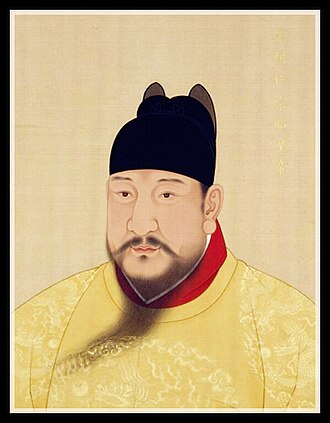
明升1366年继其父明玉珍为大夏皇帝,改元开熙,时明升年仅10岁,其母彭太后摄政。明太祖朱元璋北伐成功后,遣使命明升归降,遭到明升拒绝,洪武四年(1371年),明军由汤和、傅友德率领攻破重庆,明升出降,大夏国灭亡。同年,明太祖制授明升为归义侯,赐冠带衣服及居第于京师。
洪武五年(1372年),明升全家被明太祖流放至高丽,受恭愍王礼遇。权知朝鲜国事李成桂封为华蜀君,享受“忠勋世禄”,定居开城兴国寺。彭氏去世后,安葬在松都万寿山的肃陵,并建有祠宇。
明玉珍家族一行来到高丽后,备受礼遇,高丽恭愍王把延安、白川两县作为贡物,供奉给明升一家,并将位于松都(现朝鲜开城)北部梨井里的兴国寺提供给他们作为邸宅,配以奴婢。明氏一家在高丽定居后,明升娶总郎尹熙王之女尹氏为妻,生四男。长子仪,资宪公、资宪大夫;次子伣,总郎公、嘉靖大夫;三子俊,副使公、嘉靖大夫;四儿子信,侍郎公、通训大夫。
后世为朝鲜望族。现今有4万多明氏后裔在大韩民国,两万多在朝鲜民主主义人民共和国,他是延安明氏、西蜀明氏与南原升氏的始祖。而在中国境内的后人多改为甘姓。
妻子
- 王皇后
- 郡夫人尹氏,坡平尹氏总郎尹熙王之女
正文摘自中文维基百科「明升」(删去了参考文献、表格和图片),按 CC BY-SA 4.0 使用
英文维基百科的更多内容
中文维基百科这一条比较短,下面是英文维基百科同一条目的节选,原文为英文,未翻译。
Ming Sheng (simplified Chinese: 明升; traditional Chinese: 明昇; pinyin: Míng Shēng; b. 1356) was the second emperor of Ming Xia. His father, Ming Yuzhen, was a leader of the Red Turban Rebellions and the founder of Ming Xia, a dynasty located in Sichuan. He was later exiled to Korea, where he was known as Myŏng Sŭng (Korean: 명승).
Life
Ming Sheng's father, Ming Yuzhen, died in 1366. He had possibly been killed by his younger brother, who was in turn killed by Ming Sheng's mother, née Peng. Ming Sheng ascended the throne of Ming Xia in 1366 with his mother as regent. He was proclaimed the "Lesser Lord of Radiance", a title with Manichean associations that was similar to "Lesser Prince of Radiance," which was used by fellow rebel leader Han Lin'er. Because Ming Sheng's father, Ming Yuzhen, was able to maintain unity in the Ming Xia government, the Xia court became divided after Yuzhen's death, making it possible for regional generals to act autonomously. In particular, Xia general Wu Youren of Baoning invaded Chongqing and executed the people who had killed his fellow general Wan Sheng. Despite this internal decay, the Xia government still adhered to Ming Yuzhen's will, which advocated a defensive foreign policy stance. Due to the intra-dynastic nature of Ming Sheng's succession, he greatly emphasized following his father's precedent in order to maintain legitimacy. For example, in an edict made following his succession, Ming Sheng proclaimed: "I follow the example of my ancestor and continue his grand heritage; I will boundlessly expand this great enterprise and promulgate his civil and military achievements everywhere and I pray for a long-lasting Mandate of Heaven." The same edict also alludes to the Duke of Zhou, who acted as regent for King Cheng of Zhou just as Ming's mother acted as regent for himself.
In 1365, Zhu Yuanzhang (the future founder of the Ming Dynasty) sent the governor of Huguang, Yang Jing (Ming dynasty), to Ming Xia with a favorable letter of surrender. Ming Sheng did not reply. In 1367, Zhu had one of Ming Sheng's envoys observe general Xu Da's army in an attempt to intimidate Ming into surrender; this only made the Xia dynasty bolster its defenses. In 1371, during the Ming conquest of Sichuan, Ming Sheng was captured by a combined force under Tang He and Liao Yongzhong and was taken to Nanjing in August. He reached the city in the same month, was made the Marquis returned to righteousness, and lived a comfortable life alongside Chen Li, the son of rebel leader Chen Youliang. However, Ming Sheng and Chen Li became rallying points for people who were discontent with the Ming Dynasty. The Hongwu Emperor (Zhu Yuanzhang) thus sent a letter to King Gongmin of Goryeo saying that he wanted to get rid of "the Emperor [Chen] and the [Xia] Emperor". Hongwu promptly sent Ming and Chen to Korea and King Gongmin accepted.
Legacy
The privileges of Ming Sheng's descendants were confirmed by King Taejo, the founder of Joseon. Ming's descendants in Pyongyang and Yeonju lost their privileges after the 1636 Qing invasion of Joseon. Local Korean officials questioned the legitimacy of the privileges, which were reinstated later in 1636 and finally withdrawn in 1655. His descendants continue to live in Korea.
正文摘自英文维基百科(原文为英文,未翻译)「Ming Sheng」(节选,删去了参考文献、表格和图片),按 CC BY-SA 4.0 使用;在维基百科读全文 ›
亲属
所属政权
同时代、同地区的人物


同时代、同身份的人物(帝王与政治)