史鉴
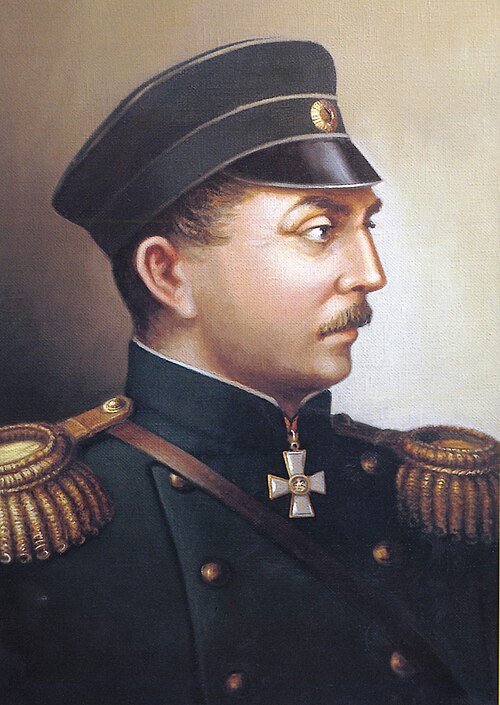
图:佚名 · Public domain · 维基共享资源
- 生卒
- 1802 年 6 月 23 日—1855 年 6 月 30 日 (日期为儒略历)
- 出生地
- Khmelita
- 去世地
- 塞瓦斯托波尔
- 国籍 / 所属
- 俄罗斯帝国
- 身份
- 海军军官
- 参与
- 希腊独立战争、纳瓦里诺海战、克里米亚战争、锡诺普海战、塞瓦斯托波尔围城战
- 就读
- 海上士官生军团、伏龙芝高等海军学校
- 军种
- 沙皇俄国海军
- 军衔
- 海军上将、海军上尉、海军大尉 等 6 项
- 简述
- Russian fleet commander
帕维尔·斯捷潘诺维奇·纳希莫夫(俄语:Павел Степанович Нахимов,罗马化:Pavel Stepanovich Nakhimov;1802年7月5日(旧历6月23日)—1855年7月12日(旧历6月30日)),俄罗斯帝国海军上将。他在克里米亚战争的塞瓦斯托波尔围城战中指挥俄军抵抗奥斯曼帝国的入侵而知名。
出生在斯摩棱斯克省。1815年在圣彼得堡的贵族海军学院毕业后,服役于波罗的海舰队。1822年至1825年,先后跟随米哈伊尔·拉扎列夫和洛德韦克·范海登,参加环球旅行。
1827年,在希腊独立战争的纳瓦里诺海战中参战。1829年回到喀琅施塔得。
1854年,担任黑海舰队司令官。在1853年12月1日的锡诺普海战中,他率军歼灭了一支奥斯曼帝国的舰队。1855年2月起,担任塞瓦斯托波尔的要塞防御指挥官。7月12日,在塞瓦斯托波尔围城战中因头部中弹而死。与米哈伊尔·拉扎列夫、弗拉基米尔·科尔尼洛夫、弗拉基米尔·伊斯托明一同葬于塞瓦斯托波尔的圣弗拉基米尔主教座堂。
正文摘自中文维基百科「帕维尔·纳希莫夫」(删去了参考文献、表格和图片),按 CC BY-SA 4.0 使用
英文维基百科的更多内容
中文维基百科这一条比较短,下面是英文维基百科同一条目的节选,原文为英文,未翻译。
Pavel Stepanovich Nakhimov (Russian: Павел Степанович Нахимов, pronounced [ˈpavʲɪl sʲtʲɪˈpanəvʲɪtɕ nɐˈxʲiməf]; 5 July [O.S. 23 June] 1802 – 12 July [O.S. 30 June] 1855) was a Russian admiral in the Imperial Russian Navy known for his victory in the Battle of Sinop and his leadership in the Siege of Sevastopol (1854–1855) during the Crimean War.
He joined the Imperial Russian Navy and moved up the ranks, serving in the Greek War of Independence and the Russo-Turkish War (1828–29). At the beginning of the Crimean War, he delivered a significant victory at the Battle of Sinop against the Ottoman Empire. Afterward, he was a leader in the defense of Sevastopol against British, French, and Ottoman forces, during which a sniper wounded him. He died a few days later.
After his death, he became a hero in Russia, with medals and ships named after him, especially during Soviet times, starting with Stalin. Also, a Soviet Film called Admiral Nakhimov was made in 1947 about his life.
Early life
Nakhimov was born in the village of Gorodok in the Vyazma district of the Smolensk Governorate into a noble Russian family. He was the seventh of eleven children of a landlord and Second Major Stepan Mikhailovich Nakhimov and his wife Feodosia Ivanovna Nakhimova (née Kozlovskaya). Six of his siblings died as infants. He and all four of his brothers would become professional seamen, including Vice Admiral Sergei Stepanovich Nakhimov (1805–1872).
Early military career
In 1817, he entered the Naval Academy for the Nobility (Morskoy Dvoryanskiy Korpus) in Saint Petersburg. That year, he made his first sea voyage aboard the frigate Feniks ("Phoenix") to the shores of Sweden and Denmark. He was promoted to a non-commissioned officer soon after. In February 1818, he passed examinations to become a midshipman and was immediately assigned to the second Fleet Crew (Flotskiy Ekipazh) of the Russian Imperial Navy's Baltic Fleet.
At the beginning of his naval career, Nakhimov's experience was limited to voyages in the Baltic Sea as well as a more extensive trip from the White Sea port of Arkhangelsk to Kronstadt naval base near Saint Petersburg. His lucky break came in March 1822, when he was assigned to the frigate Kreiser ("Cruiser");……
Crimean War and death
Battle of Sinope
During the Crimean War of 1853–1856 Nakhimov distinguished himself by defeating the Ottoman fleet at Sinope in 1853.
Before the battle, the Russian fleet in the Black Sea was divided into two groups, one led by Nakhimov and the other by V. A. Kornilov. Nakhimov was assigned the eastern part of the sea. Meanwhile, the Ottomans knew Russian forces had been in the open sea since November 23. Still, for various reasons, including fear of facing Russia in the open sea, they decided to remain in port. Nakhimov asked for reinforcements, which he got on November 27, 1853, when a squadron led by Admiral Fyodor Mihailovich Novosilskiy joined Nakhimov's squadron. By the time of the battle, Nakhimov had six battleships, two frigates, and three steamers and outgunned the Ottomans with weapons such as Paixhans guns.
Siege of Sevastopol and death
His finest hour came during the Siege of Sevastopol, where he and Admiral V. A.……
Legacy
Glorification
After his death, Nakhimov was glorified, which included misrepresenting facts. Becoming a part of the "Sevastopol myth," in which Russian figures presented glorification of the defense of the city. This populist movement glorification of the battle was conducted alongside writers such as Leo Tolstoy. In publications, Nakhimov was represented as a "friend of the common people" and "the soul of the defense of Sevastopol." Despite his popularity with populist factions, the Imperial government did not recognize Nakhimov, as evidenced by its efforts to force artists of the panoramic painting "Defense of Sevastopol, 1854-5" to remove his figure and replace it with Mikhail Dmitrievich Gorchakov.
Despite him not being included in official government accounts, he was later honored in the Soviet Union by propagandists.……
Monuments and tributes
There are many monuments and medals created in his memory.……
正文摘自英文维基百科(原文为英文,未翻译)「Pavel Nakhimov」(节选,删去了参考文献、表格和图片),按 CC BY-SA 4.0 使用;在维基百科读全文 ›
参与的事件
所属政权
同时代、同地区的人物





同时代、同身份的人物(军事)