史鉴
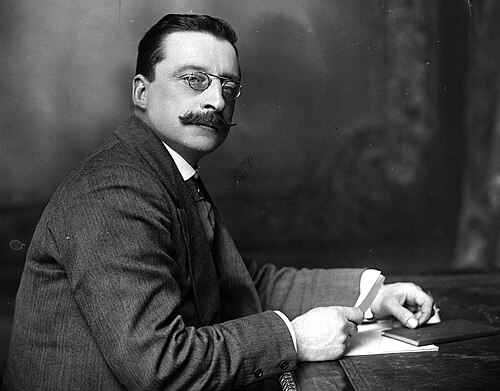
图:佚名 · Public domain · 维基共享资源
- 生卒
- 1872 年 3 月 31 日—1922 年 8 月 12 日
- 出生地
- 都柏林
- 去世地
- 都柏林
- 国籍 / 所属
- 爱尔兰自由邦、大不列颠及爱尔兰联合王国
- 身份
- 作家、政治人物、外交官、作者
- 职位
- 爱尔兰下议院议员、主席、外交部长、爱尔兰内政部长、爱尔兰共和国下议院主席、第30届英国下议院议员 等 7 项
- 原文名
- Arthur Griffith
- 宗教
- 天主教会
- 任职机构
- The United Irishmen
- 死因
- 中风
- 简述
- 爱尔兰政治人物(1872—1922)
阿瑟·约瑟夫·格里菲思(爱尔兰语:Art Ó Gríobhtha;英语:Arthur Joseph Griffith;1872年3月31日—1922年8月12日)是新芬党的创始人及第三任领导人。1922年1月至8月他担任爱尔兰下议院主席,并且是1921年在伦敦缔结英爱条约时的爱尔兰代表。
正文摘自中文维基百科「阿瑟·格里菲斯」(删去了参考文献、表格和图片),按 CC BY-SA 4.0 使用
英文维基百科的更多内容
中文维基百科这一条比较短,下面是英文维基百科同一条目的节选,原文为英文,未翻译。
Arthur Joseph Griffith (Irish: Art Seosamh Ó Gríobhtha or Art Ó Gríofa; 31 March 1871 – 12 August 1922) was an Irish writer, newspaper editor and politician who founded the political party Sinn Féin. He led the Irish delegation at the negotiations that produced the 1921 Anglo-Irish Treaty, and served as the president of Dáil Éireann from January 1922 until his death that August.
After a short spell in South Africa, Griffith founded and edited the Irish nationalist newspaper The United Irishman in 1899. In 1904, he wrote The Resurrection of Hungary, which advocated the withdrawal of Irish members from the Parliament of the United Kingdom and the setting up of the institutions of government at home in Ireland, a policy that became known as Sinn Féin (ourselves). On 28 November 1905, he presented "The Sinn Féin Policy" at the first annual convention of his organisation, the National Council; the occasion is marked as the founding date of the Sinn Féin party. Griffith took over as president of Sinn Féin in 1911, but at that time the organisation was still small.
Griffith was arrested following the Easter Rising of 1916, despite not having taken any part in it. On his release, he worked to build up Sinn Féin, which won a string of by-election victories. At the party's Ardfheis (annual convention) in October 1917, Sinn Féin became an unambiguously republican party, and Griffith resigned the presidency in favour of the 1916 leader Éamon de Valera, becoming vice-president instead. Griffith was elected as an MP for East Cavan in a by-election in June 1918, and re-elected in the 1918 general election, when Sinn Féin won a huge electoral victory over the Irish Parliamentary Party and, refusing to take their seats at Westminster, set up their own constituent assembly, Dáil Éireann.
Family and early life
Arthur Joseph Griffith was born at 61 Upper Dominick Street, Dublin on 31 March 1871, of distant Welsh lineage. His great-great-grandfather, William Griffith of Drws-y-coed Uchaf, Rhyd-ddu, Caernarfonshire (1719–1782), was a farmer and supporter of the Moravian Church cause.……
Foundation of Sinn Féin
Most historians opt for 28 November 1905 as a founding date because it was on this date that Griffith first presented his 'Sinn Féin Policy'.……
1916 Rising
In 1916, rebels seized and took over a number of key locations in Dublin, in what became known as the Easter Rising. After its defeat, it was widely described both by British politicians and the Irish and British media as the "Sinn Féin rebellion", even though Sinn Féin had very limited involvement.……
War of Independence
In May 1918, along with Éamon de Valera and 72 other Sinn Féiners, Griffith was arrested on the pretext of involvement in the fictitious German Plot. Griffith spent ten months interned in HM Prison Gloucester, being released on 6 March 1919. Fr. O'Flanagan was left as Acting-President of Sinn Féin.……
Treaty negotiations and death
In September 1921, de Valera, President of the Republic, asked Griffith to head the delegation of Irish plenipotentiaries to negotiate with the British government. The delegates set up Headquarters in Hans Place, London.……
Posthumous commemoration
The historian Diarmaid Ferriter considers that, though he had founded Sinn Féin, Griffith was 'quickly airbrushed' from Irish history. His widow had to beg his former colleagues for a pension, saying that he 'had made them all'. She considered that his grave plot was too modest and threatened to exhume his body.……
Views on race
Views on Jews
As editor of the United Irishman, Griffith took an "Anti-Dreyfusard" line, writing in 1899 to defend the conviction of "the Jew traitor" Dreyfus; accusing the Dublin press of being "almost all Jew rags"; and decrying
正文摘自英文维基百科(原文为英文,未翻译)「Arthur Griffith」(节选,删去了参考文献、表格和图片),按 CC BY-SA 4.0 使用;在维基百科读全文 ›
所属政权
同时代、同地区的人物





同时代、同身份的人物(帝王与政治)