史鉴
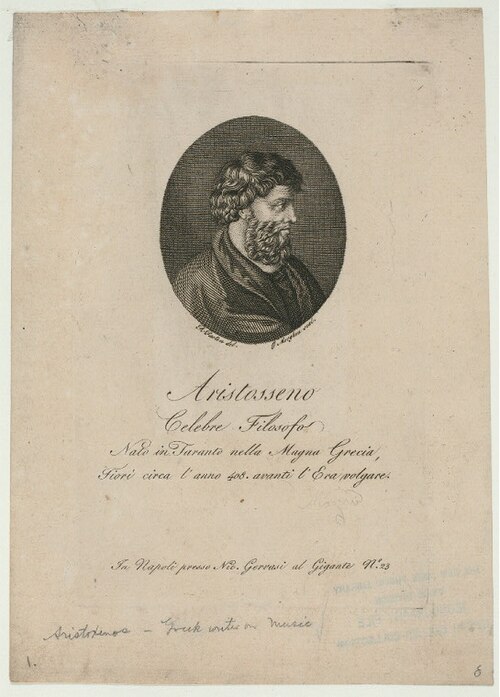
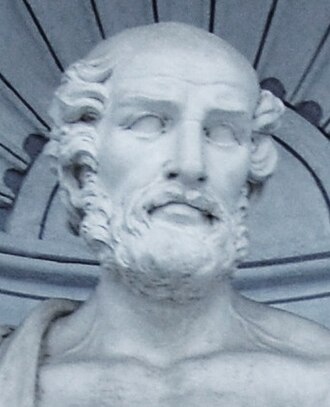
图:Guglielmo Morghen · Public domain · 维基共享资源
- 生卒
- 公元前 360 年—公元前 300 年
- 出生地
- 他林敦
- 去世地
- 古雅典
- 身份
- 数学家、哲学家、音乐学家、音乐理论家
- 父亲
- Spintharus
- 简述
- 4th century BC Greek Peripatetic philosopher and musicologist
亚里士多塞诺斯(英语:Aristoxenus),(约活动于公元前4世纪后期),古希腊逍遥学派的哲学家之一。古典时期的首位音乐理论大家。出生于意大利南部他林敦(今塔兰托),曾于雅典师从亚里士多德和泰奥弗拉斯托斯。他的兴趣广泛,著作甚多,但传世较少。除音乐作品外,其著述毕达哥拉斯、阿尔库塔斯、苏格拉底和柏拉图等人传记以及关于毕达哥拉斯伦理学的记述均仅存残篇。他认为灵魂之于躯体犹如和声之于一件乐器的各声部。在音乐理论方面,他认为音阶中的音符不应用数学比率判断,而是应当使用耳朵判断。他的作品现仅存《和声学原理》及《韵律原理》等残篇。其他部分经过后人搜集、整理,收入1945年出版的《亚里士多德学派;正文和注解》的第二卷《亚里士多塞诺斯》。
正文摘自中文维基百科「亚里士多塞诺斯」(删去了参考文献、表格和图片),按 CC BY-SA 4.0 使用
英文维基百科的更多内容
中文维基百科这一条比较短,下面是英文维基百科同一条目的节选,原文为英文,未翻译。
Aristoxenus of Tarentum (Greek: Ἀριστόξενος ὁ Ταραντῖνος; born c. 375, fl. 335 BC) was a Greek Peripatetic philosopher, and a pupil of Aristotle. Most of his writings, which dealt with philosophy, ethics and music, have been lost, but one musical treatise, Elements of Harmony (Greek: Greek: Ἁρμονικὰ στοιχεῖα; Latin: Elementa harmonica), survives incomplete, as well as some fragments concerning rhythm and meter. The Elements is the chief source of our knowledge of ancient Greek music.
Life
Aristoxenus was born at Tarentum (in modern-day Apulia, southern Italy) in Magna Graecia, and was the son of a learned musician named Spintharus (otherwise Mnesias). He learned music from his father, and having then been instructed by Lamprus of Erythrae and Xenophilus the Pythagorean, he finally became a pupil of Aristotle, whom he appears to have rivaled in the variety of his studies.
Overview of his works
His writings were said to have consisted of four hundred and fifty-three books, and dealt with philosophy, ethics and music.
Although his final years were in the Peripatetic school, and he hoped to succeed Aristotle on his death, Aristoxenus was strongly influenced by Pythagoreanism, and was only a follower of Aristotle in so far as Aristotle was a follower of Plato and Pythagoras. Thus, as Gibson tells us: "the various philosophical influences"
Elementa harmonica
In his Elements of Harmony (also Harmonics), Aristoxenus attempted a complete and systematic exposition of music. The first book contains an explanation of the genera of Greek music, and also of their species; this is followed by some general definitions of terms, particularly those of sound, interval, and system. In the second book Aristoxenus divides music into seven parts, which he takes to be: the genera, intervals, sounds, systems, tones or modes, mutations, and melopoeia. The remainder of the work is taken up with a discussion of the many parts of music according to the order which he had himself prescribed.
On rhythmics and metrics
Part of the second book of a work on rhythmics and metrics, Elementa rhythmica, is preserved in medieval manuscript tradition.
Aristoxenus was also the author of a work On the Primary Duration (chronos).
A five-column fragment of a treatise on meter (P. Oxy. 9) was published in Grenfell and Hunt's Oxyrhynchus Papyri, vol. 1 (1898) and is probably by Aristoxenus.
Other works
The edition of Wehrli presents the surviving evidence for works with the following titles (not including several fragments of uncertain origin):
Life of Pythagoras (Greek: Πυθαγόρου βίος): fr. 11 Wehrli
On Pythagoras and his pupils (Greek: Περὶ Πυθαγόρου καὶ τῶν γνωρίμων αὐτοῦ): fr. 14 Wehrli
On the Pythagorean life (Greek: Περὶ τοῦ Πυθαγορικοῦ βίου): fr. 31 Wehrli
Pythagorean maxims or Pythagorean negations (Greek: Πυθαγορικαὶ ἀποφάσεις): fr. 34 Wehrli
Educational customs or Rules of education (Greek: Παιδευτικοὶ νόμοι): fr. 42–43 Wehrli
Political laws (Greek: Πολιτικοὶ νόμοι): fr. 44–45 Wehrli
Editions and translations
Wehrli, Fritz (1967). Die Schule des Aristoteles, vol. 2: Aristoxenos, 2nd. ed. (Basel/Stuttgart), Greek text (excluding the harmonic fragments, rhythmic fragments, On the Primary Duration, and On tonoi: see p. 28) with commentary in German
Westphal, Rudolf (1883–1893). Aristoxenus von Tarent: Melik und Rhythmik des classischen Hellenenthums, 2 vols. (Leipzig) (vol. 1, vol. 2)
Westphal, Rudolf (1861). Die Fragmente und die Lehrsätze der griechischen Rhythmiker (Leipzig), pp. 26–41, Greek text of Elementa rhythmica and On the Primary Duration (Internet Archive)
正文摘自英文维基百科(原文为英文,未翻译)「Aristoxenus」(节选,删去了参考文献、表格和图片),按 CC BY-SA 4.0 使用;在维基百科读全文 ›
同时代、同地区的人物