史鉴
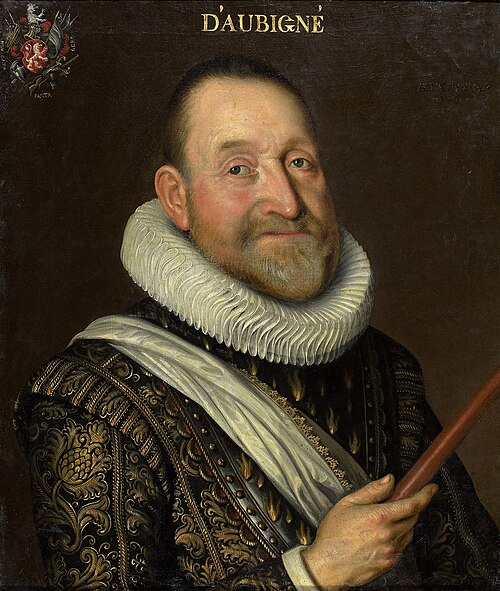
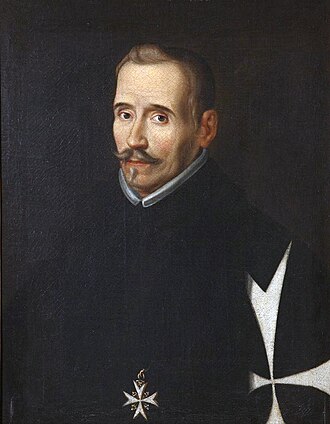
图:佚名 · Public domain · 维基共享资源
- 生卒
- 1552 年 2 月 8 日—1630 年 5 月 9 日 (日期为儒略历)
- 出生地
- 蓬镇
- 去世地
- 约西
- 国籍 / 所属
- 法国
- 身份
- 作家、军人、诗人、政治人物
- 父亲
- Jean d'Aubigné
- 母亲
- Catherine de L'Estang
- 配偶
- Renea Burlamacchi、Susanne de Lezay, Baronne de Surineau
- 子女
- Constant d'Aubigné、Madame de Villette、Nathan d'Aubigné
- 本名
- Théodore Agrippa d’Aubigné
- 原文名
- Théodore Agrippa d'Aubigné
- 家族
- Famille d'Aubigné
- 宗教
- 加尔文主义、reformed
- 就读
- 奥尔良大学、日内瓦大学
- 流派 / 运动
- 巴洛克文学
- 简述
- 法国诗人、士兵
泰奥多尔-阿格里帕·多比涅(法语:Théodore-Agrippa d'Aubigné,法语发音:[teo.dɔʁ aɡʁipa dobiɲe],1552年2月8日—1630年4月29日)是一位法国诗人、士兵。他的史诗《悲剧》(Les Tragiques,1616年)被广泛认为是其代表作。
正文摘自中文维基百科「泰奥多尔-阿格里帕·多比涅」(删去了参考文献、表格和图片),按 CC BY-SA 4.0 使用
英文维基百科的更多内容
中文维基百科这一条比较短,下面是英文维基百科同一条目的节选,原文为英文,未翻译。
Théodore-Agrippa d'Aubigné (French pronunciation: [teo.dɔʁ aɡʁipa dobiɲe], 8 February 1552 – 29 April 1630) was a French poet, soldier, propagandist and chronicler. His epic poem Les Tragiques (1616) is widely regarded as his masterpiece. In a book about his Catholic contemporary Jean de La Ceppède, the English poet Keith Bosley called d'Aubigné "the epic poet of the Protestant cause," during the French Wars of Religion. Bosley added, however, that after d'Aubigné's death, he "was forgotten until the Romantics rediscovered him."
Life
Born at the Château of Saint-Maury, near Pons, in present-day Charente-Maritime, his father was Jean d'Aubigné, who was involved in the 1560 Huguenot Amboise conspiracy to seize power by staging a palace coup, kidnapping King Francis II of France, and arresting his Catholic advisors. After the defeat of the plot, d'Aubigné's father strengthened his Calvinist sympathies by showing him, while they were passing through Amboise, the heads of the conspirators exposed on the scaffold, and instructing him not to spare his own head in avenging their deaths.
According to the poet's own account he knew Latin, Greek and Hebrew at six years of age, and he had translated the Crito of Plato before he was eleven.
After a brief residence, d'Aubigné was forced to flee from Paris to avoid arrest, but was captured and threatened with execution. Escaping through the intervention of a friend, he went to Montargis. In his fourteenth year he was present at the siege of Orléans, at which his father was killed.
In 1567 he made his escape from tutelage, and attached himself to the Huguenot army under Louis of Bourbon, Prince of Condé.……
Legacy
His daughter, Madame de Villette, was born in 1584 at Mursay to Suzanne de Lusignan de Lezay; at an early age, on 22 October 1610, she married Benjamin Valois de Vilette in Maillezais.
Through Louise, the poet's grandson was Philippe, Marquis de Villette-Mursay, who became an Admiral in the French Navy and whose children were, to his outrage, converted to Catholicism by their cousin Madame de Maintenon in 1681.
Several years after being disowned by his father, Constant d'Aubigné was imprisoned by the Cardinal for corresponding with the English Court. During his imprisonment, Constant married Jeanne de Cardilhac, the daughter of his jailer. All of their children were baptized and raised in the Roman Catholic Church at their mother's insistence.
Constant d'Aubigné's daughter and the Poet's granddaughter, Madame de Maintenon, became first the mistress and then the second wife to King Louis XIV.
The poet's great-granddaughter Françoise Charlotte d'Aubigné married Adrien Maurice de Noailles, the heir to
the Duke of Noailles, in 1698.……
Literary and historical works
Histoire universelle (1616–1618)
Les Tragiques (1616)
- Avantures du Baron de Faeneste
- Confession catholique du sieur de Sancy
- Sa Vie à Ses Enfants
Les Tragiques
Written over some three decades, the alexandrine verse of this epic poem relies on multiple genres as well as stylistic familiarity with the work of the opposing, Catholic poets of the Pléiade, headed by Pierre de Ronsard. Divided into seven books, a number symbolic of the author's ultimate, apocalyptic intent, the Tragiques incorporates literary influence from classical sources, such as tragedy and satire, palpable in the first three books ("Les Misères", "Les Princes", and "La Chambre Dorée" respectively), before resorting to influence from genres like ecclesiastical history, martyrology and apocalypse in the creation of the remaining books ("Les Feux", "Les Fers", "Vengeances", and "Jugement").
In the first of two liminal paratexts, the introduction "Aux Lecteurs," Aubigné endorses the account (also found in his autobiographical Sa Vie à Ses Enfants), that the inception of the Tragiques came to him as an ecstatic vision during a near-death experience.……
正文摘自英文维基百科(原文为英文,未翻译)「Agrippa d'Aubigné」(节选,删去了参考文献、表格和图片),按 CC BY-SA 4.0 使用;在维基百科读全文 ›
同时代、同地区的人物


同时代、同身份的人物(帝王与政治)