史鉴
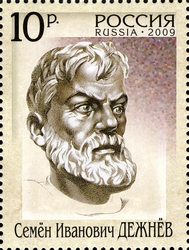
图:Stamp issuing authority - MARKA Publishing & Trading Centre. Printer - Associati · Public domain · 维基共享资源
- 生卒
- 1605 年 3 月 7 日—1673 年
- 出生地
- 大乌斯秋格、Pinega
- 去世地
- 莫斯科
- 国籍 / 所属
- 俄罗斯沙皇国
- 身份
- 发现者、world traveler、zemleprokhodtsy、探险家、seafarer
- 参与
- Expedition of Semyon Dezhnev
- 简述
- Russian explorer
谢苗·伊万诺维奇·杰日尼奥夫(姓氏又译迭日涅夫,俄语:Семён Ива́нович Дежнёв,罗马化:Semyon Ivanovich Dezhnyov,1605年—1673年),俄罗斯帝国海军军官、探险家。迭日涅夫是波默尔人,出生在今天沃洛格达州的大乌斯秋格。1648年,他从科雷马河出发,经过北冰洋,穿过白令海峡,从太平洋到达阿纳德尔河。他也是第一个航行经过白令海峡的欧洲人,比维他斯·白令早了八十年。楚科奇半岛的杰日尼奥夫角就是以他的名字命名。
正文摘自中文维基百科「谢苗·杰日尼奥夫」(删去了参考文献、表格和图片),按 CC BY-SA 4.0 使用
英文维基百科的更多内容
中文维基百科这一条比较短,下面是英文维基百科同一条目的节选,原文为英文,未翻译。
Semyon Ivanovich Dezhnev (Russian: Семён Ива́нович Дежнёв, IPA: [sʲɪˈmʲɵn ɨˈvanəvʲɪdʑ dʲɪʐˈnʲɵf]; sometimes spelled Dezhnyov; c. March 7, 1605 – 1673) was a Russian zemleprokhodets, an explorer of Siberia and the first European to sail through the Bering Strait, 80 years before Vitus Bering did. In 1648 he sailed from the Kolyma River on the Arctic Ocean to the Anadyr River on the Pacific. His exploit was forgotten for almost a hundred years and Bering is usually given credit for discovering the strait that bears his name.
Biography
Dezhnyov was a Pomor Russian, born in 1605, possibly in the town of Veliky Ustyug or the village of Pinega. According to the anthropologist Lydia T. Black, Dezhnyov was recruited for Siberian service in 1630, possibly as a service man or government agent. He served for eight years in Tobolsk and Yeniseisk, and then went to Yakutia in 1639, or possibly earlier. He is said to have been a member of the Cossack detachment under Beketov, who is credited with founding Yakutsk (on the Lena River) in 1632. In any case, no later than 1639 he was sent to Yakutia, where he married a Yakut captive and spent the next three years collecting yasak (otherwise known as fur tribute) from the natives.
In 1641, Dezhnyov moved northeast to a newly discovered tributary of the Indigirka River where he served under Mikhail Stadukhin. Finding few furs and hostile natives and hearing of a rich river to the east, he, Stadukhin and Yarilo Zyrian sailed down the Indigirka, then east along the coast to the Kolyma River, where they built an ostrog (or fort) (1643). This was at the time the easternmost Russian frontier. The Kolyma soon proved to be one of the richest areas in eastern Siberia. In 1647, 396 men paid head-tax there and 404 men received passports to travel from Yakutsk to the Kolyma.
From about 1642, Russians began hearing of a 'Pogycha River' to the east which flowed into the Arctic and that the nearby area was rich in sable fur, walrus ivory and silver ore. An attempt to reach it in 1646 failed.……
A discovery and its re-discovery
From at least 1575 European geographers had heard of a Strait of Anián connecting the Pacific and Arctic. Some had it at the Bering Strait (map at right) and others had it running from the Gulf of California to Baffin Bay. It is not certain that Russians in Siberia had heard of it. The first Western map to show a Strait of Anian between Asia and North America was probably that of Giacomo Gastaldi in 1562. Many cartographers followed this lead until the time of Bering. The source is said to be an interpretation of Marco Polo, but otherwise the documents do not explain where the idea came from.
While surviving official documents from Semyon Dezhnyov were recorded by professional scribes of the Yakutsk chancellery (*prikaznaya izba*), this reflected the mandatory administrative and legal practices of 17th-century Russia rather than serving as proof of his personal illiteracy. In modern historiography, Dezhnyov’s achievements are framed around his high practical intelligence, leadership, and exceptional navigational resourcefulness within the harsh conditions of the Siberian frontier. As historian Raymond H. Fisher emphasizes, Dezhnyov's petitions demonstrate an "articulate and legally competent mind that operated masterfully within the framework of contemporary administration, regardless of whose hand held the pen". By successfully rounding the "Great Rocky Projection" (now Cape Dezhnev) on his way to the Anadyr River, his voyage practically demonstrated the geographical separation between Asia and America.
Tributes
A mountain ridge in Chukotka, a bay of the Bering Sea, a settlement on Amur River, and Cape Dezhnyov (the easternmost cape of Eurasia) are named after Dezhnyov, as is the Dejnev crater on Mars.
In 1955, a lighthouse on the East coast of Chukotka was dedicated to Dezhnev with a plaque baring his name and details of his journey across the Bering Strait.
The 1971-built icebreaker Semyon Dezhnev is named after him.
正文摘自英文维基百科(原文为英文,未翻译)「Semyon Dezhnev」(节选,删去了参考文献、表格和图片),按 CC BY-SA 4.0 使用;在维基百科读全文 ›
所属政权
同时代、同地区的人物