史鉴
- 生卒
- 公元前 700 年代—公元前 675 年 (Wikidata 的生卒只记到十年,非确切年份)
- 国籍 / 所属
- Median Kingdom
- 身份
- 统治者
- 职位
- King of Media
- 配偶
- wife of Deioces
- 子女
- 弗拉欧尔特斯
- 简述
- the founder of the Kingdom of Medes (700–678 BC)
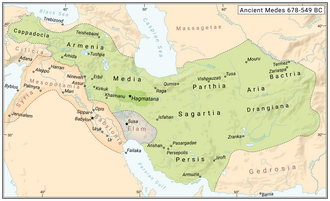
迪奥塞斯(Deioces,或称Déjocès、Diyako,?—前675年),又作戴奥凯斯,古希腊历史学家希罗多德认为他是古代西亚米底王国的建立者,不过有人认为米底王国其实是由迪奥塞斯之子弗拉欧尔特斯建立。迪奥塞斯自前728年—前675年在位,共53年。
约在公元前8世纪时,迪奥塞斯统一米底各部落,摆脱亚述统治,建埃克巴坦那城(今伊朗高原的哈马丹地方)。米底国公元前550年为波斯所灭。
正文摘自中文维基百科「迪奥塞斯」(删去了参考文献、表格和图片),按 CC BY-SA 4.0 使用
英文维基百科的更多内容
中文维基百科这一条比较短,下面是英文维基百科同一条目的节选,原文为英文,未翻译。
Deioces was the founder and the first king of the Median Kingdom, an ancient polity located in the Iranian plateau. His name has been mentioned in different forms in various sources, including the ancient Greek historian Herodotus.
The exact date of the era of Deioces' rule is not clear and probably covered most of the first half of the 7th century BC. According to Herodotus, Deioces was the first Median king to have gained independence from the Neo-Assyrian Empire and governed for 53 years. After Deioces' death, his son, Phraortes, succeeded him.
Etymology
Deioces' name has been mentioned in various forms in different sources. The Greek historian Herodotus has stated his name as Δηϊόκης (Dēiokēs). In Assyrian texts, he has been mentioned as Da-a-a-uk-ku; and in Elamite ones, as Da-a-(hi-)(ú-)uk-ka and Da-a-ya-u(k)-ka.
Deioces' name is derived from the Iranian Dahyu-ka, and is the junior noun of the word dahyu-, meaning "the land". The old Iranian name Deioces was not uncommon even in later times. In the Achaemenid period, the Old Persian form of Deioces has been mentioned in several Elamite inscriptions of the mud plates of Persepolis. Those mentions apparently referred to different persons in separate government regions, and one of them was an individual assigned to the food rationing of the horses.
Dating
The era of Deioces' reign is subject to controversy. Herodotus says that Deioces ruled for 53 years, and thus some assumptions have been made about the era of his reign; but it seems that Herodotus's report is based on a verbal narrative. Based on Herodotus's report, the researchers have concluded that Deioces was the founder of the Median kingdom and also the first Median king, having gained independence from the Assyrians. But Herodotus's report is a mixture of Greek and Oriental legends and is not historically reliable. Also, it is assumed that the Median king whom Herodotus's reports are about is the same Deioces, Phraortes' father; thus, it is not possible to clarify the exact date of the period of his rule; but it can be said that it probably covered most of the first half of the 7th century BC.……
History
Historicity
Herodotus's Deioces is sometimes associated with a provincial governor (šaknu) named Daiukku, mentioned several times in Neo-Assyrian texts from the time of Sargon II. Daiukku governed somewhat independently a district on the border between the Mannaeans and the Assyrian kingdoms. He allied with the king of Urartu against the Mannaen ruler but was captured by Sargon II, who exiled him and his family to Syria in 715 BC, where he apparently died. However, this association is highly unlikely, as the events mentioned would be located around Lake Urmia and not in Median territory. His namesake might have been one of the many chiefs of free Median districts outside Assyrian control. According to Herodotus, Deioces lived in the late 8th century BC, around the same time as the Median chief Daiku of Saparda.……
Foundation of the Median kingdom
What is known from the Assyrian texts is that from the 9th to 7th century BC, the Medes had not been able to thrive enough to cause the convergence and alliance and organization of the scattered Median tribes and clans around a superior and single leader and lord who could be called the king of all the Median lands.……
In narrative Iranian history
Some Iranologists believe Deioces to be the Hushang in Shahnameh due to the features Herodotus states for him and consider the title Paradat or Pishdadian equal to "the first legislator". The religious tradition considers Hushang the first person to establish kingship in Iran.
Among Herodotus's reports about Deioces and those of Avesta and Middle Persian, Arabic and New Persian texts about Hushang, there are some common features about the identities of Hushang and Deioces; the most important of them can be summarized in three points:
According to Herodotus, Deioces was the headman of the village during the time; and the name or title Deioces meaning farmer must have been given to him because of this; and Hushang, according to Arabic and Persian texts, made innovations in agriculture; and thus he probably acquired the title farmer.
正文摘自英文维基百科(原文为英文,未翻译)「Deioces」(节选,删去了参考文献、表格和图片),按 CC BY-SA 4.0 使用;在维基百科读全文 ›