史鉴

图:Jean-Michel Moullec from Vern sur Seiche (35, Bretagne), France · CC BY 2.0 · 维基共享资源
- 生卒
- 公元前 320 年—公元前 273 年
- 出生地
- 巴特那
- 去世地
- 巴特那
- 国籍 / 所属
- 孔雀王朝
- 身份
- sovereign
- 职位
- Mauryan Emperor
- 父亲
- 旃陀罗笈多
- 母亲
- 难持
- 配偶
- 苏哈德朗吉
- 子女
- 阿育王、修私摩、Vitashoka、Vitashok
- 家族
- Maurya dynasty
- 宗教
- 正命论
- 简述
- Mauryan Emperor
宾头娑罗(梵语:बिन्दुसार,IAST:Bindusāra,或译为宾头沙罗、频头娑罗,意译为适实王;?-前272年),摩揭陀孔雀王朝第2任皇帝(约前297年-前272年在位)。
关于宾头娑罗,现代研究者掌握的资料十分有限。他是孔雀王朝建立者旃陀罗笈多的儿子,一些文献说他的母亲叫杜陀罗。旃陀罗笈多在晚年时成了一名耆那教徒,因之放弃王位到南印迈索尔一带去修行;他将王位传给了宾头娑罗,时在约前297年。据说旃陀罗笈多后来按照耆那教的习俗绝食而死。
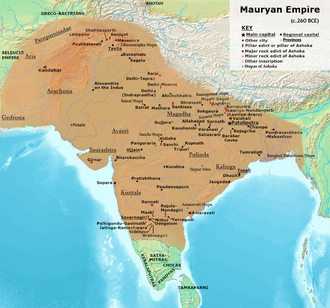
据一些希腊古典作家模糊不清的记载,宾头娑罗承继了父亲的扩张政策,为帝国增添许多领土。希腊文献称宾头娑罗为“阿利特罗卡得斯”(Αλλιτροχαδες),这个词来自梵语“阿密多罗揭多”,意为“杀敌者”,这说明他一定有过战功。他可能曾经对印度南部用兵,攻占了温迪亚山脉以南、直到本内尔河的广大地区。
宾头娑罗与各希腊化国家维持良好关系。他曾经接待过塞琉古帝国国王(可能是安条克一世)派来的使节代马库斯。埃及的托勒密王朝也曾向他派出过使节。
与父亲不同,宾头娑罗青睐正命论(“邪命外道”)学派的哲学。正命论者也受到宾头娑罗的妻子达摩王后的恩宠,并在她怀孕时预言了将有一个伟大的儿子(显然是指阿育)诞生。
宾头娑罗去世于前272年。在他死后,他的两个儿子阿育和修私摩展开了争夺继承权的斗争,最后阿育获胜。
正文摘自中文维基百科「宾头娑罗」(删去了参考文献、表格和图片),按 CC BY-SA 4.0 使用
英文维基百科的更多内容
中文维基百科这一条比较短,下面是英文维基百科同一条目的节选,原文为英文,未翻译。
Bindusara (r. c. 297 – c. 273 BCE) was the second Mauryan emperor of Magadha in ancient India. The ancient Greco-Roman writers called him Amitrochates, a name likely derived from his Sanskrit title Amitraghāta ("slayer of enemies").
Bindusara was the son of the dynasty's founder Chandragupta and the father of its most famous ruler Ashoka. His life is not documented as well as the lives of these two emperors. Much of the information about him comes from legendary accounts written several hundred years after his death. Bindusara consolidated the empire created by his father.
The 16th century Tibetan Buddhist author Taranatha credits his administration with extensive territorial conquests in southern India, but some historians doubt the historical authenticity of this claim.
Background
Ancient and medieval sources have not documented Bindusara's life in detail. Much of the information about him comes from Jain legends focused on Chandragupta and the Buddhist legends focused on Ashoka. The Jain legends, such as Hemachandra's Parishishta-Parvan were written more than a thousand years after his death. Most of the Buddhist legends about Ashoka's early life also appear to have been composed by Buddhist writers who lived several hundred years after Ashoka's death, and are of little historical value.……
Early life
Parents
Bindusara was born to Chandragupta, the founder of the Mauryan Empire. This is attested by several sources, including the various Puranas and the Mahavamsa. The Dipavamsa, on the other hand, names Bindusara as the son of the king Shushunaga. The prose version of Ashokavadana states that Bindusara was the son of Nanda and a 10th-generation descendant of Bimbisara. Like Dipavamsa, it omits Chandragupta's name altogether. The metrical version of Ashokavadana contains a similar genealogy with some variations.
Names
The name "Bindusara", with slight variations, is attested by the Buddhist texts such as Dipavamsa and Mahavamsa ("Bindusaro");……
Reign
Historian Upinder Singh estimates that Bindusara ascended the throne around 297 BCE.
Territorial conquests
The 16th century Tibetan Buddhist author Taranatha states that Chanakya, one of Bindusara's "great lords", destroyed the nobles and kings of 16 towns and made him master of all the territory between the western and the eastern seas (Arabian Sea and the Bay of Bengal). According to some historians, this implies the conquest of the Deccan by Bindusara, while others believe that this only refers to suppression of revolts.
Takshashila revolt
The Mahavamsa suggests that Bindusara appointed his son Ashoka as the viceroy of Ujjayini.……
Foreign relations
Bindusara maintained friendly diplomatic relations with the Greeks. Deimachos of Plateia was the ambassador of Seleucid king Antiochus I at Bindusara's court. Deimachos seems to have written a treatise entitled "On Piety" (Peri Eusebeias). The 3rd century Greek writer Athenaeus, in his Deipnosophistae, mentions an incident that he learned from Hegesander's writings: Bindusara requested Antiochus to send him sweet wine, dried figs and a sophist.……
Religion
The Buddhist texts Samantapasadika and Mahavamsa suggest that Bindusara followed Brahmanism, calling him a "Brahmana bhatto" ("votary of the Brahmanas"). Jain sources do not mention Bindusara's faith. A fragmentary inscription at Sanchi, in the ruins of the 3rd century BCE Temple 40, perhaps refers to Bindusara, which might suggest his connection with the Buddhist order at Sanchi.
Some Buddhist texts mention that an Ajivika astrologer or priest at Bindusara's court prophesied the future greatness of the prince Ashoka.……
Death and succession
Historical evidence suggests that Bindusara died in the 270s BCE. According to Upinder Singh, Bindusara died around 273 BCE. Alain Daniélou believes that he died around 274 BCE. Sailendra Nath Sen believes that he died around 273-272 BCE, and that his death was followed by a four-year struggle of succession, after which his son Ashoka became the emperor in 269-268 BCE.
According to the Mahavamsa, Bindusara reigned for 28 years, while according to the Puranas, he ruled for 25 years.……
正文摘自英文维基百科(原文为英文,未翻译)「Bindusara」(节选,删去了参考文献、表格和图片),按 CC BY-SA 4.0 使用;在维基百科读全文 ›
亲属


所属政权
同时代、同地区的人物
同时代、同身份的人物(帝王与政治)