史鉴
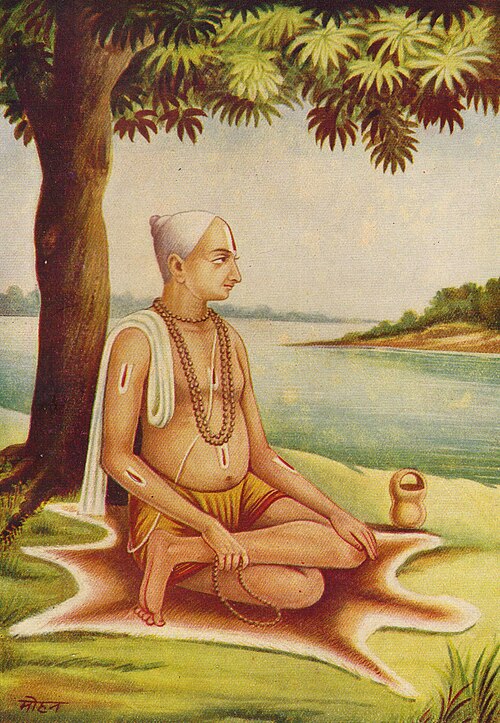
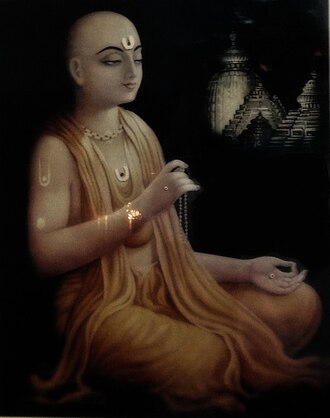
图:Mohan, 1949 · Public domain · 维基共享资源
- 生卒
- 1511 年—1623 年
- 出生地
- Rajapur
- 去世地
- 阿西河坛
- 身份
- 作家、诗人、哲学家
- 代表作
- 哈努曼四十颂、罗摩功行录
- 本名
- गोस्वामी तुलसीदास、रामबोला
- 原文名
- तुलसीदास
- 宗教
- 毘湿奴派、宗教虔诚
- 领域
- 梵语文学、Braj Bhasha literature
- 流派 / 运动
- 奉爱运动
- 简述
- Hindu saint and poet (1532–1623), author of the Ramcharitmanas and Hanuman Chalisa
戈斯瓦弥·杜勒西达斯 Gosvāmī Tulasīdāsa(1532年—1623年),又译杜罗悉陀、瞿悉伐弥·杜罗悉陀悉,古印度作家、诗人,因《罗摩功行录》而著名。
详细介绍
生平
1532年,杜勒西达斯出生在古印度(今北方邦阿拉哈巴德)的一个婆罗门家庭。幼年时,杜勒西达斯的父母就去世了,他以乞讨为生。
15岁时,杜勒西达斯被人收养,他跟着师傅在今贝拿勒斯学习梵文和宗教典籍。
25岁时,杜勒西达斯开始写作。
杜勒西达斯结婚之后抛弃妻子,出家为印度教僧人。后来,杜勒西达斯在阿逾陀写了《罗摩功行录》。
晚年时,杜勒西达斯居住贝拿勒斯。
作品
其作品由翻译家金鼎汉译成中文,以简体字出版。
《罗摩功行录》 (中文(简体)).
《谦恭书》 (中文(简体)).
《歌集》 (中文(简体)).
《双行诗集》 (中文(简体)).
《黑天歌集》 (中文(简体)).
《诗的主人》 (中文(简体)).
正文摘自中文维基百科「杜勒西达斯」(删去了参考文献、表格和图片),按 CC BY-SA 4.0 使用
英文维基百科的更多内容
中文维基百科这一条比较短,下面是英文维基百科同一条目的节选,原文为英文,未翻译。
Rambola Dubey (Hindi pronunciation: [rɑːməboːlɑː d̪ubeː]; 11 August 1511 – 30 July 1623), popularly known as Goswami Tulsīdās (Sanskrit pronunciation: [tʊlsiːdaːsa]), was a Vaishnava (Ramanandi) Hindu saint, devotee (भक्त) and poet, renowned for his devotion to the deity Rama. He wrote several popular works in Sanskrit, Awadhi, and Braj Bhasha, but is best known as the author of the Hanuman Chalisa and of the epic Ramcharitmanas, a retelling of the Sanskrit Ramayana, based on Rama's life, in the vernacular Awadhi language.
Tulsidas spent most of his life in the cities of Banaras (modern Varanasi) and Ayodhya. The Tulsi Ghat on the Ganges in Varanasi is named after him. He founded the Sankat Mochan Hanuman Temple in Varanasi, believed to stand at the place where he had the sight of the deity. Tulsidas started the Ramlila plays, a folk-theatre adaptation of the Ramayana.
He has been acclaimed as one of the greatest poets in Hindi, Indian, and world literature. The impact of Tulsidas and his works on the art, culture and society in India is widespread and is seen today in the vernacular language, Ramlila plays, Hindustani classical music, popular music, and television series.
Transliteration and etymology
The Sanskrit name of Tulsidas can be transliterated in two ways. Using the original Sanskrit, the name is written as Tulasīdāsa. Using the Hunterian transliteration system, it is written as Tulsidas or Tulsīdās reflecting the vernacular pronunciation (since the written Indian languages maintain the vestigial letters that are no longer pronounced). The lost vowels are an aspect of the Schwa deletion in Indo-Aryan languages and can vary between regions.……
Incarnation of Valmiki
He is believed by many to be a reincarnation of Valmiki.……
Early life
Birth
Tulsidas was born on Saptami, the seventh day of Shukla Paksha, the bright half of the lunar Hindu calendar month Shraavana (July–August). This correlates with 11 August 1511 of the Gregorian calendar. Although as many as three places are mentioned as his birthplace, most scholars identify Soron in Kasganj, Uttar Pradesh in Uttar Pradesh, a city on the banks of the river Ganga.……
Childhood
Legend goes that Tulsidas was born after staying in the womb for twelve months, he had all thirty-two teeth in his mouth at birth, his health and looks were like that of a five-year-old boy, and he did not cry at the time of his birth but uttered Rama instead.……
Later life
Travels
After renunciation, Tulsidas spent most of his time at Varanasi, Prayag, Ayodhya, and Chitrakuta but visited many other nearby and far-off places. He travelled across India to many places, studying with different people, meeting saints and sadhus, and meditating. The Mula Gosain Charita gives an account of his travels to the four pilgrimages of Hindus (Badrinath, Dwarka, Puri and Rameshwaram) and the Himalayas.……
Darshan of Hanuman
Tulsidas hints at several places in his works, that he had met face to face with Hanuman and Rama.……
Works
Twelve works are widely considered by biographers to be written by Tulsidas, six major works and six minor works. Based on the language of the works, they have been classified into two groups as follows–
Awadhi works – Ramcharitmanas, Ramlala Nahachhu, Barvai Ramayan, Parvati Mangal, Janaki Mangal and Ramagya Prashna.
Braja works – Krishna Gitavali, Gitavali, Sahitya Ratna, Dohavali, Vairagya Sandipani and Vinaya Patrika.
Ramcharitmanas
Ramacharitamanas (रामचरितमानस, 1574–1576), "The Mānasa lake brimming over with the exploits of Lord Rāma" is an Awadhi rendering of the Ramayana narrative.……
Doctrine
The philosophy and principles of Tulsidas are found across his works, and are especially outlined in the dialogue between Kakbhushundi and Garuda in the Uttar Kand of the Ramcharitmanas. Tulsidas' doctrine has been described as an assimilation and reconciliation of the diverse tenets and cultures of Hinduism.……
Nirguna and Saguna Brahman
As per Tulsidas, the Nirguna Brahman (quality-less impersonal absolute) and Saguna Brahman (personal God with qualities) are one and the same.……
Critical reception
From his time, Tulsidas has been acclaimed by Indian and Western scholars alike for his poetry and his impact on the Hindu society. Tulsidas mentions in his work Kavitavali that he was considered a great sage in the world. Madhusūdana Sarasvatī, one of the most acclaimed philosophers of the Advaita Vedanta tradition based in Varanasi and the composer of Advaitasiddhi, was a contemporary of Tulsidas.……
正文摘自英文维基百科(原文为英文,未翻译)「Tulsidas」(节选,删去了参考文献、表格和图片),按 CC BY-SA 4.0 使用;在维基百科读全文 ›
同时代、同地区的人物

同时代、同身份的人物(思想与学术)