史鉴
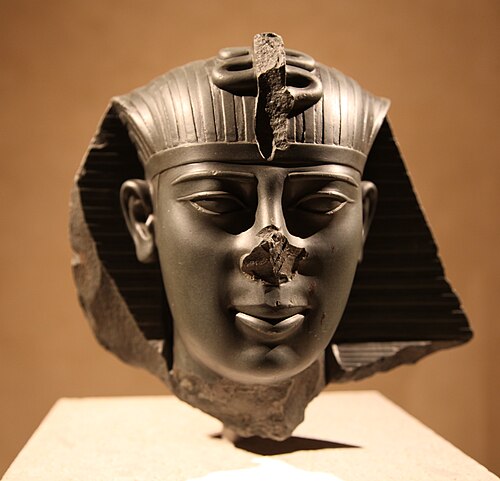
图:Raymond Ellis · CC BY-SA 4.0 · 维基共享资源
- 生卒
- 公元前 610 年代—公元前 526 年 (Wikidata 的生卒只记到十年,非确切年份)
- 国籍 / 所属
- 古埃及
- 身份
- 政治家
- 职位
- 法老
- 配偶
- Tentkheta、Ladice、Nakhtubasterau
- 子女
- 普萨美提克三世、Nitokris II、Ahmose
- 家族
- 埃及第二十六王朝
- 简述
- 埃及第二十六王朝法老
雅赫摩斯二世(英语:Ahmose II,前570年—前526年在位),埃及第二十六王朝(塞易斯王朝)法老。希腊人称之为阿摩西斯二世。原为军队长官。当时埃及国内正发生起义,当局命令雅赫摩斯前往镇压,但他却加入起义者的行列,并被军队和民众拥立为法老而推翻了原法老阿普里斯。雅赫摩斯二世缓和了利比亚雇佣军与希腊雇佣军之间的矛盾,与希腊各城邦及吕底亚广泛结盟,以防备波斯帝国侵略埃及。可是,埃及却还是在他死后的隔年,其子普萨美提克三世在位时被波斯帝国入侵并吞并。
正文摘自中文维基百科「雅赫摩斯二世」(删去了参考文献、表格和图片),按 CC BY-SA 4.0 使用
英文维基百科的更多内容
中文维基百科这一条比较短,下面是英文维基百科同一条目的节选,原文为英文,未翻译。
Amasis II (Ancient Greek: Ἄμασις Ámasis; Phoenician: 𐤇𐤌𐤎 ḤMS) or Ahmose II was a pharaoh (reigned 570 – 526 BCE) of the Twenty-sixth Dynasty of Egypt, the successor of Apries at Sais. He was the last great ruler of Egypt before the Persian conquest. He was also the first pharaoh to conquer Cyprus after Thutmose III.
Life
Most of our information about him is derived from Herodotus (2.161ff) and can only be imperfectly verified by monumental evidence. According to the Greek historian, he was of common origins. He was originally an officer in the Egyptian army. His birthplace was Siuph at Saïs. He took part in a general campaign of Pharaoh Psamtik II in 592 BC in Nubia.
A revolt which broke out among native Egyptian soldiers gave him his opportunity to seize the throne. These troops, returning home from a disastrous military expedition to Cyrene in Libya, suspected that they had been betrayed in order that Apries, the reigning king, might rule more absolutely by means of his Greek mercenaries; many Egyptians fully sympathized with them.……
Egypt's wealth
Amasis brought Egypt into closer contact with Greece than ever before. Herodotus relates that under his prudent administration, Egypt reached a new level of wealth; Amasis adorned the temples of Lower Egypt especially with splendid monolithic shrines and other monuments (his activity here is proved by existing remains). For example, a shrine built by him was excavated at Tell Nebesha.
Amasis was described by Herodotus as a philhellene. He assigned the commercial colony of Naucratis on the Canopic branch of the Nile to the Greeks, and when the temple of Delphi was burnt, he contributed 1,000 talents to the rebuilding. He also married a Greek princess named Ladice daughter of King Battus III and made alliances with Polycrates of Samos and Croesus of Lydia. Montaigne cites the story by Herodotus that Ladice cured Amasis of his impotence by praying to Aphrodite.
Tomb and desecration
Amasis II died in 526 BC. He was buried at the royal necropolis of Sais within the temple enclosure of Neith, and while his tomb has not been rediscovered, Herodotus describes it for us:
[It is] a great cloistered building of stone, decorated with pillars carved in the imitation of palm-trees, and other costly ornaments. Within the cloister is a chamber with double doors, and behind the doors stands the sepulchre.
Herodotus also relates the desecration of Amasis' mummy when the Persian king Cambyses conquered Egypt and thus ended the 26th (Saite) Dynasty:
No sooner did [Cambyses] enter the palace of Amasis that he gave orders for his [Amasis's] body to be taken from the tomb where it lay. This done, he proceeded to have it treated with every possible indignity, such as beating it with whips, sticking it with goads, and plucking its hairs...……
Later reputation
From the fifth century BCE, there is evidence of stories circulating about Amasis, in Egyptian sources (including a demotic papyrus of the third century BCE), Herodotus, Hellanikos, and Plutarch's Convivium Septem Sapientium. 'In those tales Amasis was presented as a non-conventional Pharaoh, behaving in ways unbecoming to a king but gifted with practical wisdom and cunning, a trickster on the throne or a kind of comic Egyptian Solomon'.
For example, Herodotus relates that, when the Egyptians disrespected Amasis for having been born a commoner, he had his golden footbath (ποδανιπτήρ) melted down, made into a statue of a god, and placed in the centre of city where people would worship it.……
正文摘自英文维基百科(原文为英文,未翻译)「Amasis II」(节选,删去了参考文献、表格和图片),按 CC BY-SA 4.0 使用;在维基百科读全文 ›