史鉴
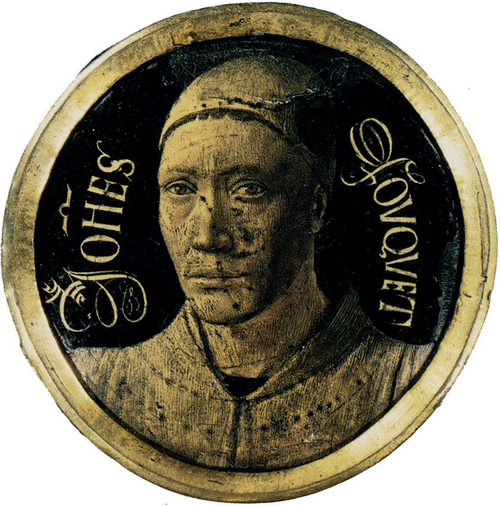
图:Jean Fouquet · Public domain · 维基共享资源
详细介绍
生平
富凯出生于图尔。关于他的生平,人们知之甚少,但可以确定的是,他在1447年之前就已身在意大利,并于该年为教皇尤金四世(Pope Eugene IV)绘制了肖像—教皇也于同年去世。这幅肖像画的原作已不存,仅留有后世的摹本。富凯受到罗马四百艺术家如安杰利科修士和菲拉雷特的影响。
回到法国后,富凯在保持其纯粹法国艺术特质的同时,将他在意大利期间习得的托斯卡纳风格元素与凡·艾克(Van Eyck)兄弟的风格相融合,从而奠定了15世纪早期法国艺术的基础,并开创了一个重要的新画派。他曾为法国宫廷及权贵效力,服务对象包括查理七世、财政官艾蒂安·谢瓦利埃(Étienne Chevalier)以及大法官纪尧姆·茹弗内尔·德·于尔桑(Guillaume Jouvenel des Ursins)。在其职业生涯晚期,他担任了路易十一的宫廷画师。
他的作品与法国宫廷在英法百年战争这场漫长冲突之后,试图巩固法国民族认同感的努力有着密切联系。一个典型的例子是富凯将查理七世描绘为“东方三贤士”之一。这是这位国王为数不多的肖像画之一。根据一些资料记载,另外两位贤士分别是王储路易(即未来的路易十一)及其兄弟。
正文摘自中文维基百科「让·富凯」(删去了参考文献、表格和图片),按 CC BY-SA 4.0 使用
英文维基百科的更多内容
中文维基百科这一条比较短,下面是英文维基百科同一条目的节选,原文为英文,未翻译。
Jean (or Jehan) Fouquet (French: [fuke]; c. 1420–1481) was a French painter and miniaturist. A master of panel painting and manuscript illumination, and the apparent inventor of the portrait miniature, he is considered one of the most important painters from the period between the late Gothic and early Renaissance. He was the first French artist to travel to Italy and experience first-hand the early Italian Renaissance.
Little is known of Fouquet's early life and education. Though long assumed to have been an apprentice of the so-called Bedford Master of Paris it is now suggested that he may have studied under the Jouvenal Master in Nantes, whose works were formerly assumed to be early works by Fouquet. Sometime between 1445 and 1447 he travelled to Italy, where he came under the influence of Roman Quattrocento artists such as Fra Angelico and Filarete. During the 1450s he began working at the French court, where he counted kings Charles VII and his successor Louis XI among his many patrons.
Life
Fouquet was born in Tours. Little is known of his life, but it is certain that he was in Italy before 1447, when he executed a portrait of Pope Eugene IV, who died that year. The portrait survives only in copies from much later.
Upon his return to France, while retaining his purely French sentiment, he grafted the elements of the Tuscan style, which he had acquired during his period in Italy, upon the style of the Van Eycks, forming the basis of early 15th-century French art and becoming the founder of an important new school. He worked for the French court, including Charles VII, the treasurer Étienne Chevalier, and the chancellor Guillaume Jouvenel des Ursins. Near the end of his career, he became court painter to Louis XI.
His work can be associated with the French court's attempt to solidify French national identity in the wake of its long struggle with England in the Hundred Years' War. One example is when Fouquet depicts Charles VII as one of the three magi. This is one of the very few portraits of the king. According to some sources, the other two magi are the Dauphin Louis, future Louis XI, and his brother.
Works
Fouquet's excellence as an illuminator, his precision in the rendering of the finest detail, and his power of clear characterization in work on this minute scale secured his eminent position in French art. His importance as a painter was demonstrated when his portraits and altarpieces were for the first time brought together from various parts of Europe for the exhibition of the "French Primitives" held at the Bibliothèque Nationale in Paris.
His self-portrait miniature would be the earliest sole self-portrait surviving in Western art, if the 1433 portrait by Jan van Eyck—usually called Portrait of a Man or Portrait of a Man in a Turban—is not in fact a self-portrait, as some art historians believe.
Far more numerous are his illuminated books and miniatures. The Musée Condé in Chantilly contains forty of the forty-seven remaining miniatures from the Hours of Étienne Chevalier, painted in 1461 for Chevalier. Fouquet also illuminated a copy of the Grandes Chroniques de France, for an unknown patron, thought to be either Charles VII or someone else at the royal court.
Also from Fouquet's hand are a few miniatures from five other books and eleven of the fourteen miniatures illustrating the Antiquities of the Jews by Flavius Josephus at the Bibliothèque Nationale. The second volume of this manuscript, with only one of the original thirteen miniatures, was discovered and bought in 1903 by Henry Yates Thompson at a London sale, and restored by him to France.
Only three drawings are attributed to Fouquet:
One of Fouquet's most important paintings is the Melun Diptych (c. 1452-1458), formerly in the Collegiate Church of Notre-Dame, Melun. The left wing of the diptych depicts Étienne Chevalier with his patron saint St. Stephen and is now in the Gemäldegalerie, Berlin.……
正文摘自英文维基百科(原文为英文,未翻译)「Jean Fouquet」(节选,删去了参考文献、表格和图片),按 CC BY-SA 4.0 使用;在维基百科读全文 ›
所属政权

同时代、同地区的人物



同时代、同身份的人物(艺术与音乐)