史鉴
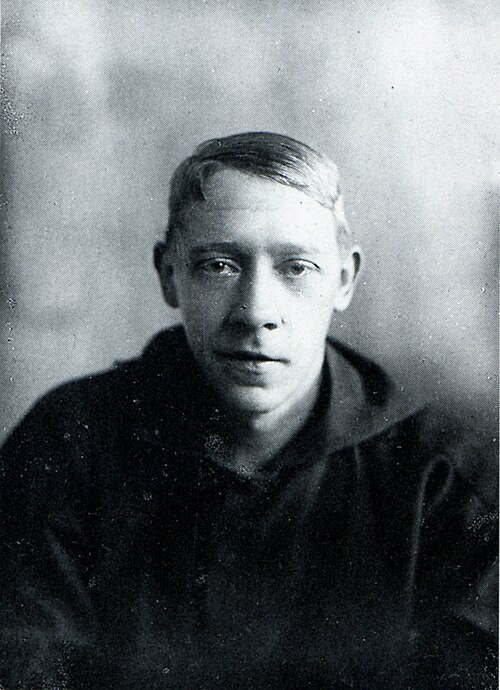
图:佚名 · Public domain · 维基共享资源
- 生卒
- 1885 年 12 月 16 日—1953 年 5 月 31 日 (日期为儒略历)
- 出生地
- 莫斯科
- 去世地
- 莫斯科
- 国籍 / 所属
- 苏联、俄罗斯帝国
- 身份
- 建筑师、插画家、画家、雕塑家、大学教师、建筑绘图员、舞台美学师、设计师
- 子女
- Anatoly Romov
- 代表作
- 塔特林塔
- 原文名
- Владимир Татлин
- 就读
- Penza Art School
- 领域
- 绘画、雕塑艺术、建筑、版画复制
- 流派 / 运动
- 构成主义
- 死因
- 传染病
- 简述
- 俄罗斯构成主义艺术家
弗拉基米尔·塔特林(俄语:Влади́мир Евгра́фович Та́тлин;1885年12月28日[儒略历12月16日]-1953年5月31日)是一名苏联画家和建筑师,与马列维奇同为1920年代苏联先锋派运动中的两大重要人物,但后来转而进行构成主义创作。他最著名的作品是《塔特林塔》。
正文摘自中文维基百科「弗拉基米尔·塔特林」(删去了参考文献、表格和图片),按 CC BY-SA 4.0 使用
英文维基百科的更多内容
中文维基百科这一条比较短,下面是英文维基百科同一条目的节选,原文为英文,未翻译。
Vladimir Yevgrafovich Tatlin (28 December [O.S. 16 December] 1885 – 31 May 1953) was a Russian and Soviet painter, architect, and stage-designer. Tatlin achieved fame as the architect who designed The Monument to the Third International, more commonly known as Tatlin's Tower, which he began in 1919. With Kazimir Malevich he was one of the two most important figures in the Soviet avant-garde art movement of the 1920s, and he later became an important artist in the constructivist movement.
Biography
According to various accounts Vladimir Yevgrafovich Tatlin was born either in Moscow or in Kharkov, Russian Empire. His father, Yevgraf Nikoforovich Tatlin was a hereditary nobleman from Oryol, a mechanical engineer who graduated from the Technological Institute in St.Petersburg and was employed by the Moscow-Brest Railway in Moscow. His mother, Nadezhda Nikolaevna Tatlina (Bart) was a poet and was a sympathizer of the Narodnaya Volya revolutionary movement. After her death in 1887, his father remarried and moved to Kharkov. Tatlin lived with his father after failing entrance examinations for the Moscow School of Painting, Sculpture and Architecture. His father died in 1904, and young Vladimir had to interrupt his studies at the Kharkov Arts School and left for Odessa where he became a merchant marine cadet. According to his memoirs, the sea and distant lands gave him both means of subsistence and a source of inspiration; he sailed all across the Black Sea and also to Egypt.
From 1905 and 1910 he studied at N. Selivestrov Penza Art School in Penza. During the summer vacations he traveled to Moscow and St. Petersburg to participate in various art events. In 1911 he resettled to Moscow, where he lived with his uncle and began his art career as an icon painter. He also played the bandura, a Ukrainian folk instrument he picked up when living in Kharkov, and performed abroad as a professional bandurist, accompanying his own singing in Ukrainian.
Tatlin became familiar with the work of Pablo Picasso during a trip to Paris in 1913.
Tatlin achieved fame as the architect who designed the huge monument to the Third International, also known as Tatlin's Tower. Tatlin began to design it in 1919. The monument was to be a tall tower made of iron, glass and steel which would have dwarfed the Eiffel Tower in Paris (the Monument to the Third International was a third taller at 400 meters high). Inside the iron-and-steel structure of twin spirals, the design envisaged three building blocks, covered with glass windows, which would rotate at different speeds (the first one, a cube, once a year; the second one, a pyramid, once a month; the third one, a cylinder, once a day). The entire building was to house the executive and legislature of the Comintern, and be a central area for the creation and dissemination of propaganda. For financial and practical reasons, however, the tower was never built.
Tatlin was also regarded as a progenitor of Soviet post-revolutionary constructivist art with his pre-revolutionary counter-reliefs, three-dimensional constructions made of wood and metal, some placed in corners (corner counter-reliefs) and others more conventionally. Tatlin conceived these sculptures in order to question the traditional ideas of art, though he did not regard himself as a constructivist and objected to many of the movement's ideas. Later prominent constructivists included Varvara Stepanova, Alexander Rodchenko, Manuel Rendón Seminario, Joaquín Torres García, László Moholy-Nagy, Antoine Pevsner and Naum Gabo.
正文摘自英文维基百科(原文为英文,未翻译)「Vladimir Tatlin」(节选,删去了参考文献、表格和图片),按 CC BY-SA 4.0 使用;在维基百科读全文 ›
所属政权

同时代、同地区的人物




同时代、同身份的人物(思想与学术)