史鉴
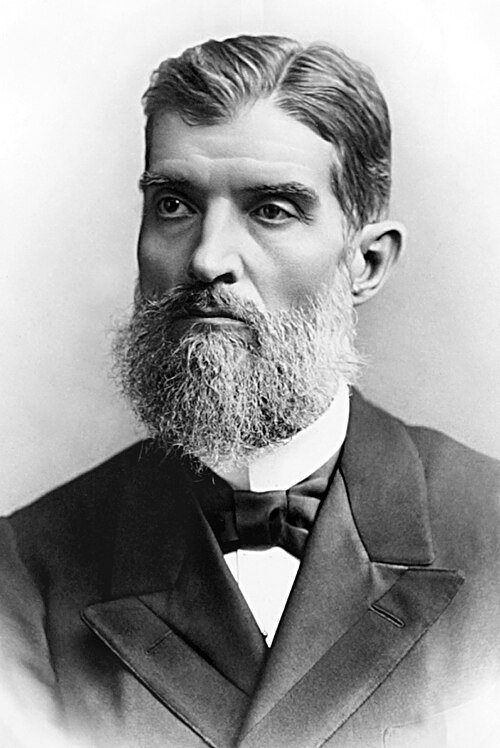
图:Governo do Brasil · Public domain · 维基共享资源
- 生卒
- 1841 年 10 月 4 日—1902 年 12 月 3 日
- 出生地
- 伊图
- 去世地
- 皮拉西卡巴
- 国籍 / 所属
- 巴西
- 身份
- 律师、政治人物
- 职位
- 巴西总统、President of the Federal Senate of Brazil、São Paulo senator、provincial deputy of São Paulo
- 父亲
- José Marcelino de Barros
- 母亲
- Catarina Maria de Moraes
- 配偶
- Adelaide de Morais Barros
- 原文名
- Prudente José de Moraes Barros
- 就读
- 圣保罗大学、圣保罗大学法学院
- 简述
- President of Brazil (1841-1902)
普鲁登特·若泽·德·莫拉伊斯-巴罗斯(葡萄牙语:Prudente José de Morais e Barros,葡萄牙语发音:[pɾuˈdẽtʃi ʒoˈzɛ dʒi moˈɾajs i ˈbaʁus],1841年10月4日—1912年12月3日),巴西总统(根据巴西的1891年宪法,首次由民众直接投票当选的第一位平民)。他的任期的标志是卡努杜斯农民战争,他还面临同葡萄牙解体的外交关系,由英国维多利亚女王调解才能够达成和平。
此前他是圣保罗州州长。普鲁登特总统城就是以他命名。
正文摘自中文维基百科「普鲁登特·德·莫拉伊斯」(删去了参考文献、表格和图片),按 CC BY-SA 4.0 使用
英文维基百科的更多内容
中文维基百科这一条比较短,下面是英文维基百科同一条目的节选,原文为英文,未翻译。
Prudente José de Morais Barros (4 October 1841 – 3 December 1902) was a Brazilian lawyer and politician who served as the third president of Brazil from 1894 to 1898. Morais was elected in 1894, being the first civilian president of the country, the first to be elected by direct popular ballot under the permanent provisions of Brazil's 1891 Constitution, and the first to serve a full term. Before his presidency he served as president (governor) of the state of São Paulo and president of the Senate from 1891 to 1894. He was also president of the Constituent Assembly that drafted and enacted the 1891 Constitution.
Morais was born in Itu, São Paulo, in 1841. His father, José Marcelino de Barros, was murdered by a slave when Prudente was three years old. Raised in Piracicaba after his mother's remarriage to major Caetano José Gomes Carneiro, Morais graduated from the Faculty of Law of São Paulo in 1863. Returning to Piracicaba, he established a law firm and soon joined the Liberal Party, serving as a municipal councilor and later as provincial deputy. In the 1870s he joined the Republican cause, taking part in the foundation of the Republican Party of São Paulo and becoming one of the most prominent leaders of the republican propaganda in São Paulo. In 1866, he married Adelaide Benvinda da Silva Gordo, with whom he had seven children, including Prudente de Morais Filho, who later became a politician. After the fall of the monarchy, Morais was part of the governing junta of São Paulo and was then appointed governor of the state. In 1890 he became senator, and the following year presided over the Constituent Assembly that promulgated Brazil's first republican Constitution, which instituted a federal system.
Early life
Education
Born on 4 October 1841 in Itu, São Paulo Province, Prudente José de Morais Barros was the son of José Marcelino de Barros and Catarina Maria de Morais. At the age of three he lost his father, who was murdered by a slave at the family's estate known as Moinho. The perpetrator was later sentenced to death by a jury, in what became the last execution carried out in that district. His mother then married major Caetano José Gomes Carneiro, described as a man of "routine and backward spirit", and the family moved to Piracicaba.
Marriage and family
Prudente de Morais married Adelaide Benvinda da Silva Gordo on 18 May 1866 in Santos.……
Political rise
Municipal councillor and provincial deputy (1865–1868)
Prudente de Morais joined the Liberal Party and was elected president of the Municipal Chamber of Piracicaba on 7 September 1864 for the 1865–1868 period. In this office he enacted the municipality's first Manners Code. In October 1867 Morais was elected provincial deputy in the 3rd district to the 1868–1869 legislature in São Paulo, being appointed a member of the Provincial Assembly's Justice and Legislation Commission.……
The Convention of Itu and foundation of the Republican Party
The country was then experiencing the beginning of republican unrest and on 3 December 1870, the Republican Manifesto was launched in Rio de Janeiro.……
Presidential election of 1894
In the contest for the succession of Floriano Peixoto, Morais was nominated by the Federal Republican Party (PRF), founded by Francisco Glicério in 1893. He won the presidential election on 1 March 1894 and took office on 15 November that year, becoming the first president of Brazil to be elected by direct vote and the first civilian president of Brazil. Prudente gleaned 276,583 votes against 38,291 for his main competitor, Afonso Pena. The election had more than 29 politicians polled. His vice-president was Dr.……
Presidency (1894–1898)
Domestic policy
The four-year government of Prudente de Morais was shaken both by partisan political issues and continued fighting in Rio Grande do Sul, the center of the Federalist Revolt (1893–1895). Early in his government, he was able to resolve the latter difficulty by signing a peace treaty with the rebels, who received amnesty.
Later, Prudente de Morais devoted all of his efforts to pacify the policial factions within his country, which included extreme advocates of the centralist policies of Floriano Peixoto and supporters of the monarchy.……
Foreign policy
In foreign policy, in 1896 Morais faced a diplomatic issue involving the British, who took possession of the islands of Trindade and Martim Vaz in 1895, and the revolt of the Military School.……
Legacy
The city of Presidente Prudente, located in the western part of the state of São Paulo, is named after him.
正文摘自英文维基百科(原文为英文,未翻译)「Prudente de Morais」(节选,删去了参考文献、表格和图片),按 CC BY-SA 4.0 使用;在维基百科读全文 ›
同时代、同地区的人物




同时代、同身份的人物(帝王与政治)