 史鉴
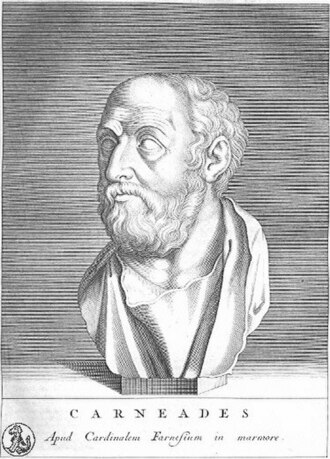
图:Unidentified engraver · Public domain · 维基共享资源
- 生卒
- 公元前 213 年—公元前 129 年
- 出生地
- 昔兰尼
- 去世地
- 雅典
- 身份
- 哲学家
- 职位
- scholarch of the Platonic Academy
- 原文名
- Καρνεάδης
- 领域
- 哲学
- 流派 / 运动
- 柏拉图主义
- 简述
- ancient Greek philosopher
卡尔内阿德斯(英语:Carneades,前213年—前129年),昔兰尼人(今属利比亚),是位哲学家,曾经在雅典学园从事研究工作,于公元前155年之前成为学园领袖,于公元前137年离任。他提出过卡涅阿德斯船板问题。
正文摘自中文维基百科「卡尔内阿德斯」(删去了参考文献、表格和图片),按 CC BY-SA 4.0 使用
英文维基百科的更多内容
中文维基百科这一条比较短,下面是英文维基百科同一条目的节选,原文为英文,未翻译。
Carneades (; Greek: Καρνεάδης, Karneadēs, "of Carnea"; 214/3-129/8 BC) was a Greek philosopher, perhaps the most prominent head of the Skeptical Academy in Ancient Greece. He was born in Cyrene. By the time of his embassy to Rome in 155 BC, he was already a leading critic of dogmatic doctrines, especially those of Stoicism and the Epicureans, continuing the critical engagement that his predecessor Arcesilaus had also directed against both schools.
As scholarch (leader) of the Academy, he was one of three philosophers sent to Rome in 155 BC where his lectures on the uncertainty of justice caused consternation among leading politicians. He left no writings. His ideas were passed on to us through his successor Clitomachus whose own books were lost but relayed to us indirectly in the writings of Cicero and Sextus Empiricus. He seems to have doubted the ability not just of the senses but of reason too in acquiring truth. His skepticism was, however, moderated by the belief that we can, nevertheless, ascertain probabilities (not in the sense of statistical probability, but in the sense of persuasiveness) of truth, to enable us to act.
According to Douglas Walton, Carneades' most important contribution to philosophy was his theory of plausibility based on reasonable evidence. The 3 criteria, as relayed by Empiricus, for accepting an argument, even if tentatively, is that it should be presented in a convincing way, that it is consistent with other arguments put forward, and that it can be confirmed by testing. Walton argues that Carneades provided a pragmatic response to skepticism by asserting that reasonable grounds were sufficient for action and belief in daily life rather than absolute certainty.
Biography
Carneades, the son of Epicomus or Philokomus, was born at Cyrene, North Africa in 214/213 BC. He migrated early to Athens. There he attended the lectures of the Stoics, learning their logic from Diogenes of Babylon and studying the works of Chrysippus. He subsequently focused his efforts on refuting the Stoics, attaching himself to the Platonic Academy, which had suffered from the attacks of the Stoics. On the death of Hegesinus of Pergamon, he was chosen scholarch (head) of the Academy. His great eloquence and skill in argument revived the glories of the Academic Skeptics. He asserted nothing (not even that nothing can be asserted), and carried on a vigorous argument against every dogma maintained by other sects.
In the year 155 BC, when he was fifty-eight years old, he was chosen with the Stoic Diogenes of Babylon and the Peripatetic Critolaus to go as ambassadors to Rome to deprecate the fine of 500 talents which had been imposed on the Athenians for the destruction of Oropus. During his stay at Rome, he attracted great notice from his eloquent speeches on philosophical subjects.……
Philosophy
Carneades is known as an Academic Skeptic. Academic Skeptics (so called because this was the type of skepticism taught in Plato's Academy in Athens) hold that all knowledge is impossible, except for the knowledge that all other knowledge is impossible.
Carneades was so faithful to his own principles of withholding assent that Clitomachus confesses he never knew what his master really thought on any subject. In ethics, which more particularly were the subject of his long and laborious study, he seems to have denied the conformity of the moral ideas with nature. This he particularly insisted on in the second oration on Justice, in which he manifestly wished to convey his own notions on the subject; and he there maintains that ideas of justice are not derived from nature, but that they are purely artificial for purposes of expediency.
Critique of criteria of truth
All this, however, was nothing but the special application of his general theory, that people did not possess, and never could possess, any criterion of truth.
Persuasiveness or probability and action
But after all, people must live and act, and must have some rule of practical life;……
正文摘自英文维基百科(原文为英文,未翻译)「Carneades」(节选,删去了参考文献、表格和图片),按 CC BY-SA 4.0 使用;在维基百科读全文 ›
