史鉴
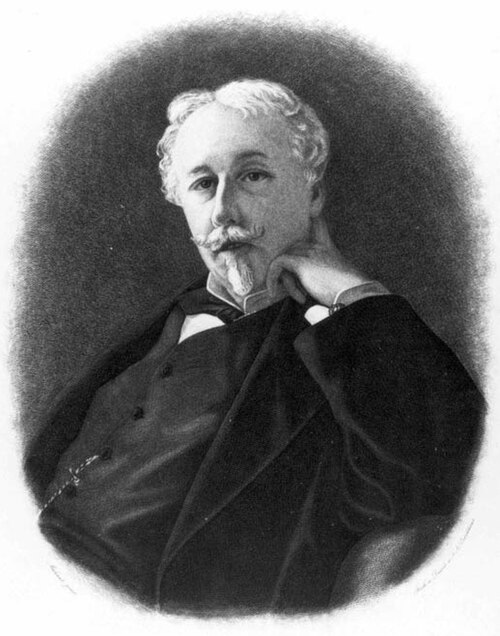
图:Paul Mahaut (Mathilde Sallier de La Tour, née Ruinart de Brimont) · Public domain · 维基共享资源
- 生卒
- 1816 年 7 月 14 日—1882 年 10 月 13 日
- 出生地
- 阿夫赖城
- 去世地
- 都灵
- 国籍 / 所属
- 法国
- 身份
- 作家、诗人、政治人物、外交官、雕塑家、东方学家、新闻工作者、人种
- 职位
- 全权公使、ambassador of France to Sweden、Mayor of Trie-Château
- 父亲
- Louis de Gobineau
- 子女
- Christine de Gobineau、Diane de Guldencrone
- 本名
- Joseph Arthur de Gobineau
- 原文名
- Joseph Arthur de Gobineau
- 宗教
- 天主教
- 简述
- French diplomat and writer known for racial theories (1816–1882)
阿蒂尔·德·戈比诺(法语:Arthur de Gobineau,常被称为戈比诺伯爵(法语:Le Comte de Gobineau);1816年7月14日—1882年10月13日)法国贵族、小说家。生于法国阿夫赖城,逝世于意大利都灵。他因在《人种不平等论》中发展了“雅利安人主宰种族”理论而知名。他的思想后来成为德国纳粹党意识形态核心的重要来源之一。戈比诺将雅利安人种塑造成高贵和文明的化身,宣扬并且夸大雅利安人对人类文明的贡献。他认为,世界上所有的文明,包括古埃及、中国、墨西哥、秘鲁文明都是由雅利安人所建立的,同时只有白人才是人类始祖亚当的后代。
正文摘自中文维基百科「阿蒂尔·德·戈比诺」(删去了参考文献、表格和图片),按 CC BY-SA 4.0 使用
英文维基百科的更多内容
中文维基百科这一条比较短,下面是英文维基百科同一条目的节选,原文为英文,未翻译。
Arthur de Gobineau, Count de Gobineau (French: [ɡɔbino]; Joseph Arthur de Gobineau; 14 July 1816 – 13 October 1882) was a French writer and diplomat who is best known for helping introduce scientific race theory and "racial demography", and for developing the theory of the Aryan master race and Nordicism. He was an elitist who, in the immediate aftermath of the Revolutions of 1848, wrote An Essay on the Inequality of the Human Races. In it he argued that aristocrats were superior to commoners and that aristocrats possessed more Aryan genetic traits because of less interbreeding with inferior races.
Gobineau was born to an aristocratic family of counts under the Ancien Régime. He was ideologically a Legitimist who supported royalist rule by the House of Bourbon and opposed the French Revolution, democracy, and rule by the House of Orléans which came to power after the 1830 July Revolution. He began his diplomatic career in the late 1840s, and beginning in 1861, variously served as minister to Persia, Brazil, Greece, and Sweden. As a writer, Gobineau authored novels and short stories, as well as non-fiction travel writings, polemical essays and other philological and anthropological works, including his Essai. His Essai is widely discredited as pseudoscience by modern scholarship. Gobineau himself never had any qualifications in anthropology.
Although Gobineau's writings were poorly received in France, they were quickly praised by white supremacist, pro-slavery Americans like Josiah C. Nott and Henry Hotze, who translated his book into English. They omitted around 1,000 pages of the original book, including those parts that negatively described Americans as a racially mixed population.……
Early life and writings
Origins
Gobineau came from an old well-established aristocratic family. His father, Louis de Gobineau (1784–1858), was a military officer and staunch royalist. His mother, Anne-Louise Magdeleine de Gercy, was the daughter of a non-noble royal tax official. The de Gercy family lived in the French Crown colony of Saint-Domingue (modern Haiti) for a time in the 18th century.
Adolescence
Gobineau spent the early part of his teenage years in the town of Inzligen where his mother and her lover were staying.……
Early diplomatic work and theories on race
Embittered royalist
Gobineau's novels and poems of the 1830s–40s were usually set in the Middle Ages or the Renaissance with aristocratic heroes who by their very existence uphold all of the values Gobineau felt were worth celebrating like honor and creativity against a corrupt, soulless middle class.……
Racial theories and aristocrats
Shocked by the Revolution of 1848, Gobineau first expressed his racial theories in his 1848 epic poem Manfredine.……
An Essay on the Inequality of the Human Races
In his An Essay on the Inequality of the Human Races, published in 1855, Gobineau seemingly accepts the prevailing Christian doctrine that all human beings shared the common ancestors Adam and Eve (monogenism as opposed to polygenism).……
Ministerial career
Minister to Persia
In 1861, Gobineau returned to Tehran as the French minister and lived a modest, ascetic lifestyle. He became obsessed with ancient Persia. This soon got out of control as he sought to prove ancient Persia was founded by his much admired Aryans, leading him to engage in what Irwin called "deranged" theories about Persia's history.……
Criticism of Gobineau's Persian work
Only with his studies in ancient Persia did Gobineau come under fire from scholars.……
Legacy and influence
Gobineau's ideas were influential in a number of countries, especially Romania, Ottoman Empire, Germany, and Brazil, both during his lifetime and after his death.……
Works in English translation
Non-fiction
The Moral and Intellectual Diversity of Races, J. B. Lippincott & Co., 1856 (rep. by Garland Pub., 1984).
The Inequality of Human Races, G. P. Putnam's Sons, 1915.
The Inequality of Human Races, William Heinemann, 1915 [Thurland & Thurland, 1915; Howard Fertig Pub., 1967; Rep., 1999].
Method of Reading Cuneiform Texts, Educational Society's Press, 1865.
正文摘自英文维基百科(原文为英文,未翻译)「Arthur de Gobineau」(节选,删去了参考文献、表格和图片),按 CC BY-SA 4.0 使用;在维基百科读全文 ›
同时代、同地区的人物




同时代、同身份的人物(帝王与政治)